




A body of mass 3Kg moving with a velocity of 4m/s towards the left collides head on with a body of mass 4kg moving in the opposite direction with a velocity of 3m/s. After collision the two bodies stick together and move with a common velocity which is:
$
(a){\text{ zero}} \\
{\text{(b) 12m/s towards left}} \\
{\text{(c) 12m/s towards right}} \\
{\text{(d) }}\dfrac{{12}}{7}{\text{m/s towards left}} \\
$
Answer
 Verified
243k+ views
Hint: In this question let the velocity of the combined system after the collision be $v{\text{ m/s}}$. Apply the concept of conservation of momentum that is the momentum of the system before the system will be equal to the momentum of the system after the conservation. Momentum is given as a product of mass and velocity. This will help approaching the problem.
Complete step-by-step solution -
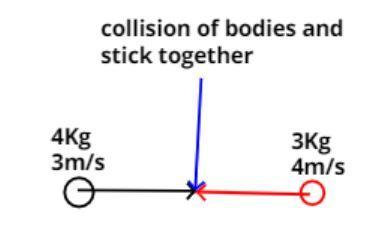
Given data:
Mass of first body is, ${m_1} = 3$Kg
Velocity of first body moving left as shown in the figure by red color is, ${u_1} = - 4$m/s, (‘-’ sign indicates the direction of the movement which is in negative direction of x-axis)
Mass of second body is, ${m_2} = 4$Kg
Velocity of second body moving opposite to first body as shown in the figure by black color is, ${u_2} = + 3$m/s, (‘+’ sign indicates the direction of the movement which is in positive direction of x-axis)
Now it is given that after the collision the two bodies are stick together and move with a common velocity,
Let the common velocity be V and the combined mass is $\left( {{m_1} + {m_2}} \right)$Kg.
Now according to conservation of linear momentum, as momentum is the product of mass and velocity.
The sum of individual momentum of the first and second body is equal to the sum of combined momentum i.e. after the collision when two bodies stick together.
Therefore,
$ \Rightarrow {m_1}{u_1} + {m_2}{u_2} = \left( {{m_1} + {m_2}} \right)V$
Now substitute the values we have,
$ \Rightarrow \left( 3 \right)\left( { - 4} \right) + \left( 4 \right)\left( 3 \right) = \left( {3 + 4} \right)V$
Now simplify this we have,
$ \Rightarrow 7V = - 12 + 12 = 0$
$ \Rightarrow V = 0$
So the combined velocity of the two bodies is zero.
So this is the required answer.
Hence option (A) is the correct answer.
Note – Since the bodies stick together after the collision therefore it implies that the collision was perfectly inelastic that is coefficient of restitution in this case will be 0. The coefficient of restitution is always in between 0 to 1, that is $0 < e < 1$.
Complete step-by-step solution -
Given data:
Mass of first body is, ${m_1} = 3$Kg
Velocity of first body moving left as shown in the figure by red color is, ${u_1} = - 4$m/s, (‘-’ sign indicates the direction of the movement which is in negative direction of x-axis)
Mass of second body is, ${m_2} = 4$Kg
Velocity of second body moving opposite to first body as shown in the figure by black color is, ${u_2} = + 3$m/s, (‘+’ sign indicates the direction of the movement which is in positive direction of x-axis)
Now it is given that after the collision the two bodies are stick together and move with a common velocity,
Let the common velocity be V and the combined mass is $\left( {{m_1} + {m_2}} \right)$Kg.
Now according to conservation of linear momentum, as momentum is the product of mass and velocity.
The sum of individual momentum of the first and second body is equal to the sum of combined momentum i.e. after the collision when two bodies stick together.
Therefore,
$ \Rightarrow {m_1}{u_1} + {m_2}{u_2} = \left( {{m_1} + {m_2}} \right)V$
Now substitute the values we have,
$ \Rightarrow \left( 3 \right)\left( { - 4} \right) + \left( 4 \right)\left( 3 \right) = \left( {3 + 4} \right)V$
Now simplify this we have,
$ \Rightarrow 7V = - 12 + 12 = 0$
$ \Rightarrow V = 0$
So the combined velocity of the two bodies is zero.
So this is the required answer.
Hence option (A) is the correct answer.
Note – Since the bodies stick together after the collision therefore it implies that the collision was perfectly inelastic that is coefficient of restitution in this case will be 0. The coefficient of restitution is always in between 0 to 1, that is $0 < e < 1$.
Recently Updated Pages
JEE Main 2026 Session 2 City Intimation Slip & Exam Date: Expected Date, Download Link

JEE Main 2026 Session 2 Application Form: Reopened Registration, Dates & Fees
JEE Main 2026 Session 2 Registration (Reopened): Last Date, Fees, Link & Process
WBJEE 2026 Registration Started: Important Dates Eligibility Syllabus Exam Pattern
Dimensions of Charge: Dimensional Formula, Derivation, SI Units & Examples
How to Calculate Moment of Inertia: Step-by-Step Guide & Formulas
Trending doubts
JEE Main 2026: Session 1 Results Out and Session 2 Registration Open, City Intimation Slip, Exam Dates, Syllabus & Eligibility
Ideal and Non-Ideal Solutions Explained for Class 12 Chemistry
JEE Main Participating Colleges 2026 - A Complete List of Top Colleges
Understanding the Angle of Deviation in a Prism
Understanding Differential Equations: A Complete Guide
Hybridisation in Chemistry – Concept, Types & Applications
Other Pages
JEE Advanced Marks vs Ranks 2025: Understanding Category-wise Qualifying Marks and Previous Year Cut-offs
JEE Advanced 2026 - Exam Date (Released), Syllabus, Registration, Eligibility, Preparation, and More
Important Questions For Class 11 Physics Chapter 1 Units and Measurement - 2025-26
CBSE Notes Class 11 Physics Chapter 1 - Units And Measurements - 2025-26
CBSE Notes Class 11 Physics Chapter 4 - Laws of Motion - 2025-26
CBSE Notes Class 11 Physics Chapter 14 - Waves - 2025-26