






Key Provisions of the Pocso Act for Child Protection in India
The POCSO Act, 2012 stands for the Protection of Children from Sexual Offences Act. It is a special law enacted by the Government of India to protect children from sexual abuse, sexual harassment, and exploitation. The Act provides a child-friendly legal framework for reporting, recording of evidence, investigation, and speedy trial of offences involving children. Understanding the POCSO Act is important for students, competitive exam aspirants, and general readers as it plays a significant role in safeguarding children's rights in India.
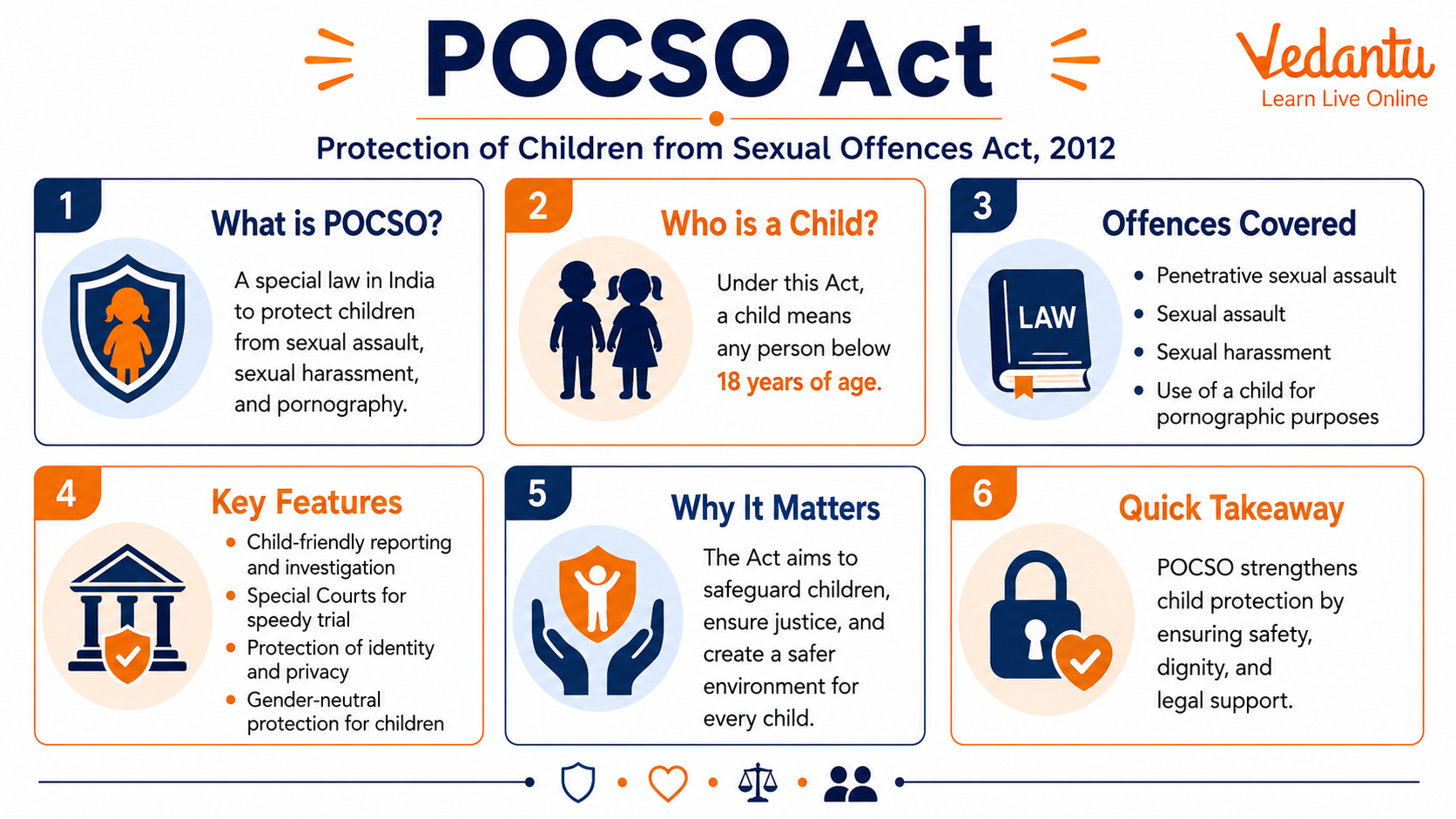
What Is the POCSO Act?
The Protection of Children from Sexual Offences Act, 2012 is a comprehensive legislation designed to address sexual crimes against children below 18 years of age. It came into force on 14 November 2012. The Act recognizes various forms of sexual abuse and provides strict punishment for offenders.
The law is gender-neutral, meaning it protects both boys and girls. It also ensures child-friendly procedures during the judicial process to prevent further trauma to the victim.
Objectives of the POCSO Act
- To protect children from sexual assault, sexual harassment, and pornography.
- To establish Special Courts for speedy trial of offences.
- To ensure child-friendly procedures during investigation and trial.
- To safeguard the best interests and dignity of the child.
Key Definitions Under the POCSO Act
Child
Under the POCSO Act, a child is defined as any person below the age of 18 years.
Sexual Assault
Sexual assault includes physical contact with sexual intent without penetration.
Penetrative Sexual Assault
This refers to acts involving penetration of the child's private parts or forcing the child to perform such acts.
Sexual Harassment
Sexual harassment includes showing pornography to a child, making sexually explicit remarks, or any gesture with sexual intent.
Major Offences and Punishments Under POCSO Act
| Offence | Description | Punishment |
|---|---|---|
| Penetrative Sexual Assault | Sexual act involving penetration | Minimum 10 years to life imprisonment and fine |
| Aggravated Penetrative Sexual Assault | Assault by police, teacher, relative or in serious situations | Minimum 20 years to life imprisonment or death penalty |
| Sexual Assault | Physical sexual contact without penetration | 3 to 5 years imprisonment and fine |
The Act was amended in 2019 to introduce stricter punishments, including the death penalty for aggravated penetrative sexual assault in certain cases.
Important Provisions of the POCSO Act
1. Child-Friendly Reporting Process
The statement of the child must be recorded at the residence of the child or a place of their choice. The police officer should not be in uniform while recording the statement to reduce fear.
2. Mandatory Reporting
Any person who has knowledge of a sexual offence against a child must report it to the police. Failure to report is punishable under the Act.
3. Special Courts
The Act provides for the establishment of Special Courts to ensure speedy trial of cases. The evidence of the child should be recorded within 30 days, and the trial should ideally be completed within one year.
4. Protection of Identity
The identity of the child victim must be kept confidential. Disclosure of identity is punishable under the law.
5. Medical Examination
Medical examination of the child must be conducted in the presence of a parent or trusted person and preferably by a female doctor in case of a girl child.
Salient Features of the POCSO Act
- Gender-neutral law protecting both boys and girls.
- Covers child pornography and use of children for sexual purposes.
- Presumption of guilt against the accused in certain cases unless proven otherwise.
- Time-bound investigation and trial process.
- Strict punishment to act as a deterrent.
Why the POCSO Act Is Important
Before the enactment of the POCSO Act, there was no specific law in India exclusively dealing with sexual offences against children. The Act filled this gap by clearly defining offences and prescribing strict penalties. It ensures that children are treated with dignity and sensitivity during the legal process.
The law also creates awareness about the seriousness of child sexual abuse and strengthens the legal framework to protect children's fundamental rights.
Conclusion
The POCSO Act, 2012 is a landmark legislation aimed at protecting children from sexual offences and ensuring justice through a child-friendly legal system. With strict punishments, mandatory reporting, and special courts, the Act plays a crucial role in safeguarding children in India. Understanding its provisions is essential for students, competitive exam aspirants, and responsible citizens as it reflects the country's commitment to child protection and justice.
FAQs on Pocso Act: Meaning, Objectives and Major Provisions
1. What is the POCSO Act?
The POCSO Act, 2012 (Protection of Children from Sexual Offences Act) is a special law enacted in India to protect children under 18 years from sexual abuse, harassment, and exploitation.
- Enforced in: 2012
- Applies to: All children below 18 years
- Covers: Sexual assault, sexual harassment, pornography, and aggravated sexual offences
- Ensures: Child-friendly legal procedures during reporting, investigation, and trial.
It is a gender-neutral law designed to safeguard children's rights and dignity.
2. What are the main objectives of the POCSO Act?
The main objective of the POCSO Act is to provide legal protection to children against sexual offences and ensure speedy justice.
- Protect children from sexual abuse and exploitation
- Establish Special Courts for fast-track trials
- Provide child-friendly reporting and evidence recording
- Ensure strict punishment for offenders
The Act strengthens child rights and promotes a safe environment for minors.
3. Who is considered a child under the POCSO Act?
Under the POCSO Act, 2012, a child is defined as any person below the age of 18 years.
- Applies equally to boys and girls (gender-neutral law)
- Protects minors regardless of caste, religion, or background
- Covers both physical and online sexual offences
This clear age definition ensures uniform legal protection for all minors in India.
4. What types of offences are covered under the POCSO Act?
The POCSO Act covers a wide range of sexual offences against children.
- Penetrative Sexual Assault
- Aggravated Penetrative Sexual Assault
- Sexual Assault (non-penetrative)
- Sexual Harassment
- Use of children for pornography
The Act also addresses online abuse and exploitation, making it comprehensive child protection legislation.
5. What are the punishments under the POCSO Act?
The punishments under the POCSO Act are strict and vary depending on the severity of the offence.
- Minimum 3 years imprisonment for sexual harassment
- 10 years to life imprisonment for aggravated penetrative assault
- In severe cases, death penalty (as amended in 2019)
These stringent penalties aim to deter crimes against children and ensure justice.
6. What is meant by child-friendly procedures under the POCSO Act?
The POCSO Act mandates child-friendly procedures to reduce trauma during legal proceedings.
- Statement recorded at the child’s residence or safe place
- No aggressive questioning or character assassination
- Identity of the child kept confidential
- Special Courts conduct in-camera trials
These provisions ensure that the child feels safe and protected throughout the judicial process.
7. What are Special Courts under the POCSO Act?
Special Courts under the POCSO Act are designated courts that ensure speedy trial of child sexual abuse cases.
- Established by State Governments
- Aim to complete trials within one year
- Maintain child confidentiality and safety
- Provide victim compensation and support
These courts help in fast-track justice and reduce delays in sensitive cases.
8. What changes were made in the POCSO Amendment Act 2019?
The POCSO Amendment Act, 2019 strengthened punishments and expanded definitions of offences.
- Introduced death penalty for aggravated penetrative assault
- Increased minimum punishments
- Included stricter provisions for child pornography
- Enhanced deterrence against repeat offenders
The amendment aimed to provide stronger legal protection for children.
9. Is reporting under the POCSO Act mandatory?
Yes, reporting offences under the POCSO Act is mandatory.
- Any person aware of an offence must inform the police
- Failure to report can lead to imprisonment or fine
- Applies to teachers, doctors, and guardians
This mandatory reporting provision ensures timely action and child safety.
10. Why is the POCSO Act important for child protection in India?
The POCSO Act, 2012 is crucial because it provides a comprehensive legal framework to combat child sexual abuse in India.
- Recognizes different forms of child sexual exploitation
- Ensures strict punishment for offenders
- Promotes child-friendly judicial processes
- Strengthens child rights and legal safeguards
It plays a vital role in protecting minors and promoting a safer society.
