






Objectives and Benefits of Social Forestry Programs in Rural Areas
Social Forestry Programme is an important environmental and community-based initiative aimed at increasing forest cover and meeting the needs of rural and urban populations for fuelwood, fodder, timber, and other forest products. It focuses on growing trees outside traditional forest areas to reduce pressure on natural forests. This programme plays a significant role in environmental protection, rural development, and sustainable resource management. For students and competitive exam aspirants, understanding Social Forestry is essential as it connects ecology, conservation, and socio-economic development.
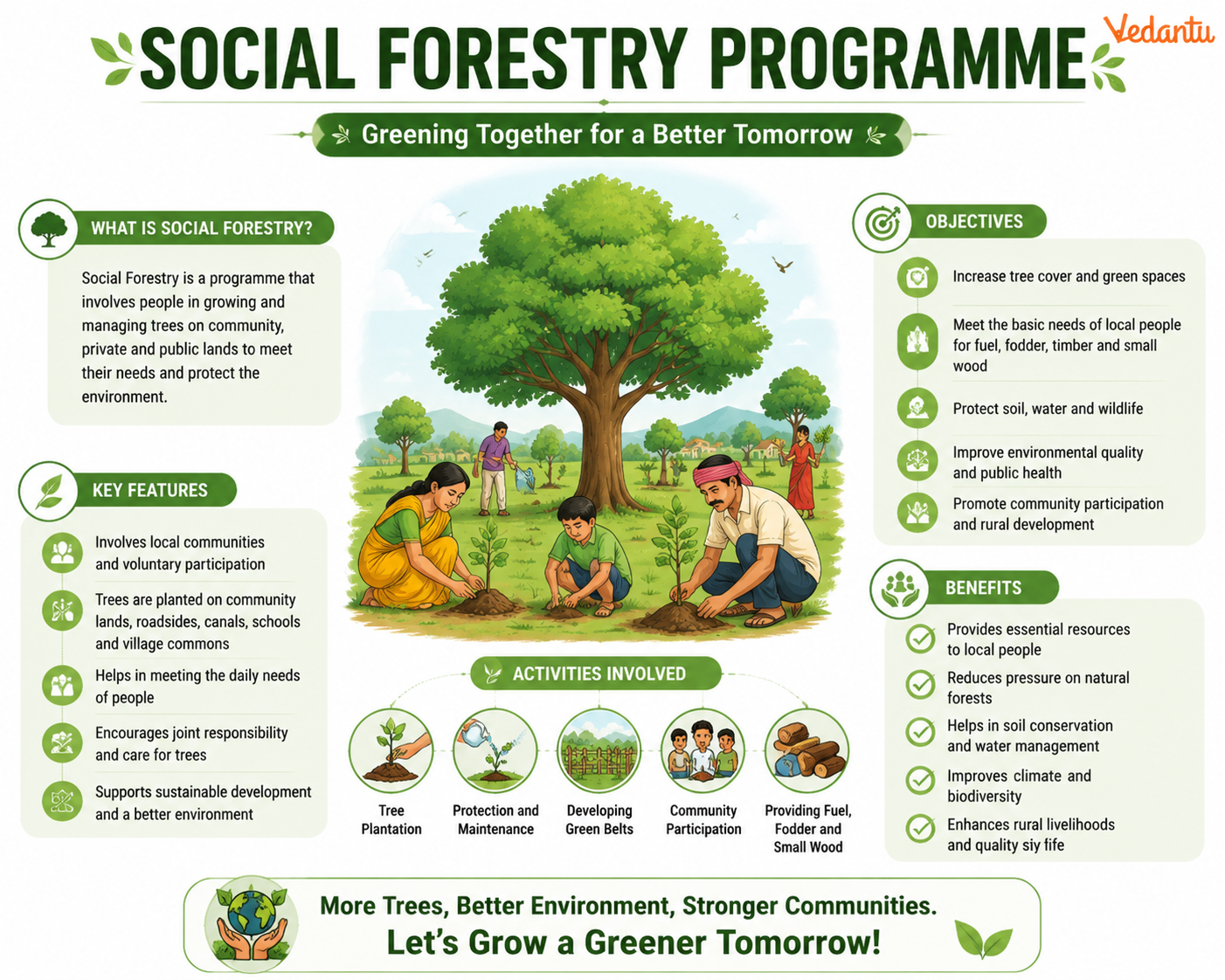
What is Social Forestry?
Social Forestry refers to the management and protection of forests and afforestation on barren lands with the purpose of helping environmental, social, and rural development. It involves planting trees in non-forest areas such as village commons, roadsides, canals, railway lines, and degraded lands to meet the basic needs of local communities.
Objectives of Social Forestry Programme
- To increase green cover and restore ecological balance.
- To reduce pressure on natural forests by providing alternative sources of fuelwood and timber.
- To supply fodder for livestock and minor forest products for rural households.
- To create employment opportunities in rural areas.
- To prevent soil erosion and improve soil fertility.
Types of Social Forestry
1. Farm Forestry
Farm Forestry encourages farmers to grow trees on their private agricultural lands to meet domestic needs or for commercial purposes. Trees are planted along field boundaries or on unused land.
2. Community Forestry
Community Forestry involves planting trees on community lands such as village commons, panchayat lands, and public parks. The benefits are shared among the community members.
3. Extension Forestry
Extension Forestry focuses on planting trees along roadsides, railway lines, canals, and other public lands. It helps improve greenery and environmental quality in urban and semi-urban areas.
Key Features of Social Forestry Programme
- Active participation of local communities in plantation and maintenance.
- Focus on fast-growing tree species suitable for local conditions.
- Utilization of degraded and wastelands for tree plantation.
- Integration of environmental protection with rural development.
- Government support through funding, saplings, and technical guidance.
Types of Social Forestry and Their Focus Areas
| Type | Area of Implementation | Main Purpose |
|---|---|---|
| Farm Forestry | Private agricultural land | Meet farmer needs and commercial use |
| Community Forestry | Village commons and public land | Provide resources to local communities |
| Extension Forestry | Roadsides, canals, railways | Increase green cover in public spaces |
The table above clearly shows how different types of Social Forestry focus on specific areas and objectives. Together, they contribute to sustainable development and environmental conservation.
Importance of Social Forestry
Social Forestry is important for maintaining ecological balance and supporting rural livelihoods. It reduces dependence on natural forests and ensures sustainable availability of forest products. It also helps in controlling desertification, reducing air pollution, and conserving biodiversity.
- Promotes sustainable use of natural resources.
- Enhances carbon sequestration and helps in climate change mitigation.
- Improves rural income through sale of timber and non-timber products.
- Encourages public awareness about environmental conservation.
Social Forestry Programme in India
The Social Forestry Programme was initiated in India during the 1970s to address the shortage of fuelwood and to reduce pressure on natural forests. It was supported by government schemes and international agencies. The programme gained importance during the Sixth Five Year Plan when large-scale afforestation activities were promoted.
Major Achievements
- Increase in tree cover in several states.
- Improved availability of fuelwood in rural areas.
- Generation of employment in afforestation projects.
- Enhanced community participation in forest management.
Challenges of Social Forestry
Despite its benefits, Social Forestry faces certain challenges such as lack of community participation in some areas, inadequate maintenance of plantations, land ownership issues, and preference for monoculture plantations. Addressing these challenges is essential for long-term success.
Conclusion
Social Forestry Programme is a vital initiative that combines environmental conservation with community development. By planting trees outside traditional forest areas, it helps reduce pressure on natural forests, improves rural livelihoods, and enhances ecological stability. For students preparing for competitive exams such as NEET and other government examinations, understanding the objectives, types, importance, and challenges of Social Forestry is crucial for scoring well in environmental and ecology related topics.
FAQs on Social Forestry Programs and Their Role in Community Development
1. What is Social Forestry Programme?
The Social Forestry Programme is a government initiative aimed at planting trees on non-forest and community lands to meet local needs and promote environmental protection. It focuses on:
- Afforestation of barren and wastelands
- Providing fuelwood, fodder, and timber to rural communities
- Reducing pressure on natural forests
- Enhancing environmental sustainability and rural livelihoods
2. When was the Social Forestry Programme launched in India?
The Social Forestry Programme in India was launched in the 1970s to address deforestation and fuelwood shortages. Key milestones include:
- Introduction during the National Commission on Agriculture (1976)
- Expansion under the National Forest Policy 1988
- Support from the World Bank for afforestation projects
3. What are the main objectives of Social Forestry?
The main objective of Social Forestry is to balance environmental protection with community needs. Its goals include:
- Meeting rural demand for fuel, fodder, and small timber
- Preventing soil erosion and land degradation
- Increasing green cover outside forest areas
- Generating employment opportunities in rural areas
- Promoting sustainable development
4. What are the types of Social Forestry?
There are four main types of Social Forestry, each targeting different land uses and communities:
- Farm Forestry – Tree plantation on private agricultural lands
- Community Forestry – Plantation on community lands like village commons
- Extension Forestry – Planting along roadsides, canals, and railways
- Agroforestry – Combining crops and trees on the same land
5. Why is Social Forestry important?
The importance of Social Forestry lies in its environmental and economic benefits. It helps in:
- Reducing deforestation and conserving biodiversity
- Combating climate change through carbon sequestration
- Providing raw materials for rural industries
- Improving air quality and preventing desertification
6. How does Social Forestry benefit rural communities?
Social Forestry directly supports rural development by providing essential resources and income. Benefits include:
- Access to fuelwood and fodder
- Employment in plantation and maintenance activities
- Increased agricultural productivity through agroforestry practices
- Community participation in forest conservation
7. What is the difference between Social Forestry and Commercial Forestry?
The key difference between Social Forestry and Commercial Forestry lies in their purpose. Social Forestry focuses on:
- Community welfare and environmental protection
- Meeting local needs for forest produce
- Large-scale timber production
- Profit generation and industrial supply
8. What role does the government play in Social Forestry?
The government plays a central role in implementing the Social Forestry Programme. Its responsibilities include:
- Providing saplings and financial assistance
- Framing policies like the National Forest Policy
- Encouraging public participation and awareness campaigns
- Monitoring afforestation and reforestation projects
9. How does Social Forestry help in environmental conservation?
Social Forestry contributes significantly to environmental conservation by increasing green cover and protecting natural resources. It helps in:
- Reducing soil erosion and floods
- Improving groundwater recharge
- Absorbing carbon dioxide and controlling global warming
- Enhancing biodiversity
10. What challenges does the Social Forestry Programme face?
Despite its benefits, the Social Forestry Programme faces several challenges. These include:
- Lack of community participation in some regions
- Insufficient funding and maintenance
- Land ownership and management issues
- Low survival rate of planted saplings
