






Key Features and Achievements of India’s Population Control Policies
National Population Policies of India refer to the strategies and measures adopted by the Government of India to regulate population growth, improve reproductive health, and promote sustainable development. India was the first country in the world to launch an official family planning program in 1952. Over the years, the policy framework has evolved to focus not only on population control but also on maternal health, child survival, women empowerment, and demographic balance. This topic is highly important for students preparing for competitive exams and for understanding India's socio-economic development.
Need for National Population Policies
India has one of the largest populations in the world. Rapid population growth after independence created pressure on resources, employment, healthcare, education, and infrastructure. A well-planned population policy became essential to ensure balanced development and improved quality of life.
- To control rapid population growth
- To reduce poverty and unemployment
- To improve maternal and child health
- To achieve sustainable economic development
- To ensure gender equality and women empowerment
Evolution of Population Policies in India
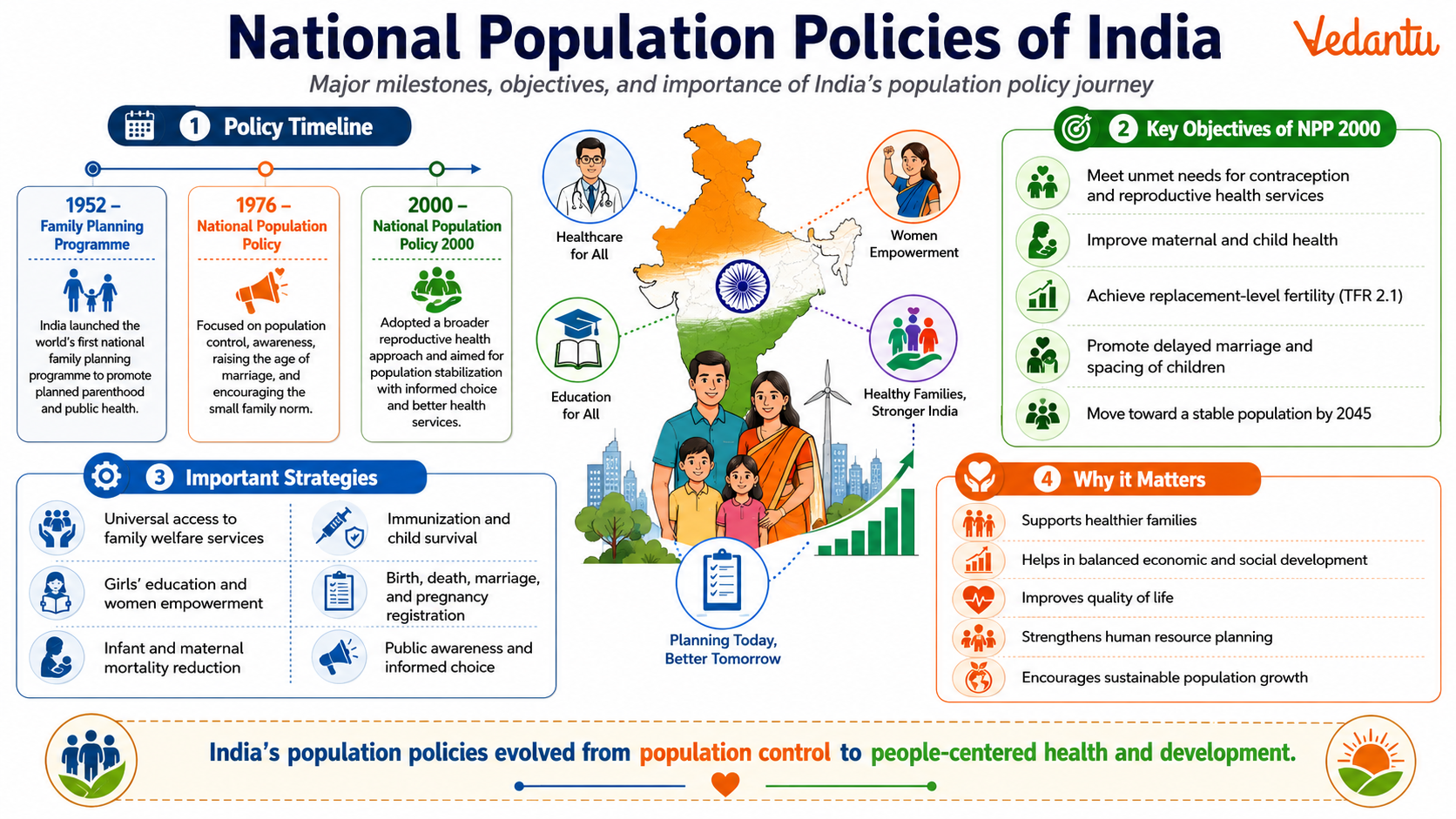
1. Family Planning Program - 1952
India launched the world's first national family planning program in 1952. The main aim was to reduce birth rates through awareness and contraceptive methods. The approach was largely clinic-based and focused on limiting family size.
2. Population Policy - 1976
In 1976, the government introduced a more aggressive population policy during the Emergency period. It emphasized sterilization, raised the legal age of marriage, and promoted small family norms. However, coercive methods led to public criticism.
3. National Population Policy - 2000
The National Population Policy 2000 marked a significant shift from population control to reproductive health and rights. It aimed at achieving population stabilization by 2045 and focused on voluntary and informed choice.
Objectives of National Population Policy 2000
Immediate Objectives
- Address unmet needs for contraception
- Improve healthcare infrastructure
- Ensure availability of reproductive and child health services
Medium Term Objectives
- Achieve replacement level fertility rate of 2.1
Long Term Objectives
- Achieve stable population by 2045
- Ensure sustainable economic growth and social development
Major Milestones in National Population Policies
| Year | Policy | Key Features |
|---|---|---|
| 1952 | Family Planning Program | First national program to control birth rate |
| 1976 | Population Policy | Sterilization focus and raised marriage age |
| 2000 | National Population Policy | Reproductive health and population stabilization by 2045 |
The table highlights the major phases in India's population policy evolution. The shift from strict population control measures to a rights-based and health-centered approach is clearly visible over time.
Key Features of National Population Policy 2000
- Free and compulsory education up to 14 years of age
- Reduce infant mortality rate and maternal mortality rate
- Promote delayed marriage for girls beyond 18 years
- Achieve universal immunization of children
- Encourage small family norms through voluntary participation
- Strengthen Panchayati Raj Institutions in implementation
Achievements and Challenges
Achievements
- Decline in Total Fertility Rate in many states
- Improvement in life expectancy
- Reduction in infant and maternal mortality rates
Challenges
- Population growth remains high in some states
- Regional disparities in healthcare access
- Gender imbalance and socio-cultural barriers
- Adolescent health and early marriage issues
Importance for Competitive Exams
National Population Policies of India are frequently asked in General Knowledge, UPSC, State PSC, SSC, and other competitive examinations. Questions may focus on important years, objectives of the National Population Policy 2000, replacement level fertility, and major milestones. Students should remember key dates such as 1952, 1976, and 2000, along with the target year 2045 for population stabilization.
Conclusion
The National Population Policies of India reflect the country's efforts to balance population growth with economic development and social welfare. From the early family planning initiatives to the comprehensive National Population Policy 2000, the approach has evolved towards reproductive rights, healthcare access, and sustainable development. Understanding these policies helps in analyzing India's demographic trends and its long-term development goals.
FAQs on National Population Policies in India: Objectives, Strategies and Outcomes
1. What is the National Population Policy (NPP) of India?
The National Population Policy (NPP) is India’s official framework to control population growth and improve reproductive health.
- First introduced in 1952, making India the first country to launch a family planning program.
- Revised significantly in National Population Policy 2000 (NPP 2000).
- Focuses on population stabilization, family planning, maternal health, and child survival.
- Aims to achieve sustainable development by balancing population growth and economic resources.
2. Why did India introduce a National Population Policy in 1952?
India introduced the National Population Policy in 1952 to address rapid population growth after Independence.
- High birth rate and declining death rate increased population pressure.
- Limited resources like food, housing, education, and employment were strained.
- Aimed to promote family planning and birth control.
- Sought to improve overall economic development and living standards.
3. What are the main objectives of National Population Policy 2000?
The National Population Policy 2000 (NPP 2000) aims to achieve population stabilization and better reproductive health services.
- Achieve replacement level fertility (TFR 2.1).
- Reduce infant mortality rate (IMR) and maternal mortality rate (MMR).
- Ensure universal access to contraception and healthcare services.
- Promote delayed marriage and childbearing.
- Achieve universal immunization and education.
4. What is meant by replacement level fertility?
Replacement level fertility refers to the average number of children a couple must have to replace themselves in the population.
- In India, it is defined as Total Fertility Rate (TFR) of 2.1.
- Ensures population stabilization without long-term growth.
- A key target under NPP 2000.
- Linked to improved women’s education, healthcare, and family planning awareness.
5. What are the key features of National Population Policy 2000?
The key features of NPP 2000 focus on reproductive health, women empowerment, and voluntary family planning.
- Free and voluntary access to contraceptive methods.
- Strengthening primary healthcare infrastructure.
- Promoting small family norms.
- Incentives for delayed marriage and girl child education.
- Integration with programs like RCH (Reproductive and Child Health).
6. How does National Population Policy promote women empowerment?
The National Population Policy promotes women empowerment by improving education and reproductive rights.
- Encourages female literacy and school education.
- Provides access to maternal healthcare and safe childbirth.
- Promotes informed choice in contraception.
- Supports delayed marriage (minimum age 18 for women).
- Enhances women’s role in decision-making and family planning.
7. What are the achievements of National Population Policy in India?
India has achieved significant progress under its National Population Policies.
- Decline in Total Fertility Rate (TFR) close to replacement level.
- Reduction in Infant Mortality Rate (IMR) and Maternal Mortality Rate (MMR).
- Increased awareness of family planning methods.
- Improvement in life expectancy and healthcare access.
- Growth in institutional deliveries and immunization coverage.
8. What challenges does India face in population control?
Despite progress, India faces challenges in achieving full population stabilization.
- Regional variations in fertility rates across states.
- Early marriage and teenage pregnancies.
- Limited awareness in rural and remote areas.
- Gender inequality and preference for male child.
- Migration and urban population pressure.
9. How is National Population Policy important for competitive exams?
The National Population Policy is important for competitive exams due to its relevance in Indian polity and social development.
- Frequently asked in UPSC, SSC, State PSC, and other GK exams.
- Related to topics like demographic transition, census data, and public health.
- Helps understand India’s population trends and economic planning.
- Linked with schemes like National Health Mission (NHM).
10. How does National Population Policy support sustainable development?
The National Population Policy supports sustainable development by balancing population growth with resources.
- Reduces pressure on natural resources, employment, and infrastructure.
- Promotes healthy families and human capital development.
- Contributes to achieving Sustainable Development Goals (SDGs).
- Encourages responsible parenthood and population stabilization for long-term economic growth.
