






Key Literary and Administrative Contributions of Mughal Emperor Akbar
Mughal Emperor Akbar, also known as Jalal-ud-din Muhammad Akbar, was one of the greatest rulers in Indian history. He ruled from 1556 to 1605 and is remembered for his administrative reforms, military conquests, cultural contributions, and policy of religious tolerance. Akbar not only expanded the Mughal Empire but also laid a strong foundation for governance, art, architecture, and social harmony in India. This page provides a detailed list of the important works of Mughal Emperor Akbar, covering his political, administrative, religious, cultural, and architectural achievements.
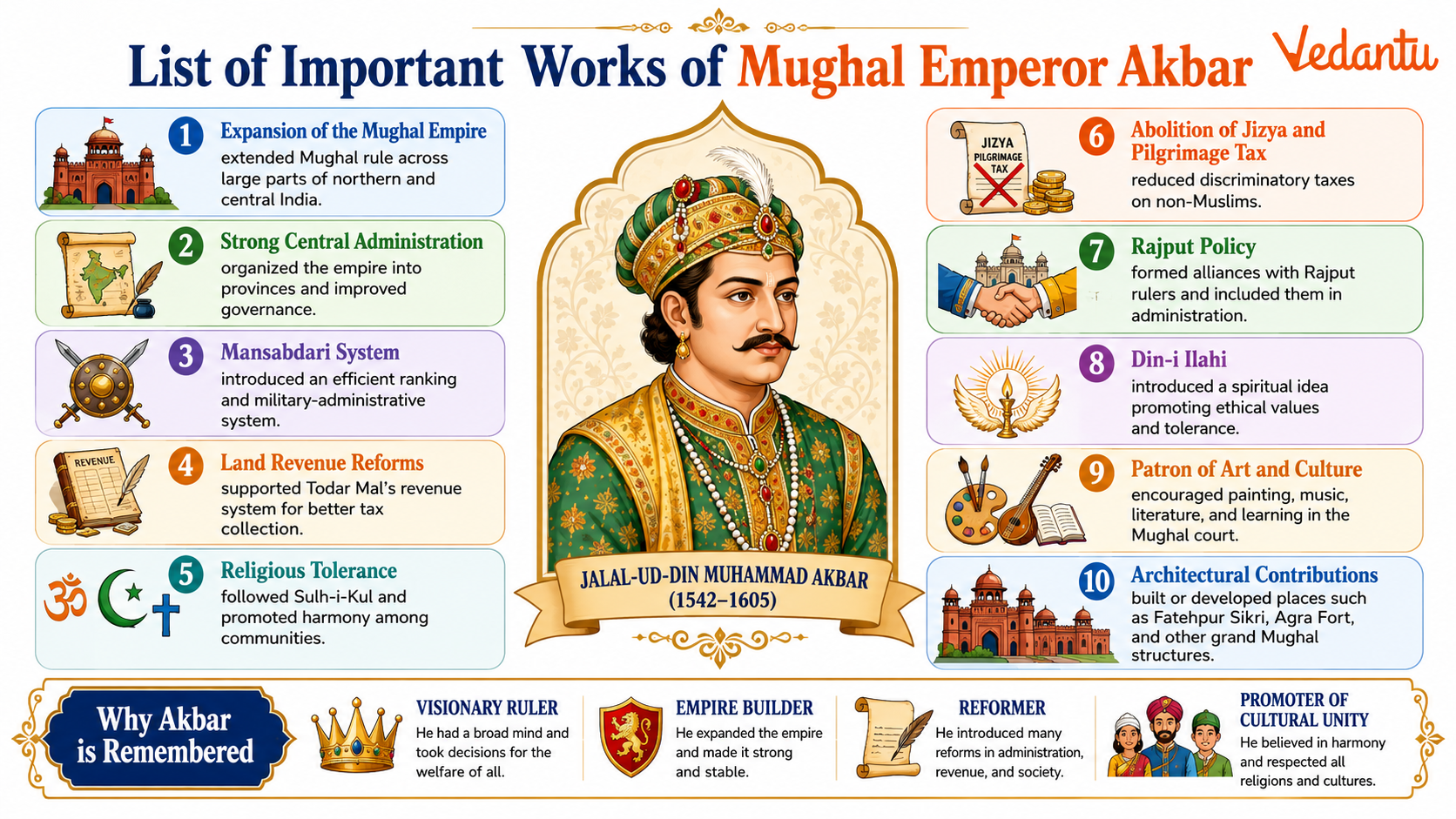
Administrative Reforms of Akbar
Akbar introduced several administrative reforms that strengthened the Mughal Empire and ensured efficient governance. His system became a model for future rulers.
- Introduction of the Mansabdari System - A military and civil service system where officers were assigned ranks known as mansabs.
- Land Revenue System - Implemented by Raja Todar Mal, known as the Zabti or Dahsala system, which fixed land revenue based on measurement and productivity.
- Centralized Administration - Divided the empire into Subas or provinces, each governed by a Subedar.
- Efficient Judiciary - Established a fair justice system with Qazis and other officials.
- Abolition of Pilgrimage Tax and Jizya - Promoted religious harmony by removing discriminatory taxes.
Religious and Social Reforms
Akbar is widely known for his policy of religious tolerance and efforts to promote unity among different communities.
- Sulh-i-Kul - Policy of universal peace and tolerance toward all religions.
- Foundation of Din-i-Ilahi in 1582 - A spiritual order combining elements of various religions.
- Establishment of Ibadat Khana at Fatehpur Sikri - A house of worship for religious discussions.
- Encouragement of Interfaith Dialogues - Invited scholars of Hinduism, Islam, Christianity, Jainism, and Zoroastrianism.
- Discouragement of Social Evils - Took steps against child marriage and supported widow remarriage in certain cases.
Military Achievements and Expansion
Akbar expanded the Mughal Empire through strategic military campaigns and alliances, making it one of the largest empires in India.
- Second Battle of Panipat in 1556 - Defeated Hemu and secured the Mughal throne.
- Conquest of Rajput States - Formed alliances through diplomacy and marriage.
- Annexation of Gujarat in 1572 - Strengthened control over trade routes.
- Conquest of Bengal and Bihar - Expanded eastern territories.
- Expansion into the Deccan - Extended Mughal influence in southern India.
Cultural and Literary Contributions
Akbar was a great patron of art, literature, music, and learning. His court became a center of cultural excellence.
- Navratnas - Nine gems in his court including Birbal, Tansen, and Abul Fazl.
- Translation of Sanskrit Texts - Mahabharata translated into Persian as Razmnama.
- Support to Persian Literature - Encouraged scholars and historians.
- Development of Mughal Painting - Fusion of Persian and Indian styles.
- Encouragement of Music - Tansen became one of the greatest musicians of his time.
Architectural Works of Akbar
Akbar commissioned several magnificent buildings that reflect a blend of Islamic, Persian, and Indian architectural styles.
Important Architectural Works of Akbar
| Monument | Location | Significance |
|---|---|---|
| Fatehpur Sikri | Uttar Pradesh | Capital city built by Akbar |
| Buland Darwaza | Fatehpur Sikri | Victory gate built after Gujarat conquest |
| Agra Fort | Agra | Major military and administrative center |
These architectural works reflect Akbar's vision of grandeur and his interest in blending different cultural elements. Fatehpur Sikri served as his capital for several years and remains a UNESCO World Heritage Site.
Economic Policies and Trade Development
Akbar strengthened the economic structure of the empire through reforms and promotion of trade.
- Standardization of Currency - Introduced silver coin called Rupiya.
- Improved Agricultural Practices - Encouraged cultivation and irrigation.
- Promotion of Trade - Maintained good relations with foreign traders including the Portuguese.
- Regulation of Markets - Ensured fair pricing and controlled corruption.
Why Akbar's Works Are Important
Akbar's contributions were significant because they created political stability, encouraged cultural integration, and promoted social harmony. His reforms laid the foundation for a strong and unified empire that lasted for generations. His policy of tolerance and administrative efficiency made him one of the most respected rulers in Indian history.
Conclusion
The important works of Mughal Emperor Akbar include administrative reforms, military conquests, religious tolerance, cultural patronage, architectural achievements, and economic development. His visionary leadership transformed the Mughal Empire into a powerful and stable state. Understanding Akbar's works is essential for students preparing for competitive exams and for anyone interested in Indian history, as his reign marked a golden period in the Mughal era.
FAQs on List of Major Works of Mughal Emperor Akbar in English
1. What were the most important works of Mughal Emperor Akbar?
The most important works of Mughal Emperor Akbar include administrative, religious, military, and cultural reforms that strengthened the Mughal Empire.
Key works of Akbar the Great (1542–1605) include:
• Establishment of a strong centralized administration
• Introduction of the Mansabdari System
• Implementation of the Dahsala Revenue System by Raja Todar Mal
• Formation of Din-i-Ilahi (religious policy)
• Abolition of Jizya Tax and pilgrimage tax
• Promotion of art, culture, and architecture
• Expansion of the Mughal Empire through military conquests
2. What administrative reforms were introduced by Akbar?
The administrative reforms of Akbar created a stable and efficient governance system in medieval India.
Main reforms included:
• Introduction of the Mansabdari System to organize military and civil services
• Division of the empire into Subas (provinces)
• Appointment of officials like Subedar, Diwan, and Qazi
• Merit-based appointments instead of hereditary positions
• Centralized control under the emperor
These reforms strengthened the Mughal administration system and improved governance.
3. What was the Mansabdari System introduced by Akbar?
The Mansabdari System was a military and administrative ranking system introduced by Emperor Akbar.
Key features:
• Officials were given ranks called Mansabs
• Ranking was based on Zat (personal rank) and Sawar (cavalry rank)
• Mansabdars were responsible for maintaining troops
• Salaries were paid in cash or land grants
This system ensured loyalty and efficient management of the Mughal military administration.
4. What was Akbar’s revenue system?
Akbar’s revenue system, known as the Dahsala System, improved tax collection and farmer welfare.
Main features:
• Introduced by Raja Todar Mal
• Based on average produce of the last 10 years
• Land measurement using Zabt system
• Fair tax rates for peasants
This reform strengthened the Mughal economy and ensured financial stability.
5. What was Din-i-Ilahi introduced by Akbar?
The Din-i-Ilahi was a religious policy introduced by Akbar in 1582 to promote unity among different religions.
Important points:
• Combined elements of Hinduism, Islam, Christianity, Jainism, and Zoroastrianism
• Promoted religious tolerance and peace
• Had limited followers
• Emphasized loyalty to the emperor
It reflected Akbar’s policy of religious harmony (Sulh-i-Kul).
6. Why did Akbar abolish the Jizya Tax?
Akbar abolished the Jizya Tax in 1564 to promote equality and religious tolerance.
Reasons and impact:
• Removed tax imposed on non-Muslims
• Encouraged unity among Hindus and Muslims
• Strengthened loyalty of Rajputs and other communities
• Supported his policy of Sulh-i-Kul (universal peace)
This step made Akbar popular among his subjects.
7. What were Akbar’s contributions to art and culture?
Akbar greatly promoted Mughal art, culture, and literature during his reign.
Major contributions:
• Construction of Fatehpur Sikri
• Development of Mughal miniature paintings
• Patronage to scholars like Abul Fazl and Faizi
• Translation of Sanskrit texts like the Mahabharata (Razmnama)
His reign is considered a golden period of Mughal cultural development.
8. What military achievements were accomplished by Akbar?
Akbar expanded the Mughal Empire through significant military conquests.
Important victories:
• Conquest of Malwa and Gujarat
• Annexation of Bengal and Bihar
• Victory over Rana Pratap at the Battle of Haldighati (1576)
• Expansion into Kabul and Deccan regions
These achievements established Akbar as one of the greatest Mughal rulers.
9. What was Sulh-i-Kul policy of Akbar?
The Sulh-i-Kul policy means “universal peace” and was Akbar’s principle of religious tolerance.
Main features:
• Equal respect for all religions
• No discrimination in government jobs
• Encouragement of interfaith dialogue in Ibadat Khana
• Promotion of harmony in the Mughal Empire
This policy helped maintain political stability and social unity.
10. Why is Akbar called Akbar the Great?
Akbar is called Akbar the Great because of his outstanding administrative reforms, military conquests, and religious tolerance.
Reasons include:
• Strong central administration
• Fair revenue system
• Policy of religious harmony
• Expansion of the Mughal Empire
• Patronage of art, architecture, and education
His reign (1556–1605) marked the foundation of a powerful and stable Mughal state in Indian history.
