






When Is Inflation Good for the Economy and Why?
Inflation refers to the general rise in the prices of goods and services over time, which reduces the purchasing power of money. It is a common economic phenomenon experienced by almost every country. A frequently asked question in economics is: Is inflation always bad for the economy? The answer is not simple. While high and uncontrolled inflation can damage economic stability, moderate inflation is often considered necessary for economic growth. Understanding the causes, types, advantages, and disadvantages of inflation helps students and competitive exam aspirants analyze its real impact on an economy.
What Is Inflation?
Inflation is the rate at which the overall price level of goods and services increases in an economy over a specific period, usually measured annually. When inflation rises, each unit of currency buys fewer goods and services than before.
Inflation is commonly measured using price indices such as:
- Consumer Price Index - CPI
- Wholesale Price Index - WPI
- Producer Price Index - PPI
Types of Inflation
1. Demand-Pull Inflation
This occurs when demand for goods and services exceeds supply. Higher consumer spending, government expenditure, or investment can push prices upward.
2. Cost-Push Inflation
This happens when production costs such as wages and raw materials increase. Producers pass these higher costs on to consumers in the form of higher prices.
3. Built-In Inflation
Also known as wage-price inflation, this occurs when workers demand higher wages to keep up with rising prices, which in turn increases production costs and leads to further price rises.
Is Inflation Always Bad?
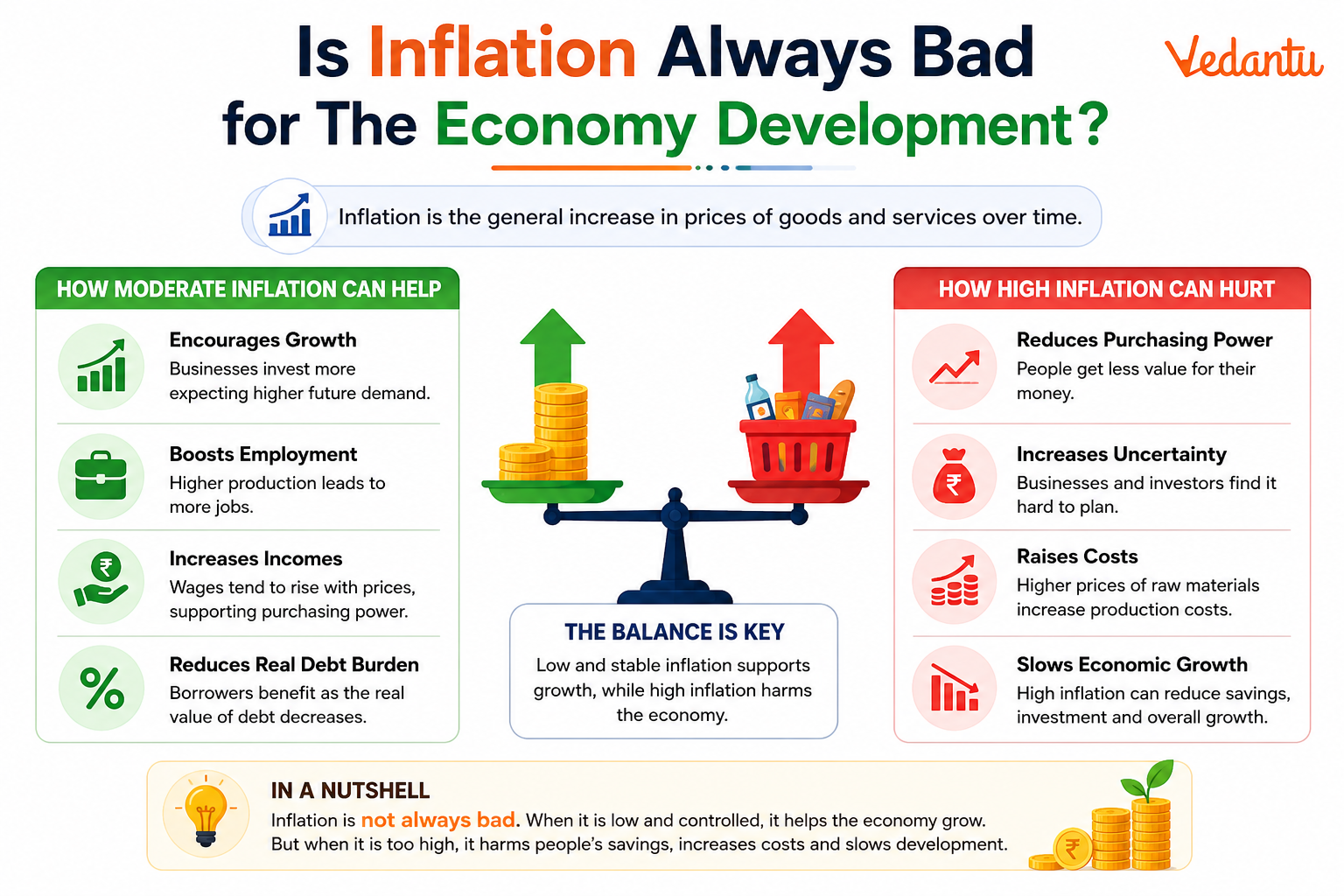
Inflation is not always harmful. Its impact depends largely on its rate and stability. Economists generally consider low and stable inflation beneficial, while high and unpredictable inflation can be harmful.
Advantages of Moderate Inflation
- Encourages spending and investment since people prefer buying now rather than later when prices may be higher.
- Reduces the real burden of debt for borrowers.
- Supports wage growth and employment when linked with economic expansion.
- Prevents deflation, which can slow down economic activity.
Disadvantages of High Inflation
- Reduces purchasing power, especially for fixed-income groups.
- Creates uncertainty in business planning and investment decisions.
- Leads to income inequality as wages may not rise at the same pace as prices.
- May reduce savings if interest rates do not keep up with inflation.
Comparison Between Moderate and High Inflation
| Basis | Moderate Inflation | High Inflation |
|---|---|---|
| Impact on Economy | Supports growth | Disrupts stability |
| Purchasing Power | Slightly reduced | Rapidly reduced |
| Investment Climate | Encourages investment | Creates uncertainty |
The table clearly shows that the effects of inflation depend on its intensity. While moderate inflation can stimulate economic activity, high inflation can weaken confidence and destabilize the economy.
How Governments Control Inflation
Governments and central banks use various tools to maintain inflation at a stable level. The aim is to achieve price stability while promoting growth.
Monetary Policy Measures
- Increasing interest rates to reduce borrowing and spending.
- Open market operations to control money supply.
- Adjusting reserve requirements for banks.
Fiscal Policy Measures
- Reducing government spending.
- Increasing taxes to control excessive demand.
Conclusion
Inflation is not always bad for the economy. Moderate and controlled inflation is often a sign of a growing economy and can encourage spending, investment, and employment. However, high and uncontrolled inflation can reduce purchasing power, create uncertainty, and slow economic progress. Therefore, the real concern is not inflation itself but its rate and management. A balanced approach by governments and central banks ensures that inflation remains within a healthy range, supporting long-term economic stability and growth.
FAQs on Is Inflation Always Harmful for the Economy? A Student-Friendly Guide
1. Is inflation always bad for the economy?
No, inflation is not always bad for the economy; moderate inflation can support economic growth.
- Low and stable inflation (around 2–3%) encourages spending and investment.
- It reduces the real burden of debt for borrowers.
- However, high inflation reduces purchasing power and creates economic instability.
- Extremely high inflation can lead to hyperinflation and economic crisis.
2. What are the main causes of inflation?
Inflation is mainly caused by excess demand, rising production costs, or increased money supply in the economy.
- Demand-pull inflation: When demand exceeds supply.
- Cost-push inflation: When wages or raw material costs rise.
- Built-in inflation: Caused by wage-price spirals.
- Expansionary monetary policy by central banks can also increase inflation.
3. How does inflation affect consumers?
Inflation affects consumers by reducing their purchasing power over time.
- Prices of goods and services increase.
- Fixed-income earners suffer the most.
- Savings lose value if interest rates are lower than inflation.
- Moderate inflation may encourage early spending instead of hoarding money.
4. What is the difference between inflation and deflation?
Inflation is a rise in the general price level, while deflation is a fall in overall prices.
- Inflation decreases money’s purchasing power.
- Deflation increases purchasing power but may reduce economic activity.
- Persistent deflation can lead to unemployment and recession.
- Economists generally prefer low, controlled inflation over deflation.
5. What is considered a healthy rate of inflation?
A healthy inflation rate is usually around 2% to 3% annually in most developed economies.
- Maintains price stability.
- Encourages spending and investment.
- Allows central banks flexibility in monetary policy.
- Prevents risks of deflation and economic slowdown.
6. How do governments control inflation?
Governments and central banks control inflation through monetary and fiscal measures.
- Raising interest rates to reduce borrowing.
- Reducing money supply through monetary policy.
- Increasing taxes or reducing public spending.
- Controlling wages and prices in extreme situations.
7. Who benefits from inflation?
Certain groups benefit from moderate inflation, especially borrowers and businesses.
- Borrowers repay loans with less valuable money.
- Businesses may earn higher profits if prices rise faster than costs.
- Asset owners benefit from rising property or stock prices.
- Governments benefit as the real value of public debt decreases.
8. What is hyperinflation?
Hyperinflation is an extremely high and rapid rise in prices that destroys currency value.
- Prices increase uncontrollably within months or days.
- Money loses its function as a store of value.
- Often caused by excessive money printing.
- Historical examples include Germany (1923) and Zimbabwe (2000s).
9. How does inflation impact economic growth?
Inflation can both support and harm economic growth depending on its level.
- Moderate inflation stimulates production and investment.
- High inflation creates uncertainty and reduces savings.
- Businesses may delay long-term planning during unstable inflation.
- Stable inflation supports sustainable economic development.
10. Why do central banks aim for low and stable inflation?
Central banks target low and stable inflation to maintain price stability and economic confidence.
- Protects purchasing power of citizens.
- Encourages long-term investment and savings.
- Reduces risk of recession or deflation.
- Supports balanced macroeconomic stability and employment growth.
