






Key Missions of ISRO and Their Impact on India and the World
The Indian Space Research Organisation - ISRO is the national space agency of India, established in 1969. It operates under the Department of Space and is responsible for designing, developing, and launching satellites, launch vehicles, and space missions. ISRO has gained global recognition for its cost-effective space programs, successful planetary missions, and advanced satellite technology. The achievements of ISRO reflect India’s growing strength in science, technology, and innovation, making it one of the leading space agencies in the world.
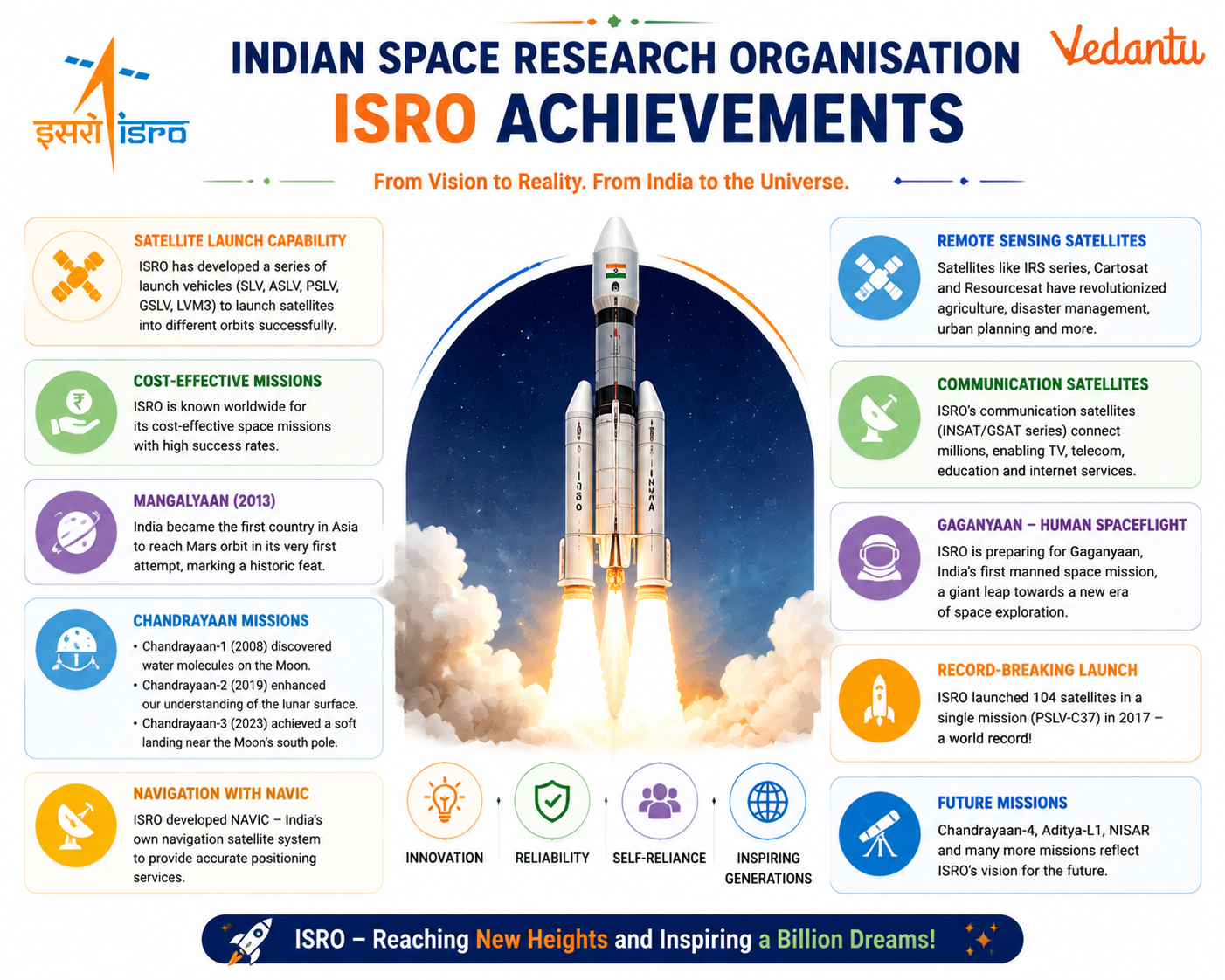
About ISRO
ISRO was founded by Dr. Vikram Sarabhai, who is known as the Father of the Indian Space Program. The main objective of ISRO is to harness space technology for national development while pursuing space science research and planetary exploration. Its headquarters is located in Bengaluru, Karnataka.
- Established - 15 August 1969
- Headquarters - Bengaluru, Karnataka
- Founder - Dr. Vikram Sarabhai
- Governing Body - Department of Space, Government of India
Major Achievements of ISRO
1. Aryabhata - First Indian Satellite
Launched in 1975, Aryabhata was India’s first satellite. It marked India’s entry into space exploration and laid the foundation for future satellite development programs.
2. Polar Satellite Launch Vehicle - PSLV Success
PSLV is one of ISRO’s most reliable launch vehicles. It has launched numerous Indian and foreign satellites into orbit. In 2017, PSLV set a world record by launching 104 satellites in a single mission.
3. Chandrayaan Missions
ISRO’s lunar missions have significantly enhanced India’s position in space exploration.
- Chandrayaan-1 - Launched in 2008, confirmed the presence of water molecules on the Moon.
- Chandrayaan-2 - Launched in 2019, included an orbiter, lander, and rover.
- Chandrayaan-3 - Successfully landed near the Moon’s south pole in 2023, making India the first country to achieve this feat.
4. Mars Orbiter Mission - Mangalyaan
Launched in 2013, Mangalyaan made India the first country to reach Mars orbit on its first attempt. It also made India the fourth space agency in the world to reach Mars. The mission was praised globally for its low cost and high efficiency.
5. Navigation with Indian Constellation - NavIC
NavIC is India’s regional satellite navigation system that provides accurate position information over India and surrounding regions. It enhances navigation services for civilian and strategic uses.
6. Gaganyaan Mission
Gaganyaan is India’s human spaceflight program. Its aim is to send Indian astronauts into space aboard an Indian spacecraft. Successful test missions have already been conducted, marking progress toward human space exploration.
Timeline of Major ISRO Achievements
| Year | Mission | Significance |
|---|---|---|
| 1975 | Aryabhata | First Indian Satellite |
| 2008 | Chandrayaan-1 | Discovery of Water on Moon |
| 2013 | Mangalyaan | First Mars Mission Success |
| 2023 | Chandrayaan-3 | South Pole Moon Landing |
The table above highlights some of the landmark missions of ISRO that brought international recognition to India. These missions demonstrate technological advancement, innovation, and scientific capability.
Importance of ISRO’s Achievements
ISRO’s achievements have significant impact on national development and global collaboration. Space technology supports communication, weather forecasting, disaster management, agriculture, and national security.
- Improved communication through INSAT and GSAT satellites
- Accurate weather forecasting and disaster warning systems
- Support for agriculture and resource mapping
- Strengthening India’s global scientific reputation
ISRO in Competitive Exams
Questions related to ISRO achievements frequently appear in competitive examinations such as UPSC, SSC, Banking, Railways, and state-level exams. Important areas include major missions, launch vehicles, satellite systems, and recent developments. Students should focus on mission names, years, objectives, and outcomes for effective preparation.
Conclusion
The achievements of the Indian Space Research Organisation - ISRO highlight India’s remarkable progress in space science and technology. From launching its first satellite Aryabhata to successfully landing near the Moon’s south pole and reaching Mars, ISRO has consistently demonstrated innovation, efficiency, and excellence. Its contributions not only advance scientific knowledge but also support national development and global cooperation. Understanding ISRO’s achievements is essential for students, competitive exam aspirants, and anyone interested in India’s scientific growth.
FAQs on Indian Space Research Organisation (ISRO) Achievements and Milestones Explained
1. What is the Indian Space Research Organisation (ISRO)?
The Indian Space Research Organisation (ISRO) is India’s national space agency responsible for space research and satellite development.
• Established in 1969 by Dr. Vikram Sarabhai
• Functions under the Department of Space, Government of India
• Headquarters located in Bengaluru, Karnataka
• Focuses on satellite launches, space exploration, remote sensing, and communication technology
ISRO is known for cost-effective missions and major achievements in space science and technology.
2. What are the major achievements of ISRO?
ISRO has achieved several historic milestones in global space exploration.
• Chandrayaan-1 (2008) – Discovered water molecules on the Moon
• Mangalyaan (Mars Orbiter Mission, 2013) – First Asian mission to Mars
• Chandrayaan-3 (2023) – Successful soft landing near Moon’s south pole
• Launch of 104 satellites in a single mission (2017)
• Development of NavIC, India’s regional navigation system
These achievements highlight ISRO’s leadership in space missions, planetary exploration, and satellite technology.
3. What is Chandrayaan mission and why is it important?
The Chandrayaan mission is ISRO’s lunar exploration program aimed at studying the Moon.
• Chandrayaan-1 (2008) confirmed presence of water on the Moon
• Chandrayaan-2 (2019) orbiter still operational
• Chandrayaan-3 (2023) achieved successful soft landing
This mission is important for lunar research, space science, and future human space exploration, making India the first country to land near the Moon’s south pole.
4. What is Mangalyaan or Mars Orbiter Mission?
The Mangalyaan (Mars Orbiter Mission) is India’s first interplanetary mission to Mars.
• Launched in 2013 using PSLV-C25
• Made India the first Asian country to reach Mars orbit
• Achieved success in its first attempt
• Known as one of the most cost-effective Mars missions
Mangalyaan strengthened India’s position in deep space exploration and planetary missions.
5. What are the main rockets developed by ISRO?
ISRO has developed reliable launch vehicles for satellite deployment and space missions.
• PSLV (Polar Satellite Launch Vehicle) – Most trusted and versatile rocket
• GSLV (Geosynchronous Satellite Launch Vehicle) – Used for heavier payloads
• LVM3 (Launch Vehicle Mark-3) – Used for Chandrayaan-2, Chandrayaan-3, and Gaganyaan missions
These rockets support satellite launches, communication satellites, and interplanetary missions.
6. What is Gaganyaan mission?
The Gaganyaan mission is India’s first planned human spaceflight program.
• Aims to send Indian astronauts (Vyomanauts) into space
• Will use the LVM3 rocket
• Focuses on developing human spaceflight capability
This mission marks a major step in India’s manned space program and space technology advancement.
7. What is NavIC developed by ISRO?
The NavIC (Navigation with Indian Constellation) is India’s regional satellite navigation system.
• Provides accurate positioning and timing services
• Covers India and surrounding regions
• Useful for navigation, disaster management, and defense applications
NavIC strengthens India’s independence in satellite-based navigation systems similar to GPS.
8. Who is the founder of ISRO?
The founder of ISRO is Dr. Vikram Sarabhai, known as the father of the Indian space program.
• Established ISRO in 1969
• Promoted peaceful use of space technology for national development
• Played a key role in developing India’s satellite and research programs
His vision laid the foundation for India’s success in space exploration and satellite communication.
9. How does ISRO help in India’s development?
ISRO contributes significantly to India’s economic and social development.
• Provides communication satellites for TV, internet, and telecommunication
• Supports weather forecasting and disaster management
• Assists in agriculture, resource mapping, and environmental monitoring
• Enhances defense and navigation systems
Through space applications, ISRO improves daily life, governance, and national security.
10. Why is ISRO considered one of the best space agencies in the world?
ISRO is considered one of the top space agencies due to its cost-effective and successful missions.
• High mission success rate in satellite launches and planetary missions
• Achievements like Mangalyaan and Chandrayaan-3
• Ability to launch multiple satellites in one mission
• Strong focus on innovation, research, and indigenous technology
Its achievements place India among leading nations in global space exploration and aerospace research.
