






Important MCQs on Ozone Layer Causes, Effects and Prevention
The ozone layer is a protective shield of gas present in the Earth's stratosphere that absorbs most of the harmful ultraviolet (UV) radiation coming from the Sun. Ozone layer depletion refers to the thinning of this protective layer due to human-made chemicals and natural factors. It is an important topic in General Knowledge, environmental studies, and competitive exams because it directly affects human health, ecosystems, and climate systems. Understanding ozone layer depletion helps students and aspirants grasp global environmental issues and international efforts taken to protect the planet.
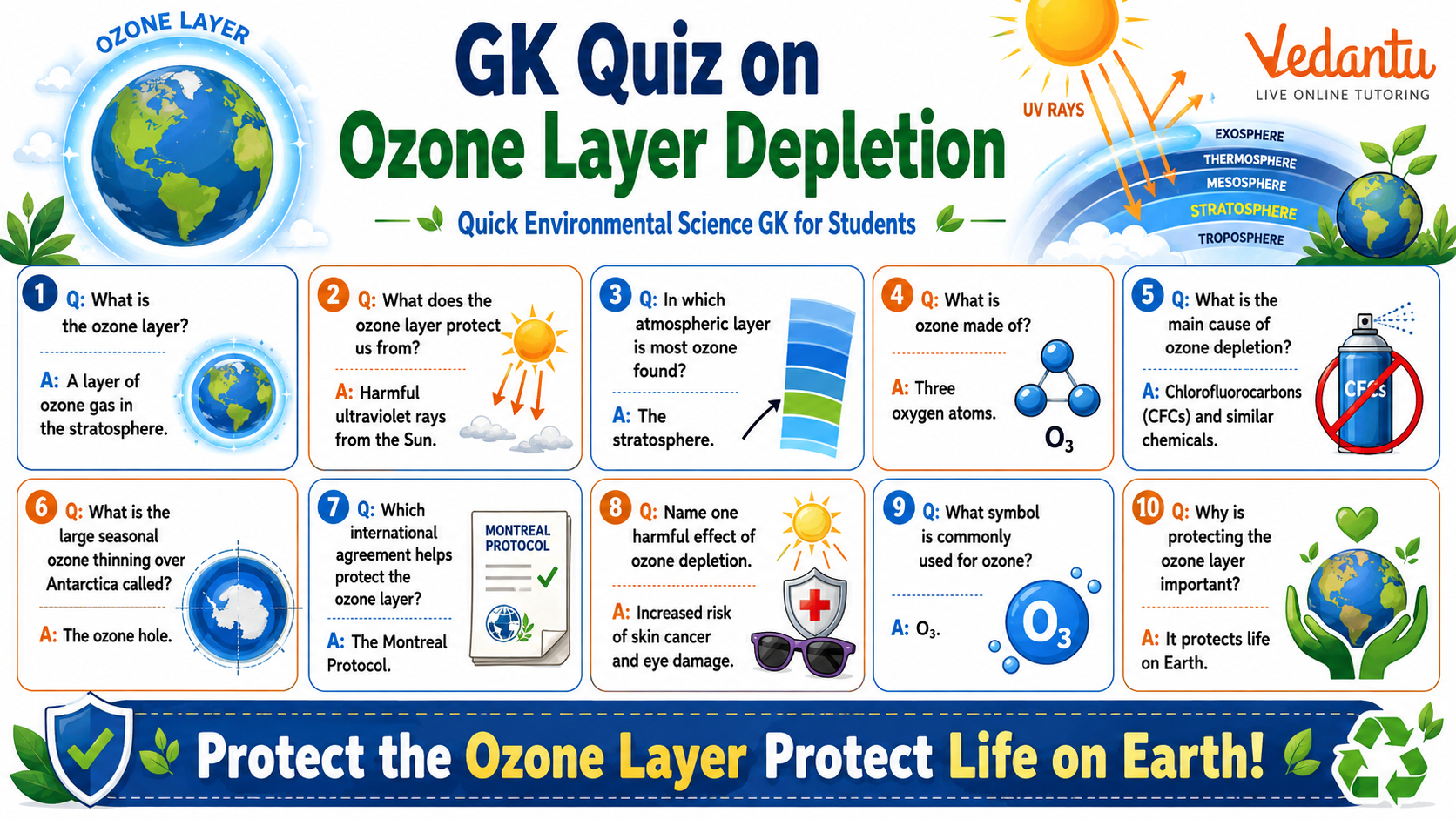
What is the Ozone Layer?
The ozone layer is a region in the stratosphere, located about 15 to 35 kilometers above the Earth's surface. It contains a high concentration of ozone gas (O3). Although ozone makes up only a small fraction of the atmosphere, it plays a crucial role in blocking harmful ultraviolet-B (UV-B) and ultraviolet-C (UV-C) rays.
- Protects humans from skin cancer and cataracts
- Prevents damage to crops and marine life
- Maintains ecological balance
What is Ozone Layer Depletion?
Ozone layer depletion refers to the gradual thinning of the ozone layer in the Earth's stratosphere. This process is mainly caused by the release of certain chemicals that break down ozone molecules. When ozone molecules are destroyed faster than they are formed, the layer becomes thinner, allowing more harmful UV radiation to reach the Earth.
Main Causes of Ozone Layer Depletion
The major cause of ozone depletion is the emission of chlorine and bromine containing compounds. These substances are commonly found in industrial products and refrigerants.
- Chlorofluorocarbons - CFCs: Used in refrigerators, air conditioners, and aerosol sprays
- Halons: Used in fire extinguishers
- Carbon tetrachloride: Used in cleaning solvents
- Methyl chloroform: Used in industrial processes
- Nitrogen oxides: Released from aircraft and combustion processes
How Do CFCs Destroy Ozone?
When CFCs reach the stratosphere, they are broken down by ultraviolet radiation. This releases chlorine atoms, which react with ozone molecules. One chlorine atom can destroy thousands of ozone molecules through a chain reaction process.
Ozone Hole
The ozone hole refers to the severe thinning of the ozone layer over Antarctica. It was first discovered in 1985 by British scientists. The ozone hole appears mainly during the spring season in the Southern Hemisphere due to extremely cold temperatures and the presence of polar stratospheric clouds that accelerate ozone destruction.
Effects of Ozone Layer Depletion
Ozone depletion has serious consequences for human health, animals, plants, and the environment.
- Human Health: Increased risk of skin cancer, sunburn, and eye cataracts
- Marine Ecosystems: Damage to phytoplankton, which forms the base of the ocean food chain
- Agriculture: Reduced crop productivity due to UV radiation
- Animals: Skin and eye damage in wildlife
- Material Damage: Faster degradation of plastics and rubber materials
Major Ozone Depleting Substances
| Substance | Common Use | Impact on Ozone |
|---|---|---|
| CFCs | Refrigeration and aerosols | Release chlorine that destroys ozone |
| Halons | Fire extinguishers | Release bromine which is highly destructive |
| Carbon Tetrachloride | Industrial solvent | Contributes to ozone thinning |
These substances remain in the atmosphere for many years and continue to damage the ozone layer long after their release.
Global Efforts to Protect the Ozone Layer
Recognizing the serious threat of ozone depletion, the international community has taken strong measures to reduce ozone depleting substances.
- Vienna Convention 1985: Framework for international cooperation
- Montreal Protocol 1987: Agreement to phase out ozone depleting substances
- Kigali Amendment 2016: Aims to reduce hydrofluorocarbons which contribute to global warming
The Montreal Protocol is considered one of the most successful environmental agreements in history. Due to global cooperation, the ozone layer is gradually recovering and is expected to return to its 1980 levels by the middle of the 21st century.
Important GK Points for Exams
- Ozone layer is located in the stratosphere
- Ozone hole discovered in 1985 over Antarctica
- Montreal Protocol signed in 1987
- CFCs are the main cause of ozone depletion
- September 16 is celebrated as World Ozone Day
Conclusion
Ozone layer depletion is a critical environmental issue with global consequences. It highlights the impact of human activities on the atmosphere and the importance of international cooperation. Thanks to global agreements like the Montreal Protocol, significant progress has been made in protecting the ozone layer. For students and competitive exam aspirants, understanding the causes, effects, and preventive measures related to ozone depletion is essential for scoring well in General Knowledge and environmental science sections.
FAQs on GK Quiz on Ozone Layer Depletion: Practice Questions for Students
1. What is ozone layer depletion?
Ozone layer depletion refers to the thinning of the ozone layer in the Earth's stratosphere due to harmful chemical substances.
• The ozone layer protects life by absorbing ultraviolet (UV) radiation from the Sun.
• Depletion is mainly caused by chlorofluorocarbons (CFCs) and other ozone-depleting substances.
• It leads to increased UV exposure, causing health and environmental risks.
• Commonly searched terms include ozone hole, UV rays, and atmospheric pollution.
2. What causes ozone layer depletion?
Ozone layer depletion is mainly caused by man-made chemicals released into the atmosphere.
• Chlorofluorocarbons (CFCs) from refrigerators and air conditioners.
• Halons used in fire extinguishers.
• Carbon tetrachloride and methyl chloroform.
• These chemicals release chlorine and bromine atoms that destroy ozone molecules.
• Related topics include greenhouse gases, global warming, and atmospheric chemistry.
3. What is the ozone hole?
The ozone hole is a severe thinning of the ozone layer observed mainly over Antarctica.
• It was first discovered in 1985 by British scientists.
• It forms during the Antarctic spring (September–November).
• Caused by chemical reactions involving CFCs and polar stratospheric clouds.
• Frequently searched as Antarctic ozone hole and causes of ozone hole.
4. What are the harmful effects of ozone layer depletion?
Ozone depletion increases exposure to harmful ultraviolet radiation, affecting health and ecosystems.
• Causes skin cancer and sunburn.
• Leads to eye damage like cataracts.
• Harms marine life, especially phytoplankton.
• Reduces crop productivity and affects biodiversity.
• Related searches include UV radiation effects and environmental impact.
5. What is the Montreal Protocol?
The Montreal Protocol is an international treaty designed to protect the ozone layer by phasing out harmful substances.
• Signed in 1987.
• Aims to reduce production of CFCs and other ozone-depleting substances.
• Considered one of the most successful environmental agreements.
• Linked topics include global environmental treaties and ozone protection laws.
6. How does ozone depletion affect climate change?
Ozone depletion and climate change are interconnected environmental issues.
• Some ozone-depleting substances are also greenhouse gases.
• Changes in ozone levels influence atmospheric temperature patterns.
• The Montreal Protocol also helped reduce global warming.
• Related terms include global warming, climate crisis, and atmospheric changes.
7. How can ozone layer depletion be prevented?
Ozone layer depletion can be reduced by limiting the use of harmful chemicals and following global agreements.
• Avoid products containing CFCs.
• Maintain air conditioners and refrigerators properly.
• Support policies under the Montreal Protocol.
• Promote awareness about ozone protection and sustainable practices.
• Often searched as ways to protect ozone layer and prevention of ozone depletion.
8. Why is the ozone layer important for life on Earth?
The ozone layer is essential because it shields Earth from harmful ultraviolet radiation.
• Absorbs most of the Sun’s UV-B and UV-C rays.
• Protects humans from skin diseases and immune damage.
• Safeguards plants, animals, and marine ecosystems.
• Connected searches include importance of ozone layer and UV protection.
9. In which layer of the atmosphere is the ozone layer found?
The ozone layer is located in the stratosphere, about 10 to 50 km above the Earth's surface.
• Highest concentration found between 15–35 km altitude.
• Distinct from the troposphere where weather occurs.
• Plays a key role in atmospheric temperature balance.
• Related terms include layers of atmosphere and stratospheric ozone.
10. Is the ozone layer recovering?
Yes, the ozone layer is gradually recovering due to global efforts under the Montreal Protocol.
• Reduction in CFC emissions has slowed depletion.
• Scientists predict near full recovery by the mid-21st century.
• Continuous monitoring by organizations like UNEP and WMO.
• Frequently searched as ozone layer recovery and future of ozone layer.
