






How to Read and Use the English Calendar System
A calendar is a system used to organize and measure time in days, weeks, months, and years. It helps societies track important events, festivals, seasons, and historical dates. The modern calendar used in most parts of the world is based on astronomical movements of the Earth around the Sun. Understanding the calendar is important in General Knowledge as it is frequently asked in competitive exams and is essential for understanding history, geography, and daily life time management.
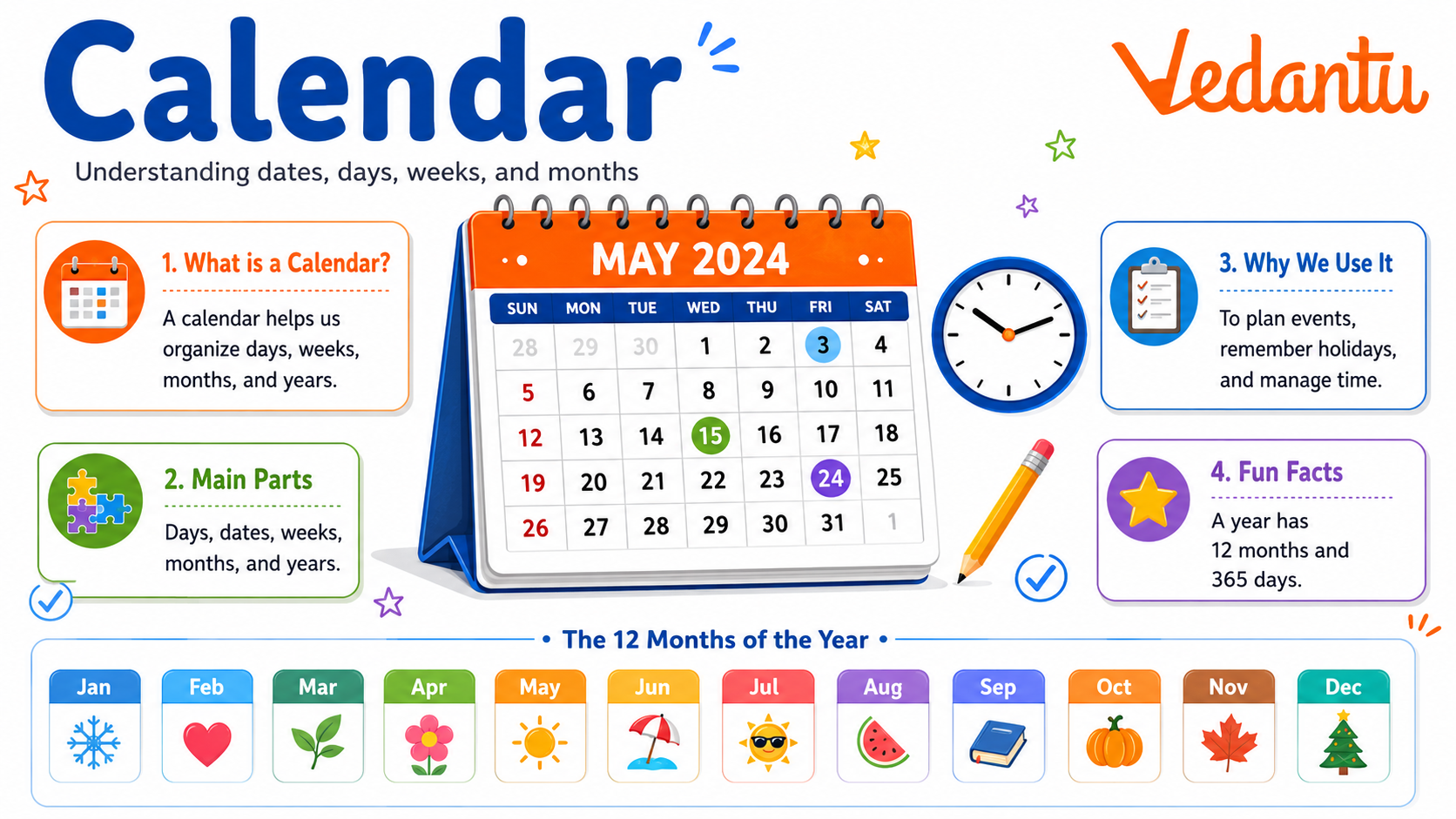
Meaning and Importance of Calendar
The word calendar is derived from the Latin word "Kalendae", which referred to the first day of the month in the Roman calendar. A calendar provides a systematic way to divide time into years, months, weeks, and days based on astronomical observations such as the Earth's rotation and revolution.
- Helps in determining dates and planning activities
- Used to fix religious and cultural festivals
- Important for agricultural and seasonal activities
- Essential for historical record keeping
Types of Calendars
Different civilizations have developed various types of calendars based on the movement of the Sun, Moon, or both.
1. Solar Calendar
A solar calendar is based on the Earth's revolution around the Sun. One solar year is approximately 365.2422 days. The Gregorian calendar is the most widely used solar calendar.
2. Lunar Calendar
A lunar calendar is based on the phases of the Moon. A lunar month is about 29.5 days. Twelve lunar months make around 354 days, which is shorter than a solar year. The Islamic calendar is an example.
3. Lunisolar Calendar
A lunisolar calendar combines both solar and lunar calculations. It adjusts the lunar months to match the solar year. The Hindu and Chinese calendars are examples.
Comparison of Calendar Types
| Type | Based On | Example |
|---|---|---|
| Solar | Earth's revolution around Sun | Gregorian Calendar |
| Lunar | Phases of the Moon | Islamic Calendar |
| Lunisolar | Sun and Moon cycles | Hindu Calendar |
Each type of calendar has its own method of adjusting days and months to match astronomical observations. The solar calendar stays aligned with seasons, while the lunar calendar shifts every year relative to seasons.
The Gregorian Calendar
The Gregorian calendar is the internationally accepted civil calendar today. It was introduced by Pope Gregory XIII in 1582 to correct errors in the earlier Julian calendar.
- Consists of 365 days in a common year
- Leap year has 366 days
- Leap year occurs every 4 years
- Century years are leap years only if divisible by 400
Leap Year Rule
- If a year is divisible by 4, it is a leap year
- If a year is divisible by 100, it is not a leap year
- If a year is divisible by 400, it is a leap year
Structure of the Gregorian Calendar
The Gregorian calendar consists of 12 months and 7 days in a week. The months have either 28, 29, 30, or 31 days.
Months and Number of Days
| Month | Days | Type |
|---|---|---|
| February | 28 or 29 | Shortest Month |
| April, June, September, November | 30 | Short Months |
The remaining months January, March, May, July, August, October, and December have 31 days each. February has 29 days in a leap year.
Interesting Facts About Calendar
- A week consists of 7 days based on ancient Babylonian astronomy
- The Julian calendar was introduced by Julius Caesar in 45 BCE
- Not all countries adopted the Gregorian calendar at the same time
- The Islamic calendar year is about 11 days shorter than the solar year
Why Calendar is Important for Competitive Exams
Questions related to calendars are common in reasoning, general awareness, and aptitude sections. Understanding leap years, odd days, and day calculations helps in solving problems quickly.
- Day and date calculations
- Leap year identification
- Number of days between two dates
- Historical year based questions
Conclusion
The calendar is a fundamental system for measuring and organizing time. From ancient civilizations to the modern Gregorian calendar, it plays a crucial role in daily life, agriculture, religion, and governance. A clear understanding of the calendar system not only strengthens general knowledge but also helps in solving competitive exam questions effectively. Mastering basic concepts such as types of calendars, leap year rules, and month structures ensures strong preparation in this topic.
FAQs on Calendar Basics in English for Students
1. What is a calendar and why is it important?
A calendar is a system used to organize days, weeks, months, and years for measuring time.
• It helps in planning events, holidays, and festivals.
• It is used in schools, offices, and competitive exams.
• It tracks dates, weekdays, months, and years.
• Common types include the Gregorian calendar and lunar calendar.
This makes calendars essential for time management and daily life.
2. How many months are there in a year?
There are 12 months in a year according to the Gregorian calendar.
• January
• February
• March
• April
• May
• June
• July
• August
• September
• October
• November
• December
These months help divide the 365 days (or 366 in a leap year) into manageable periods.
3. What is a leap year in the calendar?
A leap year is a year that has 366 days instead of 365.
• It occurs every 4 years.
• February has 29 days in a leap year.
• Example: 2020, 2024, 2028.
This extra day helps adjust the calendar year with the Earth’s revolution around the Sun.
4. How many days are there in each month?
Different months have different numbers of days in the calendar year.
• 31 days: January, March, May, July, August, October, December
• 30 days: April, June, September, November
• 28 or 29 days: February
This pattern is important for solving calendar reasoning questions in exams.
5. What are the days of the week in order?
There are 7 days in a week in the modern calendar system.
• Sunday
• Monday
• Tuesday
• Wednesday
• Thursday
• Friday
• Saturday
These weekdays are commonly used in date calculations, scheduling, and GK questions.
6. What is the Gregorian calendar?
The Gregorian calendar is the most widely used civil calendar in the world today.
• Introduced by Pope Gregory XIII in 1582.
• It replaced the Julian calendar.
• It has 365 days in a year and 366 in a leap year.
This calendar is used internationally for official and academic purposes.
7. What is the difference between a lunar and solar calendar?
The main difference lies in how time is measured in lunar and solar calendars.
• Solar calendar: Based on the Earth’s movement around the Sun (e.g., Gregorian calendar).
• Lunar calendar: Based on the phases of the Moon (e.g., Islamic calendar).
• Solar year ≈ 365 days; Lunar year ≈ 354 days.
This difference affects the dates of festivals and religious events.
8. How do you calculate the day of a given date?
To find the day of a given date, you use calendar calculation methods.
• Count odd days in years and months.
• Consider leap years.
• Use known reference dates.
• Apply formulas used in reasoning and aptitude exams.
This skill is important for competitive exams and logical reasoning tests.
9. Why does February have only 28 days?
February has 28 days due to historical adjustments in the Roman calendar.
• Early Roman calendar reforms reduced its length.
• In a leap year, it has 29 days.
• It helps balance the total days in a 365-day solar year.
This unique feature makes February important in calendar-based GK questions.
10. What are some important calendar-based questions asked in exams?
Calendar-based questions test logical and date calculation skills in exams.
• Finding the day of a given date.
• Counting number of odd days.
• Identifying leap years.
• Matching dates with weekdays.
These topics are common in banking exams, SSC, UPSC, and school GK tests.
