






Why Article 32 is Called the Heart and Soul of the Constitution and Its Five Writs
Article 32 of the Indian Constitution is one of the most important provisions for the protection of Fundamental Rights. It gives citizens the right to directly approach the Supreme Court of India when their Fundamental Rights are violated. Dr. B. R. Ambedkar described Article 32 as the "heart and soul" of the Constitution because it ensures that rights are not just theoretical but enforceable in reality. For students, competitive exam aspirants, and general readers, understanding Article 32 is essential to grasp how constitutional remedies safeguard democracy in India.
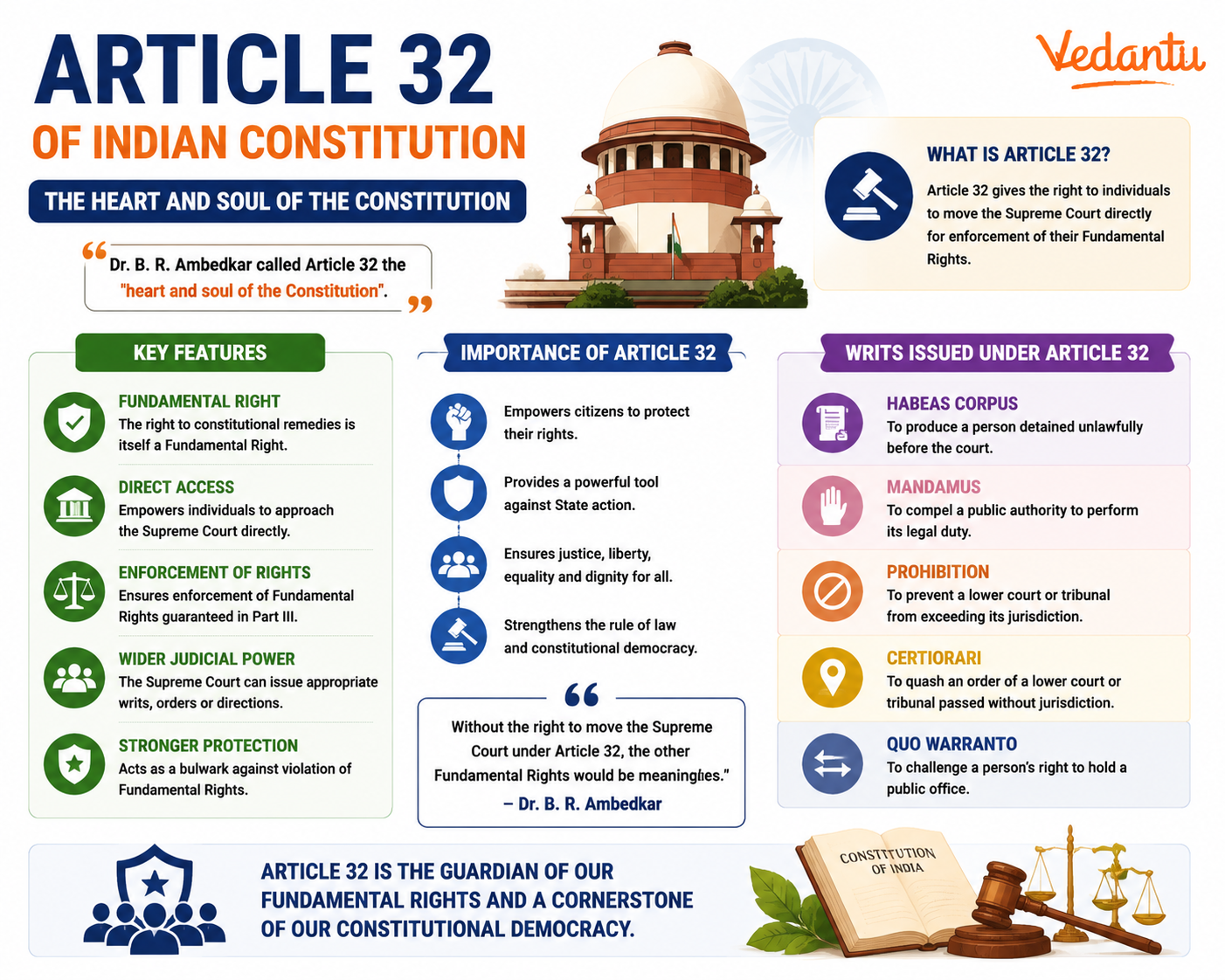
What is Article 32 of the Indian Constitution?
Article 32 provides the Right to Constitutional Remedies. It empowers individuals to move the Supreme Court directly for the enforcement of their Fundamental Rights guaranteed under Part III of the Constitution. If any Fundamental Right is violated by the State, the Supreme Court can issue appropriate writs to restore those rights.
- It is itself a Fundamental Right.
- It allows direct access to the Supreme Court.
- It ensures enforcement of other Fundamental Rights.
- The right cannot be suspended except during a national emergency as provided in the Constitution.
Features of Article 32
- Guaranteed right to move the Supreme Court for enforcement of Fundamental Rights.
- The Supreme Court has the power to issue writs.
- Parliament can empower other courts to issue writs.
- Suspension possible only under specific constitutional provisions.
Types of Writs Issued Under Article 32
The Supreme Court can issue five types of writs to protect Fundamental Rights. These writs are powerful judicial remedies that ensure accountability of public authorities.
Five Types of Writs Under Article 32
| Writ | Meaning | Purpose |
|---|---|---|
| Habeas Corpus | Produce the body | To release a person from illegal detention |
| Mandamus | We command | To order a public authority to perform its duty |
| Prohibition | To forbid | To stop a lower court from exceeding its jurisdiction |
| Certiorari | To be informed | To transfer or quash orders of lower courts |
| Quo Warranto | By what authority | To question the legality of a person holding public office |
These writs form the backbone of judicial review and ensure that authorities act within the framework of law.
Importance of Article 32
Article 32 is vital for maintaining the rule of law in India. It guarantees that Fundamental Rights are meaningful and enforceable. Without Article 32, citizens would have rights without effective remedies.
- Acts as a protector of Fundamental Rights.
- Strengthens judicial review.
- Maintains constitutional supremacy.
- Promotes accountability of government authorities.
Article 32 vs Article 226
Both Article 32 and Article 226 deal with writ jurisdiction, but they differ in scope and authority. Article 32 applies to the Supreme Court, while Article 226 empowers High Courts.
Difference Between Article 32 and Article 226
| Basis | Article 32 | Article 226 |
|---|---|---|
| Authority | Supreme Court | High Courts |
| Scope | Only for Fundamental Rights | For Fundamental Rights and other legal rights |
| Nature | It is a Fundamental Right | It is a constitutional power |
Article 226 has a wider scope because it covers both Fundamental Rights and other legal rights, whereas Article 32 is limited to Fundamental Rights only.
Landmark Judgments Related to Article 32
- Romesh Thappar v. State of Madras (1950) - Strengthened freedom of speech and allowed direct access under Article 32.
- Kesavananda Bharati v. State of Kerala (1973) - Established the Basic Structure doctrine and reinforced judicial review.
- ADM Jabalpur v. Shivkant Shukla (1976) - Related to suspension of rights during Emergency.
Role of Article 32 During Emergency
During a national emergency under Article 359, the right to move the Supreme Court for enforcement of certain Fundamental Rights may be suspended. However, after the 44th Constitutional Amendment, rights under Articles 20 and 21 cannot be suspended even during an emergency.
Why Dr. B. R. Ambedkar Called It the Heart and Soul of the Constitution
Dr. Ambedkar emphasized that without remedies, Fundamental Rights would be meaningless. Article 32 ensures that citizens have the power to seek justice directly from the highest court. It transforms rights from mere declarations into enforceable guarantees.
Key Points for Competitive Exams
- Article 32 is included in Part III of the Constitution.
- It deals with the Right to Constitutional Remedies.
- Supreme Court can issue five types of writs.
- Called the heart and soul of the Constitution by Dr. B. R. Ambedkar.
- Closely related to Article 226 of the Constitution.
Conclusion
Article 32 of the Indian Constitution plays a central role in protecting Fundamental Rights and maintaining constitutional governance. It empowers citizens to directly approach the Supreme Court and seek justice against violations of their rights. By ensuring judicial remedies, Article 32 strengthens democracy, upholds the rule of law, and preserves the supremacy of the Constitution. For students and exam aspirants, a clear understanding of Article 32 is essential for mastering Indian Polity and constitutional law topics.
FAQs on Article 32 of the Indian Constitution – Right to Constitutional Remedies Explained
1. What is Article 32 of the Indian Constitution?
Article 32 of the Indian Constitution guarantees the Right to Constitutional Remedies, allowing citizens to approach the Supreme Court directly for enforcement of Fundamental Rights.
• It is included in Part III (Fundamental Rights).
• It empowers individuals to file petitions if their rights are violated.
• Dr. B.R. Ambedkar called it the “Heart and Soul of the Constitution”.
• It ensures judicial protection against state actions violating Fundamental Rights.
• Related terms (PAA/PAS): Right to move Supreme Court, constitutional remedies, protection of fundamental rights.
2. Why is Article 32 called the Heart and Soul of the Constitution?
Article 32 is called the Heart and Soul of the Constitution because it provides the legal mechanism to enforce Fundamental Rights.
• Statement made by Dr. B.R. Ambedkar in the Constituent Assembly.
• Without remedies, rights would be meaningless.
• It ensures direct access to the Supreme Court of India.
• Acts as a safeguard against misuse of state power.
• Related concepts: judicial review, constitutional protection, enforcement of rights.
3. What writs can be issued under Article 32?
Under Article 32, the Supreme Court can issue five types of writs to enforce Fundamental Rights.
• Habeas Corpus – To release a person unlawfully detained.
• Mandamus – To order a public authority to perform its duty.
• Prohibition – To stop a lower court from exceeding jurisdiction.
• Certiorari – To transfer or quash a case from a lower court.
• Quo Warranto – To question the legality of a public office holder.
• Also searched as: types of writs in Indian Constitution, constitutional writ remedies.
4. Can Article 32 be suspended?
Yes, Article 32 can be suspended during a National Emergency under certain conditions.
• Suspension occurs under Article 359.
• Enforcement of specific Fundamental Rights may be restricted.
• However, rights under Article 20 and Article 21 cannot be suspended (after 44th Amendment).
• It applies only during a proclaimed emergency.
• Related queries: suspension of fundamental rights, emergency provisions in India.
5. What is the difference between Article 32 and Article 226?
The main difference between Article 32 and Article 226 lies in jurisdiction and scope of writ powers.
• Article 32: Writs issued by the Supreme Court only for Fundamental Rights.
• Article 226: Writs issued by High Courts for Fundamental Rights and other legal rights.
• Article 32 is itself a Fundamental Right.
• Article 226 has wider scope but is discretionary.
• Keywords: Supreme Court vs High Court powers, writ jurisdiction difference.
6. Who can file a petition under Article 32?
Any person whose Fundamental Rights are violated can file a petition under Article 32.
• Citizens of India can approach directly.
• In some cases, non-citizens (except rights limited to citizens) may apply.
• Public Interest Litigation (PIL) can also be filed.
• NGOs or individuals may file on behalf of affected persons.
• Related searches: who can approach Supreme Court, PIL under Article 32.
7. Is Article 32 itself a Fundamental Right?
Yes, Article 32 is itself a Fundamental Right guaranteed under Part III of the Constitution.
• It ensures the right to constitutional remedies.
• It allows direct access to the Supreme Court.
• It cannot be removed except by constitutional amendment.
• Strengthens democratic and judicial framework.
• Also known as: right to move Supreme Court, enforcement right.
8. What is the importance of Article 32 in Indian democracy?
Article 32 plays a crucial role in protecting democracy by safeguarding Fundamental Rights.
• Prevents arbitrary government actions.
• Strengthens judicial review powers.
• Promotes rule of law and constitutional supremacy.
• Enhances citizens’ trust in the judiciary.
• Related themes: democratic rights protection, constitutional safeguards in India.
9. What is Public Interest Litigation (PIL) under Article 32?
Public Interest Litigation (PIL) under Article 32 allows any public-spirited person to seek justice for others whose rights are violated.
• Introduced in the 1980s by judicial activism.
• Helps poor and marginalized sections.
• Filed directly in the Supreme Court.
• Expands access to justice.
• Also searched as: PIL meaning, judicial activism in India.
10. What role does the Supreme Court play under Article 32?
Under Article 32, the Supreme Court of India acts as the guardian of Fundamental Rights.
• Issues constitutional writs for enforcement.
• Exercises power of Judicial Review.
• Protects citizens against unconstitutional laws.
• Ensures supremacy of the Constitution.
• Related keywords: guardian of Constitution, apex court powers, constitutional remedies in India.
