






Major Anti-Poverty Job Schemes in India and Their Benefits
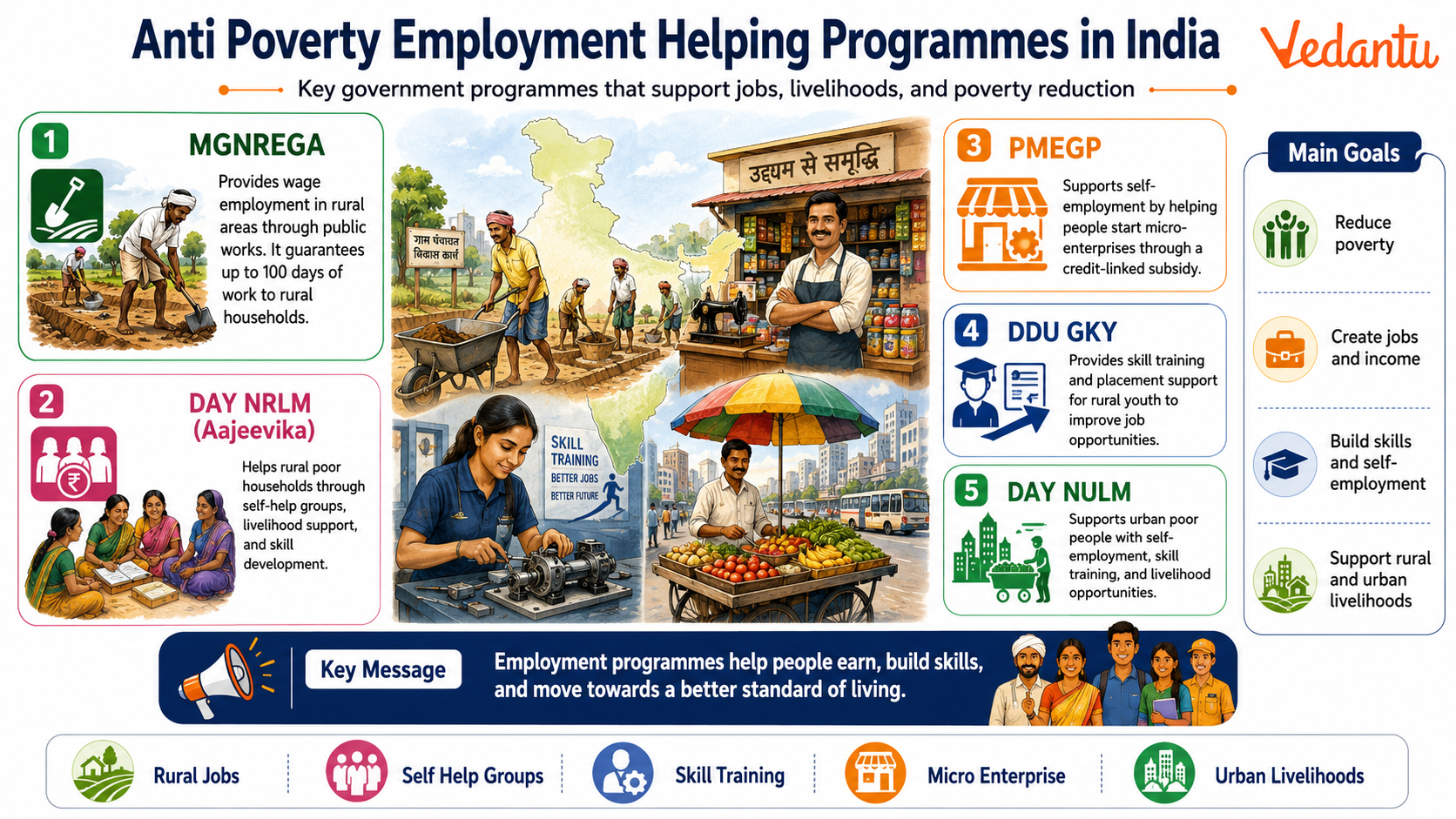
Anti Poverty Employment Helping Programmes in India are government initiatives aimed at reducing poverty by generating wage employment, promoting self-employment, and improving livelihood opportunities for the poor. These programmes focus on rural and urban populations, especially economically weaker sections, Scheduled Castes, Scheduled Tribes, women, and unemployed youth. By creating job opportunities and strengthening income sources, these schemes play a major role in inclusive growth and social justice in India.
Introduction to Anti Poverty Employment Programmes
India has faced poverty as a major socio-economic challenge since independence. A large section of the population lacked access to basic needs such as food, shelter, healthcare, and education. To address this issue, the government introduced various employment-oriented programmes that not only provide income but also create durable assets and improve infrastructure. These programmes are an important part of India's poverty alleviation strategy.
Objectives of Employment Based Poverty Alleviation Programmes
- Provide wage employment to unemployed and underemployed people.
- Promote self-employment through financial assistance and skill development.
- Create durable community assets such as roads, irrigation facilities, and housing.
- Reduce rural and urban poverty levels.
- Empower women and marginalized communities economically.
Major Anti Poverty Employment Helping Programmes in India
1. Mahatma Gandhi National Rural Employment Guarantee Act - MGNREGA
Launched in 2005, MGNREGA guarantees 100 days of wage employment in a financial year to every rural household whose adult members volunteer to do unskilled manual work. It is a rights-based programme aimed at enhancing livelihood security in rural areas.
- Legal guarantee of employment.
- Focus on rural infrastructure such as ponds, roads, and water conservation.
- Promotes transparency through social audits.
- Ensures equal wages for men and women.
2. National Rural Livelihoods Mission - NRLM
NRLM, also known as Deendayal Antyodaya Yojana - NRLM, aims to reduce poverty by promoting self-employment and organization of rural poor into Self Help Groups - SHGs. It encourages financial inclusion and skill development.
- Formation of women SHGs.
- Access to bank credit and subsidies.
- Skill training and capacity building.
- Promotion of micro-enterprises.
3. Pradhan Mantri Rozgar Yojana - PMRY
PMRY was launched to provide self-employment opportunities to educated unemployed youth. It offered financial assistance to set up small businesses and industries. Though later merged with other schemes, it played a significant role in employment generation.
4. Prime Minister Employment Generation Programme - PMEGP
PMEGP is a credit-linked subsidy programme implemented by the Ministry of Micro, Small and Medium Enterprises. It supports the establishment of micro-enterprises in rural and urban areas.
- Financial assistance through bank loans.
- Subsidy provided by the government.
- Encourages entrepreneurship among youth.
5. Swarna Jayanti Shahari Rozgar Yojana - SJSRY
SJSRY aimed at providing employment to the urban unemployed and underemployed poor. It focused on self-employment and wage employment through urban local bodies. It was later replaced by the National Urban Livelihoods Mission - NULM.
Comparison of Major Employment Programmes
| Programme | Launched | Main Focus |
|---|---|---|
| MGNREGA | 2005 | Wage employment in rural areas |
| NRLM | 2011 | Self-employment through SHGs |
| PMEGP | 2008 | Micro-enterprise development |
The above table highlights the differences in focus areas of major anti poverty employment programmes in India. While MGNREGA emphasizes wage employment, NRLM and PMEGP promote self-employment and entrepreneurship.
Impact of Employment Programmes on Poverty Reduction
Employment oriented schemes have significantly contributed to reducing poverty levels in India. They have increased rural wages, improved infrastructure, strengthened women's participation in economic activities, and promoted financial inclusion. MGNREGA has been particularly effective in providing livelihood security during economic distress and natural calamities.
Challenges Faced by These Programmes
- Delay in wage payments.
- Corruption and leakages in implementation.
- Lack of awareness among beneficiaries.
- Inadequate skill training in some regions.
Importance for Competitive Exams and General Knowledge
Anti Poverty Employment Helping Programmes in India are frequently asked topics in competitive exams such as UPSC, SSC, state PSC, and other government examinations. Students should remember the year of launch, objectives, target groups, and key features of each scheme. Understanding the difference between wage employment and self-employment schemes is essential for objective type questions.
Conclusion
Anti Poverty Employment Helping Programmes in India play a vital role in promoting inclusive growth and reducing economic inequality. By providing wage employment, encouraging entrepreneurship, and empowering marginalized communities, these schemes help improve the standard of living of millions of people. Continuous monitoring, transparency, and effective implementation are necessary to ensure that the benefits reach the needy sections of society.
FAQs on Anti-Poverty Employment Programmes in India: Overview for Students
1. What are Anti-Poverty Employment Helping Programmes in India?
Anti-poverty employment helping programmes in India are government initiatives aimed at reducing poverty by generating wage employment and self-employment opportunities.
- Focus on poverty alleviation and livelihood security
- Provide rural employment and skill-based jobs
- Target BPL families, rural poor, and urban unemployed youth
- Include schemes like MGNREGA, NRLM, and PMEGP
These programmes are key to India's inclusive growth and social welfare strategy.
2. What is MGNREGA and how does it help reduce poverty?
The Mahatma Gandhi National Rural Employment Guarantee Act (MGNREGA) guarantees 100 days of wage employment to rural households to reduce poverty.
- Launched in 2005
- Provides legal right to work
- Ensures minimum wages for unskilled labour
- Focuses on rural infrastructure development
MGNREGA strengthens rural livelihood security and reduces seasonal unemployment.
3. What is the National Rural Livelihoods Mission (NRLM)?
The National Rural Livelihoods Mission (NRLM) aims to organize rural poor into self-help groups and promote self-employment.
- Launched in 2011
- Also known as Aajeevika
- Promotes SHGs (Self-Help Groups)
- Provides skill development and financial support
NRLM enhances women empowerment and sustainable income generation in rural areas.
4. What is PMEGP and who benefits from it?
The Prime Minister’s Employment Generation Programme (PMEGP) promotes self-employment by supporting micro-enterprises.
- Launched in 2008
- Implemented by KVIC
- Provides subsidy for setting up small businesses
- Targets unemployed youth and artisans
PMEGP boosts entrepreneurship development and reduces urban and rural unemployment.
5. What was the Swarnajayanti Gram Swarozgar Yojana (SGSY)?
The Swarnajayanti Gram Swarozgar Yojana (SGSY) was a rural self-employment scheme aimed at promoting income-generating activities.
- Launched in 1999
- Focused on self-help groups
- Provided bank credit and government subsidy
- Later restructured into NRLM
SGSY played a major role in strengthening rural self-employment programmes.
6. How does the Deen Dayal Upadhyaya Grameen Kaushalya Yojana (DDU-GKY) help the poor?
The DDU-GKY is a skill development programme designed to provide employment to rural youth from poor families.
- Focuses on skill training and placement
- Targets youth aged 15–35 years
- Linked with Make in India initiative
- Provides industry-relevant training
This scheme enhances employability and reduces rural poverty through skilled jobs.
7. What is the role of urban employment schemes in poverty reduction?
Urban employment schemes help reduce poverty by supporting self-employment and wage opportunities in cities.
- Example: DAY-NULM (National Urban Livelihoods Mission)
- Promotes urban self-help groups
- Provides skill training and microfinance
- Supports street vendors and informal workers
These schemes address urban poverty and unemployment challenges.
8. Why are employment generation programmes important for economic development?
Employment generation programmes are essential because they directly increase income and reduce poverty levels.
- Improve living standards
- Reduce income inequality
- Promote sustainable development
- Strengthen rural and urban economies
Such anti-poverty schemes contribute to India’s economic growth and social stability.
9. What are the main objectives of anti-poverty programmes in India?
The main objective of anti-poverty programmes is to uplift economically weaker sections through employment and income support.
- Provide wage and self-employment
- Ensure food and livelihood security
- Promote skill development
- Empower women and marginalized communities
These initiatives aim at achieving poverty eradication and inclusive growth.
10. How have anti-poverty employment programmes impacted India?
Anti-poverty employment programmes have significantly improved rural livelihoods and reduced extreme poverty in India.
- Generated millions of person-days under MGNREGA
- Increased rural incomes and assets
- Encouraged entrepreneurship through PMEGP
- Strengthened women participation via SHGs
Overall, these schemes play a crucial role in India's poverty reduction strategy and social welfare system.
