






Major Rulers of Ancient Indian Empires and Their Cultural, Scientific, and Political Contributions
Ancient Indian Dynasties and Contributions form a crucial part of General Knowledge and Indian history. From the Indus Valley Civilization to the rise of powerful empires like the Mauryas and Guptas, ancient dynasties shaped India’s political structure, culture, economy, religion, science, art, and architecture. Understanding these dynasties is essential for students, competitive exam aspirants, and general readers because they laid the foundation of Indian civilization and influenced later historical developments.
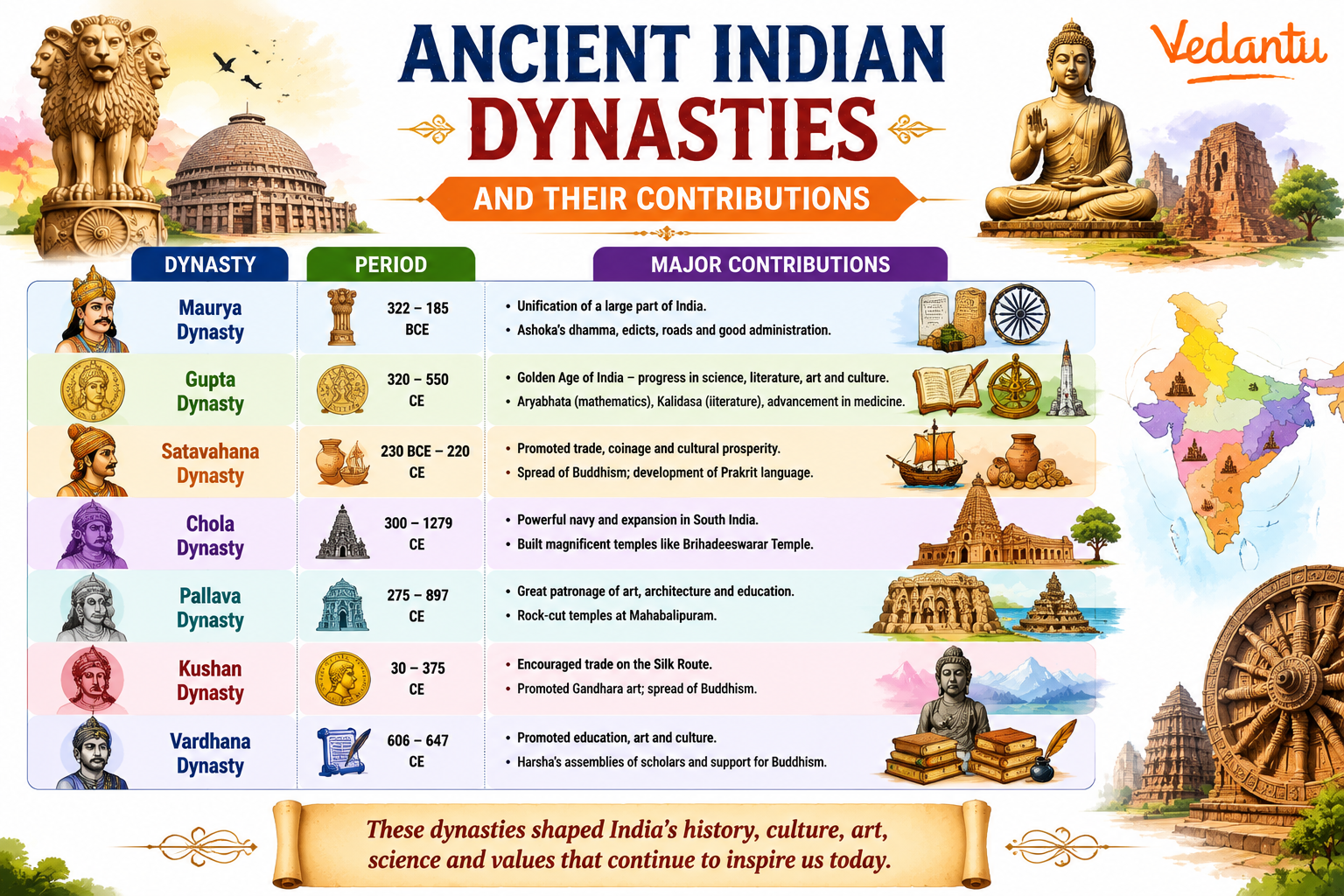
Major Ancient Indian Dynasties
Ancient India witnessed the rise and fall of several powerful dynasties. Each dynasty contributed uniquely to governance, religion, trade, literature, science, and art. Below are the most significant dynasties that shaped early Indian history.
Important Ancient Indian Dynasties Overview
| Dynasty | Time Period | Major Contribution |
|---|---|---|
| Harappan Civilization | 2600 - 1900 BCE | Urban planning and drainage system |
| Maurya Dynasty | 322 - 185 BCE | Political unification and administration |
| Gupta Dynasty | 320 - 550 CE | Golden Age of art and science |
These dynasties played a transformative role in shaping ancient Indian society, governance systems, economic practices, and cultural achievements.
Harappan Civilization
The Harappan Civilization, also known as the Indus Valley Civilization, is one of the earliest urban civilizations in the world. It flourished in northwestern India and present-day Pakistan.
Key Contributions
- Well-planned cities like Harappa and Mohenjo-daro with grid patterns.
- Advanced drainage and sanitation systems.
- Standardized weights and measures for trade.
- Seals and script indicating organized administration and trade.
Vedic Period and Later Kingdoms
The Vedic Period followed the decline of the Harappan Civilization. It marked the composition of the Vedas and the development of early social and political institutions.
Important Developments
- Formation of Janapadas and Mahajanapadas.
- Emergence of social structure known as Varna system.
- Composition of important texts like Rigveda, Samaveda, Yajurveda, and Atharvaveda.
- Rise of new religions like Buddhism and Jainism.
Maurya Dynasty
Founded by Chandragupta Maurya in 322 BCE, the Maurya Dynasty was the first empire to unify most of the Indian subcontinent. It reached its peak under Emperor Ashoka.
Major Contributions
- Centralized administrative system described in Arthashastra by Kautilya.
- Spread of Buddhism after the Kalinga War.
- Construction of pillars and stupas such as Sanchi Stupa.
- Establishment of diplomatic relations with foreign kingdoms.
Gupta Dynasty
The Gupta Dynasty is often referred to as the Golden Age of India due to remarkable progress in science, mathematics, literature, and art.
Key Achievements
- Development of decimal system and concept of zero by Aryabhata.
- Classical Sanskrit literature by Kalidasa.
- Ajanta cave paintings and temple architecture.
- Advancements in astronomy and medicine.
Other Significant Dynasties
Chola Dynasty
The Cholas were powerful rulers of South India known for naval strength and temple architecture.
- Construction of Brihadeeswara Temple.
- Strong naval trade with Southeast Asia.
- Efficient local self-government system.
Satavahana Dynasty
The Satavahanas ruled in the Deccan region and acted as a bridge between North and South India.
- Promotion of trade and commerce.
- Support to Buddhism and construction of stupas.
- Issuance of coins with bilingual inscriptions.
Cultural and Scientific Contributions
Ancient Indian dynasties made lasting contributions that influenced not only India but also the world.
- Mathematics - Invention of zero and decimal system.
- Medicine - Ayurveda and surgical techniques by Sushruta.
- Architecture - Stupas, temples, rock-cut caves.
- Literature - Epics like Ramayana and Mahabharata.
- Religion and Philosophy - Hinduism, Buddhism, Jainism development.
Importance for Competitive Exams
Ancient Indian Dynasties and their contributions are frequently asked in competitive exams such as UPSC, SSC, State PSC, Railway exams, and other government recruitment tests.
Preparation Tips
- Prepare a timeline of major dynasties and rulers.
- Focus on unique contributions of each dynasty.
- Revise important monuments and literary works.
- Practice previous year questions regularly.
Conclusion
Ancient Indian Dynasties and Contributions highlight the rich heritage and intellectual achievements of early India. From advanced urban planning in the Harappan period to scientific progress during the Gupta Age, each dynasty left a lasting legacy. A clear understanding of these dynasties helps students build a strong foundation in history and perform better in competitive examinations while appreciating the depth of Indian civilization.
FAQs on Ancient Indian Dynasties and Their Contributions to Indian Civilization
1. What were the major ancient Indian dynasties?
The major ancient Indian dynasties shaped the political, cultural, and economic foundation of early India. Key dynasties include:
• Maurya Dynasty (322–185 BCE) – Founded by Chandragupta Maurya, known for Ashoka the Great.
• Gupta Dynasty (320–550 CE) – Known as the Golden Age of India.
• Harsha’s Empire – Promoted art and religion.
• Chola Dynasty – Famous for naval power and temple architecture.
• Satavahana Dynasty – Promoted trade and Buddhism.
These dynasties contributed to Indian history, governance, art, science, and culture.
2. Why is the Maurya Dynasty important in Indian history?
The Maurya Dynasty was the first empire to unify most of India under centralized rule. Its importance includes:
• Founded by Chandragupta Maurya in 322 BCE.
• Expansion under Ashoka the Great after the Kalinga War.
• Spread of Buddhism across Asia.
• Establishment of strong administration and governance systems.
The Mauryan Empire marked the beginning of large-scale political unity in Ancient India.
3. Why is the Gupta period called the Golden Age of India?
The Gupta period is called the Golden Age of India due to advancements in science, art, literature, and mathematics. Key achievements include:
• Invention of zero and decimal system by Aryabhata.
• Flourishing of Sanskrit literature by Kalidasa.
• Progress in astronomy, medicine, and metallurgy.
• Development of classical Indian art and temple architecture.
This era represents cultural and intellectual excellence in Ancient Indian civilization.
4. What were the main contributions of the Chola Dynasty?
The Chola Dynasty significantly contributed to South Indian culture and maritime power. Major contributions include:
• Construction of the Brihadeeswara Temple at Thanjavur.
• Strong naval dominance and overseas trade with Southeast Asia.
• Efficient local self-government system.
• Promotion of Dravidian architecture and Tamil literature.
The Cholas strengthened India’s influence in the Indian Ocean region.
5. How did ancient Indian dynasties contribute to science and mathematics?
Ancient Indian dynasties encouraged major advancements in science and mathematics. Important contributions include:
• Concept of zero and decimal system.
• Works of Aryabhata in astronomy.
• Medical knowledge in Ayurveda by Charaka and Sushruta.
• Development of advanced metallurgy like the Iron Pillar of Delhi.
These innovations influenced global developments in mathematics, medicine, and astronomy.
6. What role did Ashoka play in spreading Buddhism?
Emperor Ashoka the Great played a key role in spreading Buddhism across Asia. His contributions include:
• Conversion after the Kalinga War.
• Sending missionaries to Sri Lanka, Central Asia, and Southeast Asia.
• Issuing Ashokan Edicts promoting peace and dharma.
• Building stupas and pillars.
Ashoka transformed Buddhism into a major world religion.
7. What administrative systems were followed in ancient Indian dynasties?
Ancient Indian dynasties developed structured administrative systems for governance. Key features include:
• Centralized rule under the Mauryas.
• Provincial administration with governors.
• Local self-government in the Chola Empire.
• Taxation and revenue systems.
These systems ensured political stability and efficient empire management in ancient India.
8. What were the cultural contributions of ancient Indian dynasties?
Ancient Indian dynasties enriched India’s culture, art, and heritage. Major cultural contributions include:
• Development of temple architecture (Nagara and Dravidian styles).
• Growth of Sanskrit and Tamil literature.
• Promotion of classical music and dance.
• Creation of sculptures, paintings, and inscriptions.
These contributions form the backbone of Indian cultural heritage.
9. How did trade flourish under ancient Indian dynasties?
Trade flourished due to strong political stability and maritime networks. Key points include:
• Silk Route trade during the Gupta period.
• Overseas trade by the Chola navy.
• Export of spices, textiles, and precious stones.
• Use of coins and regulated markets.
Ancient India became a major center of international trade and commerce.
10. Why are ancient Indian dynasties important for competitive exams and GK?
Ancient Indian dynasties are crucial for General Knowledge (GK) and competitive exams like UPSC, SSC, and state PSC. Important areas include:
• Questions on Maurya and Gupta rulers.
• Contributions to science, art, and religion.
• Important battles like the Kalinga War.
• Cultural and architectural achievements.
Understanding these dynasties helps in mastering Indian history, polity roots, and cultural evolution.
