







Rules and Examples of In On Under Prepositions in Sentences
A group of words that we use ahead of noun, pronoun, or noun phrase to represent direction, time, place, location, spatial relationships, or even introduce an object are called prepositions. Some of the examples of prepositions are in, under, on, at, etc. Now, let us know the use of in on under with certain examples.
We can relate prepositions to our real-life experiences and then frame our own sentences. Prepositions can be of various types depending on the type of sentence you form.
Now, to understand what prepositions are, we will go through individual poems or stories on three prepositions - in, on, and under. Also, we will go through some more examples to understand prepositions in detail.
Poem of a Preposition ‘In’ - Little By Little
Here, we have to determine prepositions by highlighting the ‘in’ preposition.
Little by Little Poem
“Little by little,” an acorn said,
As it slowly sank in its mossy bed;
“I am improving every day,
Hidden deep in the earth away."
Little by little each day it grew,
Little by little, it sipped the dew.
Downward it sent out a thread-like root
Up in the air sprang a tiny shoot;
Day by day, and year by year,
Little by little the leaves appear,
And the slender branches spread far and wide
Till the mighty oak is the forest’s pride.
Story on a Preposition - On
One day, Jiya was sitting on the bench and wondering how beautiful is everything around me. It is really great to see birds sitting on the branches of the tree and a dog laying on the ground. I wish to remain here for my entire life.
Story on a Preposition - Under
One day, I found a cat under the tree. I was very upset to see her crying. A few days ago, this cat was sitting inside the box and four boys driving harshly killed her mother. Now, this cat is under trauma and she really needs a lot of care and attention. Now, she is my friend and the best buddy ever.
Examples of Preposition - In, On, and Under
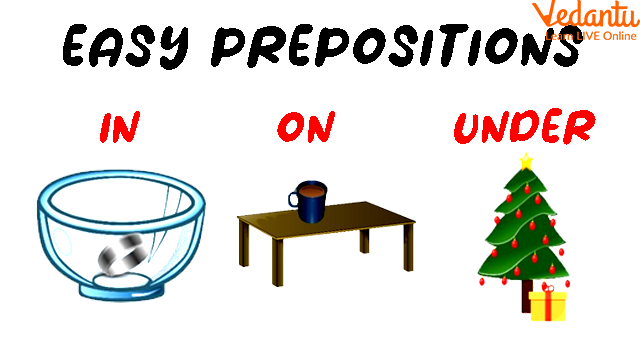
Easy examples of prepositions
Preposition of Direction
These types of prepositions tell us about the location or direction of a person or thing in relation to another one.
To - The route of Shanvi Express from Haldwani to Delhi is changed from Bareilly to Delhi.
Into - Please put the dirty utensil into the dishwasher.
In - Please leave the door ajar when you are not in your room.
On - The bus is on time.
Onto - The apple fell onto the floor.
Preposition of Time
These types of prepositions give us an idea of the month, year, week, certain time during the day or a longer period of time in the past.
She goes for a walk in the evening.
The weather is hot in June.
Meghan was born in 1996.
You make noises in the morning.
I go to my office at 9: 00 a.m.
She eats lunch in the office hour.
She loves to walk in the night.
Kids go to bed at night.
I complete my homework on Sundays
He goes to meet his friend on Wednesdays.
Example on Miscellaneous Prepositions
Sheena can sit before the desktop (or in front of the desk). The teacher can lay on the table (when she's being informal) or behind the table, and then her feet are under the chair or beneath the chair. She can stand behind the classroom door (meaning next to the desk), before the table, between the desk and you, or even on the desk (if she's a strange woman).
If she's fat, he can bump into the desk or try to move through the table. Passing her hands over the table resting her hands upon the desk, she often looks across the classroom and speaks as if there were nothing else like the classroom table. It’s because sometimes she wonders about her home, and how to reach there on time. Lastly, she leans against the desk and sleeps.
So, this was all about the use of in on under. Going through this article will help you understand this topic clearly. To learn more about such interesting topics of English grammar, you can check out our website and choose from the numerous articles provided for kids concerning, stories, poems, Maths, English Grammar, etc.
FAQs on Use of In On Under Prepositions in English Grammar
1. What is the difference between in, on, and under in English?
The difference between in, on, and under is that in shows something inside, on shows something touching a surface, and under shows something below another object.
- In = inside a space (The keys are in the bag.)
- On = touching a surface (The book is on the table.)
- Under = below something (The cat is under the chair.)
2. How do you use in as a preposition of place?
You use in to show that something is inside a closed or defined space.
- Rooms, buildings, containers: She is in the room.
- Cities and countries: They live in Canada.
- Boxes or bags: The gift is in the box.
3. When should I use on in a sentence?
You should use on when something is touching or resting on a surface.
- Tables, walls, floors: The phone is on the desk.
- Pages or screens: There is a mistake on the page.
- Streets: She lives on King Street.
4. How is under used in English grammar?
The preposition under is used to show that something is below or covered by something else.
- Position: The shoes are under the bed.
- Cover: He sat under a tree.
- Age or amount (less than): Children under 12 enter free.
5. What are the rules for using in, on, and under with time and place?
The basic rule is that in is used for larger areas or longer periods, on for surfaces and specific dates, and under for lower position or less than a number.
- In time: in July, in 2025
- On time: on Monday, on 5th June
- Under numbers: under 18 years old
6. Can you give simple examples of in, on, and under in sentences?
Yes, simple examples help understand how in, on, and under work in context.
- The milk is in the fridge.
- The keys are on the table.
- The dog is sleeping under the bed.
7. Why do learners confuse in and on in English?
Learners confuse in and on because both describe location, but one means inside and the other means on a surface.
- In = enclosed space (in a box)
- On = surface contact (on a box)
8. Is it in the bus or on the bus?
We usually say on the bus because public transport is treated as a surface or platform in English usage.
- On the bus
- On the train
- On the plane
9. What is the difference between under and below?
The difference is that under often implies direct coverage or contact, while below simply means at a lower level.
- The cat is under the table. (directly beneath it)
- The temperature is below zero. (lower level, not physical contact)
10. How can I remember the correct use of in, on, and under?
You can remember the correct use by linking each preposition to a simple visual rule: inside, surface, and below.
- In = inside a box
- On = on top of a box
- Under = under the box
