







How to Improve Handwriting Practice in Key Stage 2 with Letter Formation and Fluency Techniques
This content is written in regards to the parents and the teachers who are willing to teach their kids good handwriting. By the end of the 5th year, your child will be reaching the level of handwriting practice ks2, meaning the handwriting practice done in key stage 2.
In year 5, your child will gradually inherit a fluent style of writing. Their writing will change in different contexts. In this time, your child will require assistance and support to practise efficiently. In this context, we will be presenting a draft of guidance that might help you in supporting your child.
What Will Your Kids Learn?
In the 5th year, that is when your child will be of ages 9 to 10, they will enhance their style of writing. In this stage, they will identify their handwriting and will try to improve it or they will try to reach a definite style of writing. During this time, a kid should know how to:
Choose the shape of a specific letter, meaning its style and eliminate those styles which do not favour them or are not clear enough. Here, as parents or teachers, you need to encourage your child to pick up their unique style of writing and discourage them to write untidily.
Choose the writing style which is best suited for the particular requirement. Here the students or kids should understand what type of writing tone they should acquire in different situational writing.
Help Starts from Home - Simple Tips for Handwriting Practice ks2 at Home
In this section, we will be discussing how you can help your kids at home in handwriting practice ks2. We present our ideas as below:
1. Art and craft to make their handwriting practice interesting -
A child practising handwriting with different crayons
Your child will love art and colour. Thus, take advantage of this and make them do their handwriting practice sometimes with chalk, colour, crayons, and even paintbrushes. You will be amazed to see them exploring their writing style.
Make them use slate and pencil to make them practice handwriting as they can erase innumerable times without wasting any paper.
Also, another way to intensify their interest in handwriting practice is to make them write on sand or the ground with sticks. While doing these activities make sure that your child does not hold the bad habit of writing on the walls.
2. Writing is next to reading and learning -
After they practise regular handwriting books, they can practise writing from magazines or non-fictional texts. This will help them to evolve in an all-round manner. With the practice of writing, they will also gain experience in reading in a real-world context. This will help them to stay connected with current affairs and other general knowledge content.
You can also encourage your kids to make national assessments where they will develop their learning about the different formats and text sizes of presentations. Give as many good books with good writing format, your child will grasp the writing techniques used there.
3. Keep on writing-
Make your child write every day. They can write the grocery list for you while you dictate them, they can write invitation letters for the guests while you organise a simple tea party, even they can start their every day with a good morning quote. Just concentrate on what writing excites your child, follow that religiously so that they can be good at handwriting.
Make sure your child is writing on a consistent basis and not only as homework or assignment.
Bonus Round - Activities for Your Child
Following are some activities that you can implement on your child as a part of handwriting practice ks2.
Activity 1:
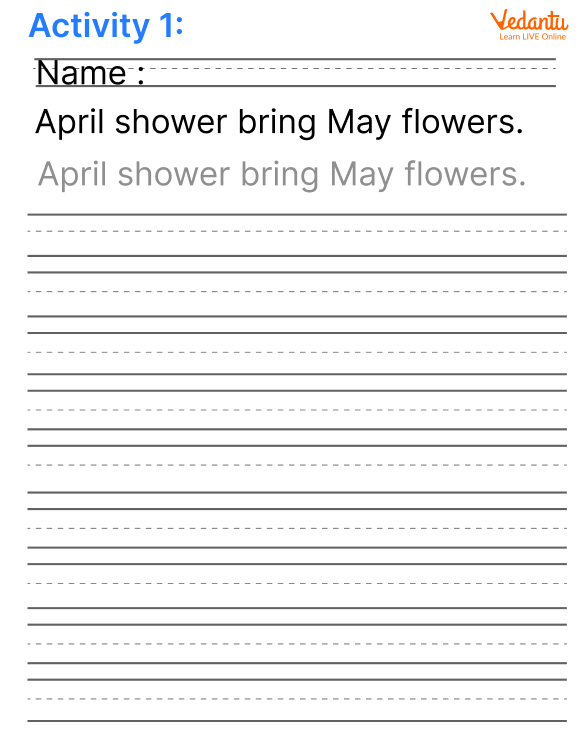
A sentence to practice handwriting
You can print this paper given above and make your child practice handwriting.
Activity 2:
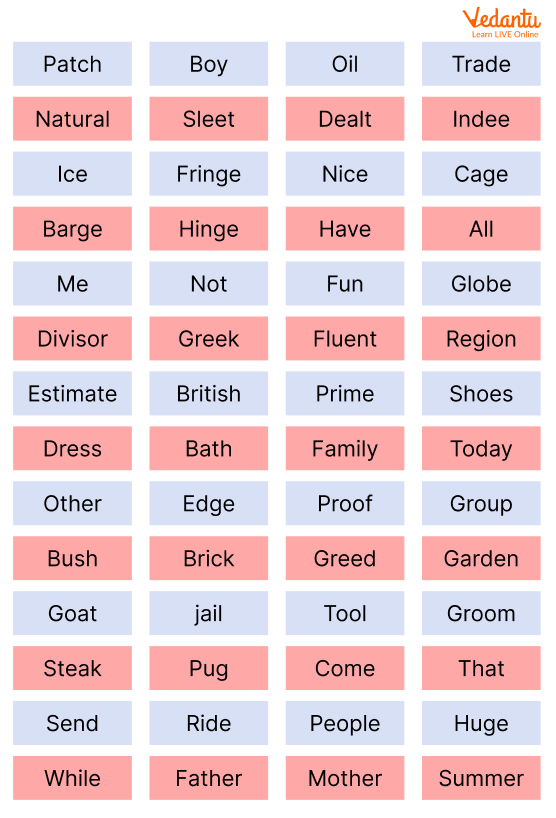
56 words for handwriting practice
Dictate these 56 words to check the handwriting of your child.
In order to help your child in the writing process, it is very important for you to keep a vigilant check on your child’s writing progress. Track the progress of your child and level it up further. This was based on the handwriting practice ks2; for further practice, you can download or purchase various handwriting books and make your child write on them.
FAQs on Handwriting Practice for Key Stage 2 Pupils
1. What is handwriting practice in Key Stage 2?
Handwriting practice in Key Stage 2 (KS2) focuses on improving pupils’ joined handwriting, consistency, and presentation. In Years 3–6, children are expected to write fluently and legibly using a neat, consistent style.
- Develop clear, correctly sized letters
- Use consistent spacing between words
- Join letters accurately and smoothly
- Write at a steady speed for longer tasks
2. What are the handwriting expectations for KS2?
In KS2, pupils are expected to write legibly, fluently, and with increasing speed using joined handwriting. According to the National Curriculum, children should:
- Form letters correctly and consistently
- Use diagonal and horizontal strokes to join letters
- Maintain appropriate letter size and spacing
- Ensure writing is neat and presentation is clear
3. How can I improve my child’s handwriting in KS2?
You can improve a child’s KS2 handwriting by practising letter formation, joins, and spacing regularly. Effective strategies include:
- Daily short handwriting practice sheets
- Tracing then free-writing sentences
- Practising tricky letter joins such as br, th, and ing
- Encouraging correct pencil grip and posture
4. Why is joined handwriting important in Key Stage 2?
Joined handwriting is important in KS2 because it increases writing speed and fluency. When letters are joined correctly:
- Writing becomes smoother and quicker
- Spelling patterns are reinforced visually
- Work looks neater and more consistent
5. What are the common handwriting mistakes in KS2?
Common KS2 handwriting mistakes include incorrect letter formation, inconsistent sizing, and poor spacing. Frequent issues are:
- Letters floating above or below the line
- Capital letters used mid-word
- Uneven gaps between words
- Incorrect joins between letters
6. How often should children practise handwriting in KS2?
Children in KS2 should practise handwriting briefly but regularly, ideally 3–5 times a week. Short sessions of 10–15 minutes can focus on:
- Letter formation drills
- Practising specific joins
- Copying sentences or paragraphs
7. What is the correct pencil grip for KS2 handwriting?
The correct pencil grip for KS2 handwriting is the tripod grip, where the pencil is held between the thumb and index finger and supported by the middle finger. A proper grip:
- Allows better control of letter formation
- Reduces hand fatigue
- Improves neatness and consistency
8. How do you teach letter joins in KS2?
Letter joins in KS2 are taught by modelling correct strokes and practising common joining patterns. Teachers typically:
- Demonstrate joins on lined paper or a whiteboard
- Group letters by join type (e.g. diagonal joins to letters like a, o)
- Provide guided and independent practice
9. How can handwriting practice support spelling and grammar in KS2?
Handwriting practice supports spelling and grammar by reinforcing correct word patterns and sentence structure. When pupils write neatly and fluently:
- They remember spelling patterns such as -tion and -ous
- They focus more easily on punctuation and capital letters
- Their written sentences are clearer to read and edit
10. What are good handwriting activities for Key Stage 2?
Good KS2 handwriting activities combine skill practice with meaningful writing tasks. Effective activities include:
- Copying short poems or extracts
- Writing spelling lists in joined script
- Sentence dictation exercises
- Creative writing with a focus on neat presentation
