









What Happens When Alcohol Reacts with Oxygen Complete Combustion Reaction Equation and Products
Alcohols are organic compounds, and they can be easily extracted from natural sources through the process of distillation. Alcohols are used to manufacture sanitiser, perfumes, and sweeteners and to prepare several chemical compounds. Ethyl alcohol is used as a solvent for many compounds, as it helps in dissolving polar, nonpolar, hydrophilic, and hydrophobic compounds as it acts as a universal solvent. On oxidation, alcohols produce aldehydes and ketones, which on further oxidation, produce carboxylic acid.
Water is a compound made of elemental hydrogen and oxygen. H2O is a chemical formula of water. It is a tasteless and odourless liquid. It is believed that the first life originated in water. It is one of the best solvents for inorganic compounds. To know more about alcohol and water, continue reading this article.
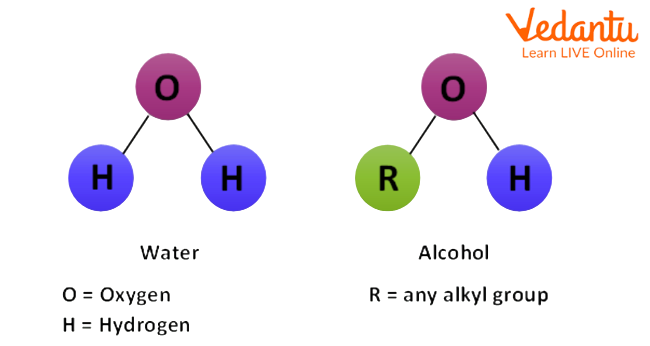
Molecular Structure of Water and Alcohol
Classification of Alcohol
Alcohols are mainly classified into primary, secondary and tertiary alcohols based on the chain of hydrocarbons (alkyl group) to the hydroxyl group attached.
1. Primary Alcohols
Primary alcohols are the alcohols in which only one alkyl substituent is attached to the carbon-containing hydroxyl (-OH) group; methanol also comes under this classification. The general formula of a primary alcohol is- R—CH2—OH, where R can be any alkyl group or hydrogen.
Examples of primary alcohols are-
CH3—OH (methanol)
CH3—CH2—OH (ethanol)
CH3— CH2— CH2—OH (propan-1-ol)
CH3— CH(CH3)— CH2— CH2—OH (3-methylbutan-2-ol)
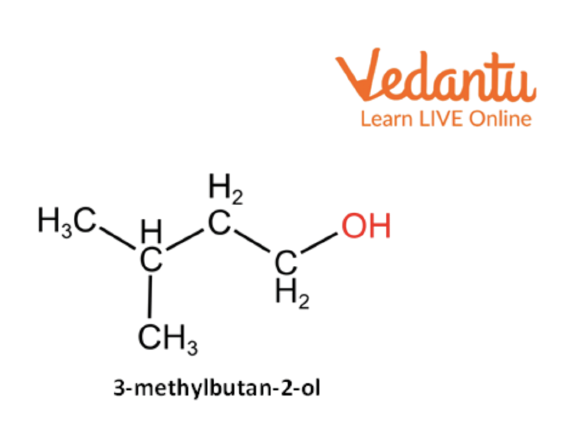
3-Methylbutan-2-ol
2. Secondary Alcohols
Secondary alcohols are the alcohols in which two alkyl substituents are attached to the carbon-containing hydroxyl (-OH) group. The general formula of secondary alcohol is- R2—CH—OH, where R can be any alkyl group.
Examples of secondary alcohols are-
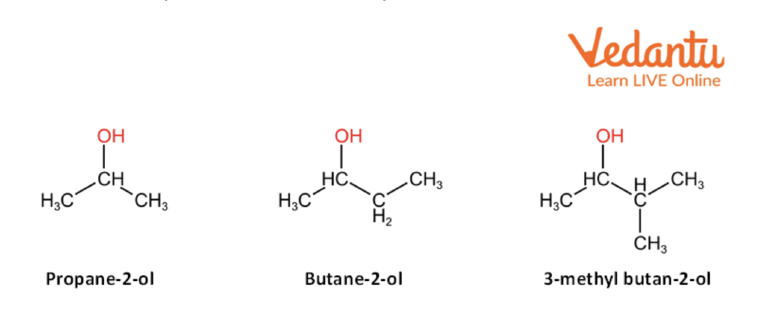
Secondary Alcohol
3. Tertiary Alcohols
Tertiary alcohols are the alcohols in which three alkyl substituents are attached to the carbon-containing hydroxyl (-OH) group. The physical properties of tertiary alcohols are primarily dependent on their structure. The general formula of tertiary alcohol is- R3—C—OH, where R can be any alkyl group.
Examples of tertiary alcohols are-
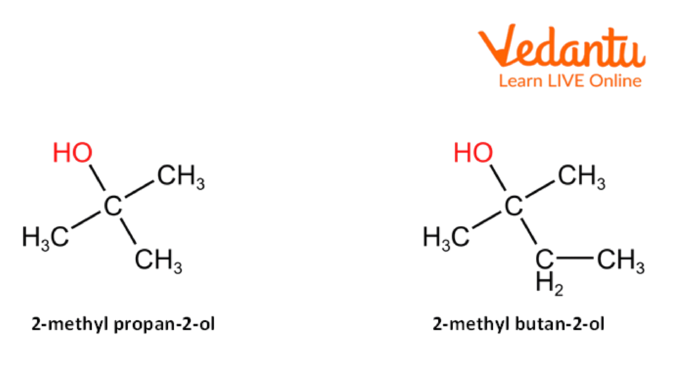
Tertiary Alcohol
4. Aromatic Alcohols (Phenols)
Phenols are the alcohols in which the hydroxyl (-OH) group is directly attached to the aromatic ring. Phenols are acidic due to the presence of an aromatic ring.
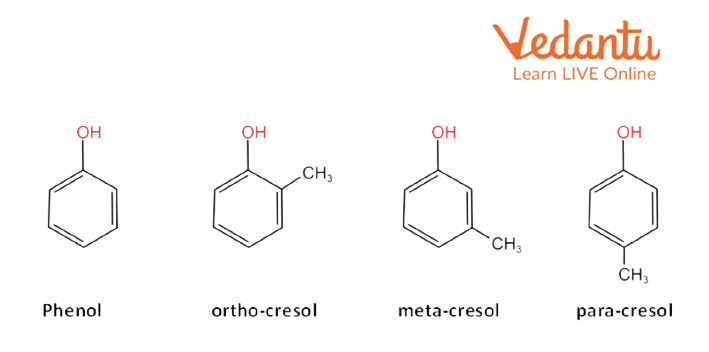
Aromatic Alcohol
Physical Properties of Alcohol
1. State: Generally, all alcohols are liquid at room temperature, but glycerol is a viscous liquid.
2. Colour: Alcohols are primarily colourless liquids.
3. Odour: Alcohols generally possess a sweet smell except for some lower alcohols and glycerol.
4. Boiling Point: They have a comparatively higher boiling point than other hydrocarbons of the same weight. Because intermolecular hydrogen bonding is present in the molecules of alcohol between the hydroxyl group. The boiling point of alcohol increases with the number of carbons in the hydrocarbon chain.
5. Flammability: Alcohols are flammable as they have a blue-coloured flame.
6. Nature: Alcohols act as weak acids as well as weak bases
7. Solubility in Water: Alcohols are soluble in water
8. Alcohol does not produce smoke while burning, and hence they, are also used as a fuel.
Physical Properties of Water
The following are some of the important physical properties of water:
Appearance: water is odourless, colourless and tasteless liquid.
Specific heat capacity of water: water has a high specific heat capacity due to extensive hydrogen bonds.
The density of water: The density of water varies with temperature.
The viscosity of water: The viscosity of water is 0.89 centipoise.
Surface tension: water has high surface tension.
Reaction of Ethanol with Air
When ethanol is burnt in the air it produces water and carbon dioxide.
CH3CH2OH(l)+3O2(g) → 2CO2(g)+3H2O(g)+Heat
Alcohols are highly flammable and are also used as a fuel.
When 2 moles of ethanol are burnt, carbon dioxide obtained is 4 moles and
When 2 moles of ethanol are burnt, CO2 obtained is 4 moles.
Interesting Facts
Drinking alcohol reduces the sugar level in the blood.
Drinking alcohol in small amounts can help us against heart disease, and it reduces the risk of heart disease.
Alcohol is used as a disinfectant and antiseptic, and it is also used in mouthwashes and sanitisers.
It is also used for the crystallisation of several compounds during laboratory preparations of these compounds.
Important Questions
1. Why is the boiling point of alcohol more than other hydrocarbons?
The boiling point of alcohol is more than other hydrocarbons because of hydrogen bonding in the molecules of the alcohols. Due to the high electronegativity of Oxygen, the shared pair of electrons shifts towards oxygen, creating a partial negative charge on oxygen and a partial positive charge on hydrogen. Which results in hydrogen bonding between hydroxyl groups of alcohol hence increasing the boiling point of alcohol.
2. What is glycerol?
Glycerol is a trihydroxy alcohol containing three hydroxyl groups on three different carbons of the same chain. The IUPAC name of glycerol is propane-1,2,3 triol. The structure of glycerol is-
Key Features
Alcohols are organic compounds containing at least one hydroxy (-OH) group. Alcohol burning in the presence of oxygen produces a large amount of energy, and hence alcohols are used as a fuel.
It can be used in chemical laboratories to form several compounds like carboxylic acid, aldehyde, ketone, alkene, and alkyl halides.
Alcohol is also a drug and is present in alcoholic beverages, which in smaller quantities is good for health, but in larger quantities, it is toxic. Alcohol is used as a sweetener in the food industry.
When ethanol is burnt in Oxygen it produces water and carbon dioxide.
FAQs on Alcohol and Oxygen Reaction in Organic Chemistry
1. What happens when alcohol reacts with oxygen?
When alcohol reacts with oxygen, it undergoes combustion or oxidation to form carbon dioxide and water or partially oxidized products. In complete combustion of ethanol, the balanced equation is: C2H5OH(l) + 3O2(g) → 2CO2(g) + 3H2O(l).
- This reaction is exothermic and releases heat and light.
- If oxygen supply is limited, incomplete combustion may produce CO(g) instead of CO2.
- In controlled oxidation, alcohols form aldehydes, ketones, or carboxylic acids.
2. What is the balanced equation for ethanol reacting with oxygen?
The balanced equation for complete combustion of ethanol is C2H5OH(l) + 3O2(g) → 2CO2(g) + 3H2O(l).
- 2 carbon atoms form 2CO2.
- 6 hydrogen atoms form 3H2O.
- Total oxygen atoms are balanced on both sides.
3. Is the reaction between alcohol and oxygen exothermic or endothermic?
The reaction between alcohol and oxygen is exothermic because it releases heat energy during combustion. For example, ethanol burning in air produces heat and a blue flame according to: C2H5OH + 3O2 → 2CO2 + 3H2O.
- Chemical bonds in CO2 and H2O are more stable.
- Energy released is greater than energy absorbed.
- This is why alcohols are used as fuels.
4. What is oxidation of alcohol by oxygen?
Oxidation of alcohol by oxygen is the chemical process in which an alcohol loses hydrogen or gains oxygen to form aldehydes, ketones, or acids. Examples include:
- Primary alcohol: Ethanol → Ethanal → Ethanoic acid.
- Secondary alcohol: Propan-2-ol → Propanone.
- Tertiary alcohol: Generally resistant to mild oxidation.
5. What are the products of complete combustion of alcohol?
The products of complete combustion of alcohol are carbon dioxide (CO2) and water (H2O). For ethanol, the balanced reaction is: C2H5OH(l) + 3O2(g) → 2CO2(g) + 3H2O(l).
- Occurs in excess oxygen.
- Produces a clean blue flame.
- Releases significant heat energy.
6. What is the difference between complete and incomplete combustion of alcohol?
The difference between complete and incomplete combustion of alcohol is the amount of oxygen available and the products formed.
- Complete combustion: Excess O2, forms CO2 and H2O.
- Incomplete combustion: Limited O2, forms CO and/or C (soot) plus H2O.
7. How do you balance the combustion equation of an alcohol?
To balance the combustion equation of an alcohol, balance carbon, hydrogen, and then oxygen atoms in that order.
- Step 1: Balance C atoms to form CO2.
- Step 2: Balance H atoms to form H2O.
- Step 3: Balance O atoms using O2.
C2H5OH + 3O2 → 2CO2 + 3H2O.
8. Why does alcohol burn with a blue flame?
Alcohol burns with a blue flame because it undergoes clean, complete combustion with sufficient oxygen. The reaction forms mainly CO2 and H2O without producing glowing carbon particles.
- No soot formation.
- Efficient oxidation.
- Typical of ethanol and methanol fuels.
9. Can alcohol react with oxygen at room temperature?
Alcohol does not rapidly react with oxygen at room temperature without a catalyst or ignition source. Combustion requires activation energy such as a spark or flame.
- At room temperature, oxidation is very slow.
- Biological oxidation occurs in the body via enzymes.
- Industrial oxidation uses catalysts.
10. What is the general formula for alcohol combustion?
The general combustion equation for a monohydric alcohol (CnH2n+1OH) is CnH2n+1OH + \(\frac{3n}{2}\)O2 → nCO2 + (n+1)H2O.
- n represents the number of carbon atoms.
- Applies to primary, secondary, and tertiary alcohols.
- Produces CO2 and H2O in complete combustion.
