







Saint Francis Of Assisi Early Life Spiritual Mission and Contributions to the Church
Saint Francis of Assisi was a 13th-century Italian Catholic friar, preacher, and founder of the Franciscan Order. He is widely known for his deep love for nature, commitment to poverty, humility, and service to the poor. His life marked a turning point in Christian spirituality, as he chose a path of simplicity and compassion at a time of growing wealth and power in medieval Europe. The Saint Francis of Assisi biography is important for students because it teaches values such as kindness, selflessness, respect for nature, and dedication to peace.
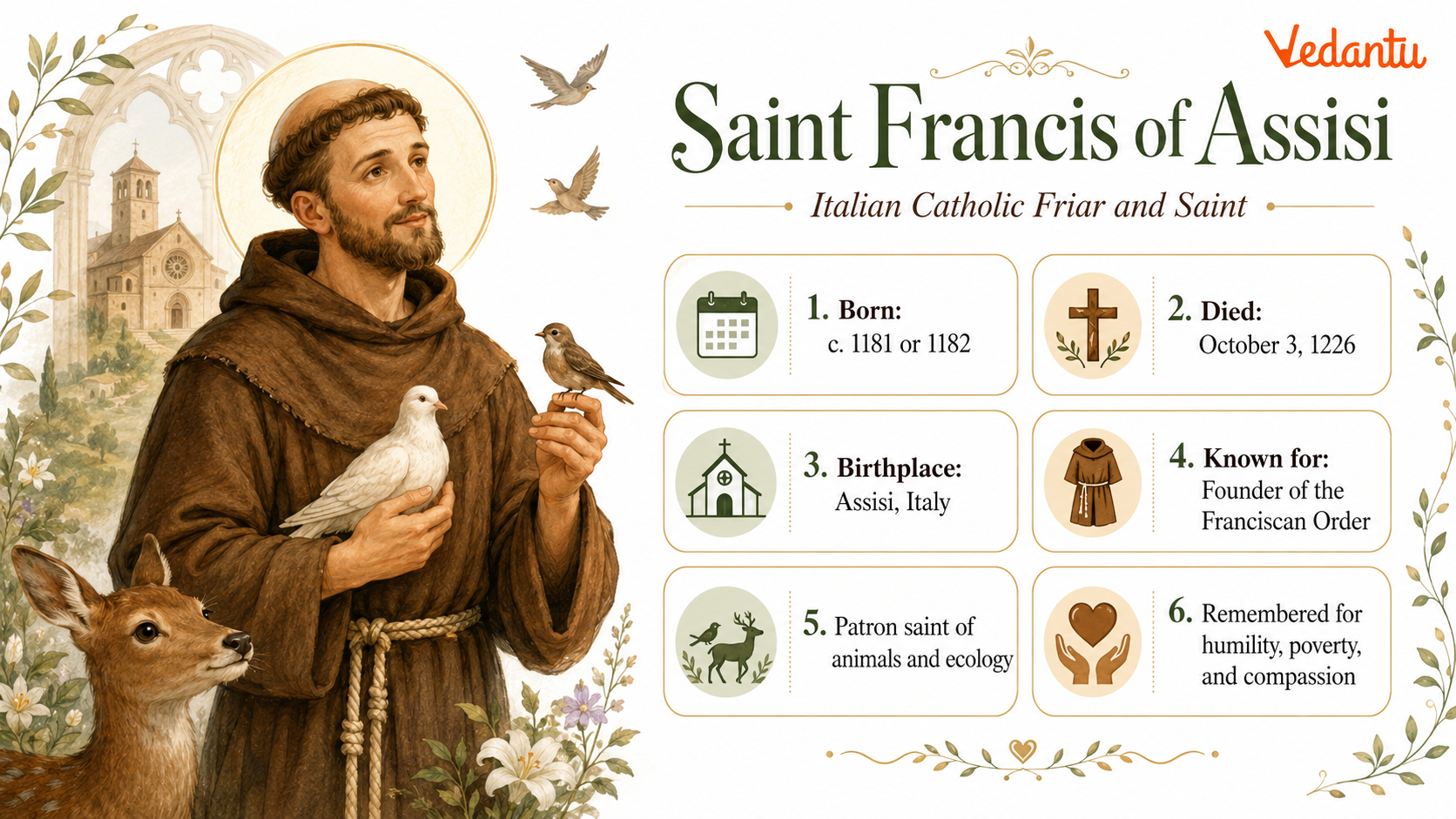
Basic Information About Saint Francis of Assisi
| Particulars | Details |
|---|---|
| Full Name | Giovanni di Pietro di Bernardone |
| Popular Name | Saint Francis of Assisi |
| Birth | 1181 or 1182, Assisi, Italy |
| Death | 3 October 1226, Assisi, Italy |
| Nationality | Italian |
| Known For | Founder of the Franciscan Order, Love for Nature, Life of Poverty |
| Canonised | 1228 by Pope Gregory IX |
Who is Saint Francis of Assisi?
Saint Francis of Assisi was a Catholic friar, preacher, and religious reformer from Italy. He founded the Order of Friars Minor, commonly known as the Franciscans. He is remembered for living a life of complete poverty, serving the poor and sick, and promoting peace and harmony. He is also known as the patron saint of animals and the environment. The Saint Francis of Assisi life history is studied worldwide because of his spiritual influence and humanitarian values that continue to inspire millions of people.
Early Life and Family Background
The Saint Francis of Assisi early life reflects a dramatic transformation from a wealthy young man to a humble servant of God.
- Born in 1181 or 1182 in Assisi, a small town in Italy.
- His birth name was Giovanni di Pietro di Bernardone.
- His father, Pietro di Bernardone, was a wealthy cloth merchant.
- His mother, Pica, was of French origin.
- He grew up in comfort and enjoyed music, poetry, and social gatherings.
As a young man, Francis dreamed of becoming a knight. However, after experiencing illness and being held captive during a local war, his outlook on life began to change. These experiences played a key role in shaping his spiritual journey.
Education and Early Interests
Saint Francis received basic education in reading, writing, and arithmetic, which was common for children of wealthy families at that time.
- He learned some French because of his mother’s background.
- He showed interest in poetry and songs of the troubadours.
- He was admired for his cheerful nature and generosity among friends.
Although he did not pursue formal higher education, his spiritual learning and deep reflection later made him one of the most influential religious figures in history.
Career Journey and Major Life Events
Spiritual Awakening
After returning from war and suffering illness, Francis began to question his previous lifestyle. He spent time in prayer and reflection. A turning point came when he felt called by God to rebuild a ruined church in Assisi.
Renunciation of Wealth
In a public act, Francis gave up his inheritance and wealth, choosing to live in poverty. He began preaching about repentance, simplicity, and love for all living beings.
Founding of the Franciscan Order
In 1209, he founded the Order of Friars Minor. The members lived simple lives, served the poor, and spread the message of peace. The order was officially approved by the Pope.
Missionary Work
Francis travelled across Italy and even visited Egypt during the Crusades to promote peace and dialogue. His humble and loving approach won respect from many people.
Timeline of Important Events
| Year | Event |
|---|---|
| 1181 or 1182 | Born in Assisi, Italy |
| 1202 | Captured during a war between Assisi and Perugia |
| 1209 | Founded the Order of Friars Minor |
| 1212 | Helped establish the Order of Poor Clares with Saint Clare |
| 1224 | Received the stigmata, marks resembling Christ’s wounds |
| 1226 | Died in Assisi, Italy |
| 1228 | Canonised as a saint |
Major Achievements of Saint Francis of Assisi
- Founded the Franciscan Order, which spread across Europe.
- Established the Poor Clares with Saint Clare.
- Promoted peace during the time of the Crusades.
- Canonised as a saint just two years after his death.
- Recognised as the patron saint of animals and ecology.
Contributions of Saint Francis of Assisi
Contribution to Religion
- Revived spiritual life within the Church through simplicity and humility.
- Encouraged living according to the teachings of Jesus Christ.
Contribution to Society
- Served lepers and the poor with compassion.
- Promoted peace and brotherhood among people.
Contribution to Environment
- Taught respect for nature and animals.
- Inspired modern environmental movements.
Ideology, Thoughts, and Values
The teachings of Saint Francis were based on love, humility, and service.
- Poverty - Living without material possessions.
- Compassion - Serving the sick and poor.
- Peace - Promoting harmony even during conflicts.
- Respect for Nature - Treating animals and the environment with care.
Challenges and Struggles
- Opposition from his family after giving up wealth.
- Physical illness in later years.
- Difficulty in maintaining discipline within the growing Franciscan Order.
- Facing hardships while serving lepers and the poor.
Famous Works and Movements
| Work / Movement | Importance |
|---|---|
| Franciscan Order | Religious order focused on poverty and service |
| Poor Clares | Order for women devoted to prayer and simplicity |
| Canticle of the Sun | Religious hymn praising God and nature |
Later Life and Death
In his later years, Saint Francis suffered from illness and blindness. In 1224, he reportedly received the stigmata, wounds resembling those of Jesus Christ. He died on 3 October 1226 in Assisi. Two years later, he was declared a saint by the Church. His tomb in Assisi remains a place of pilgrimage.
Legacy and Historical Significance
- One of the most beloved saints in Christian history.
- Inspired the global Franciscan movement.
- Declared patron saint of ecology.
- His life continues to inspire peace movements and environmental awareness.
Lessons Students Can Learn from Saint Francis of Assisi
- Value simplicity over material wealth.
- Show kindness to all living beings.
- Practice humility and service.
- Work for peace and harmony.
- Care for the environment.
Quick Facts About Saint Francis of Assisi
| Particulars | Details |
|---|---|
| Full Name | Giovanni di Pietro di Bernardone |
| Birth | 1181 or 1182 |
| Death | 3 October 1226 |
| Field | Religion and Social Service |
| Major Contribution | Founder of the Franciscan Order |
| Patronage | Animals and Ecology |
Interesting Facts About Saint Francis of Assisi
- He is often shown in art surrounded by birds and animals.
- He gave up his rich lifestyle at a young age.
- He travelled to Egypt during the Crusades to promote peace.
- His feast day is celebrated on 4 October.
- He wrote the Canticle of the Sun, one of the earliest works of Italian literature.
- Many schools, churches, and organisations are named after him.
Conclusion
The Saint Francis of Assisi biography teaches timeless lessons of love, humility, and service. From a wealthy young man to a devoted servant of humanity, his transformation remains inspiring. His commitment to peace, care for the poor, and respect for nature made him one of the most respected spiritual leaders in history. The life and legacy of Saint Francis continue to guide people toward compassion, simplicity, and harmony with the world.
FAQs on Saint Francis Of Assisi Life History Achievements and Legacy
Saint Francis of Assisi was a 13th-century Italian Catholic friar and preacher known for his life of poverty, humility, and love for nature. Born in 1181/1182 in Assisi, Italy, he founded the Franciscan Order and became one of the most respected figures in Christian history. His biography highlights his spiritual transformation, charitable works, and deep compassion for the poor and all living beings.
Saint Francis of Assisi is famous for renouncing wealth and dedicating his life to poverty, peace, and service to humanity. He is widely known for:
- Founding the Order of Friars Minor (Franciscans)
- His love for animals and nature
- Receiving the stigmata in 1224
- Promoting peace during the Crusades
His life history made him one of the most beloved saints in Christian tradition.
The early life of Saint Francis of Assisi was marked by comfort and privilege before his spiritual transformation. He was born to Pietro di Bernardone, a wealthy cloth merchant, and grew up enjoying luxury, fine clothes, and social life. As a young man, he dreamed of becoming a knight, but after experiencing illness and imprisonment during a local war, he began questioning his life’s purpose, which led to his spiritual awakening.
Saint Francis of Assisi received basic education typical of a merchant’s son in medieval Italy. He learned reading, writing, and some Latin, mainly to assist in his father’s business. However, his biography shows that his real learning came from spiritual reflection, prayer, and practical service rather than formal academic education.
The major achievements of Saint Francis of Assisi center around religious reform and spiritual leadership. His key achievements include:
- Founding the Franciscan Order in 1209
- Establishing the Order of Poor Clares with Saint Clare of Assisi
- Receiving papal approval from Pope Innocent III
- Being canonized as a saint in 1228
These achievements shaped Christian spirituality and church history.
Saint Francis of Assisi contributed significantly to religious life through his teachings on poverty, humility, and care for creation. His main contributions include:
- Promoting voluntary poverty and simple living
- Encouraging compassion for the poor and sick
- Strengthening missionary and preaching traditions
- Inspiring environmental awareness within Christian theology
His contributions continue to influence social service and spiritual movements worldwide.
The life history of Saint Francis of Assisi includes several personal and social challenges. He faced strong opposition from his father after renouncing wealth and publicly gave up his inheritance. He also struggled with illness, physical suffering, and the difficulties of leading a rapidly growing religious order. Despite these struggles, he remained committed to his spiritual mission and reforms.
Saint Francis of Assisi is known for several important religious writings and prayers. His famous works include:
- Canticle of the Sun (also called Canticle of Brother Sun)
- The Rule of the Friars Minor
- Various prayers and letters
These writings reflect his deep love for God, humanity, and nature, and are studied in religious and literary contexts.
Saint Francis of Assisi was canonized as a saint by Pope Gregory IX in 1228, just two years after his death in 1226. He is also recognized as the Patron Saint of Animals and the Environment. His feast day is celebrated on 4 October, and he is one of the most venerated saints in Christian history.
The legacy of Saint Francis of Assisi lies in his example of simplicity, peace, and universal brotherhood. His biography remains significant for:
- Inspiring the global Franciscan Movement
- Promoting interfaith dialogue and peace
- Encouraging environmental responsibility
- Serving as a model for essays, speeches, and exam preparation topics
His life continues to influence religious thought, social service, and moral education around the world.
