

Courses
Courses for Kids
Free study material
Offline Centres
More
Store Icon
Store

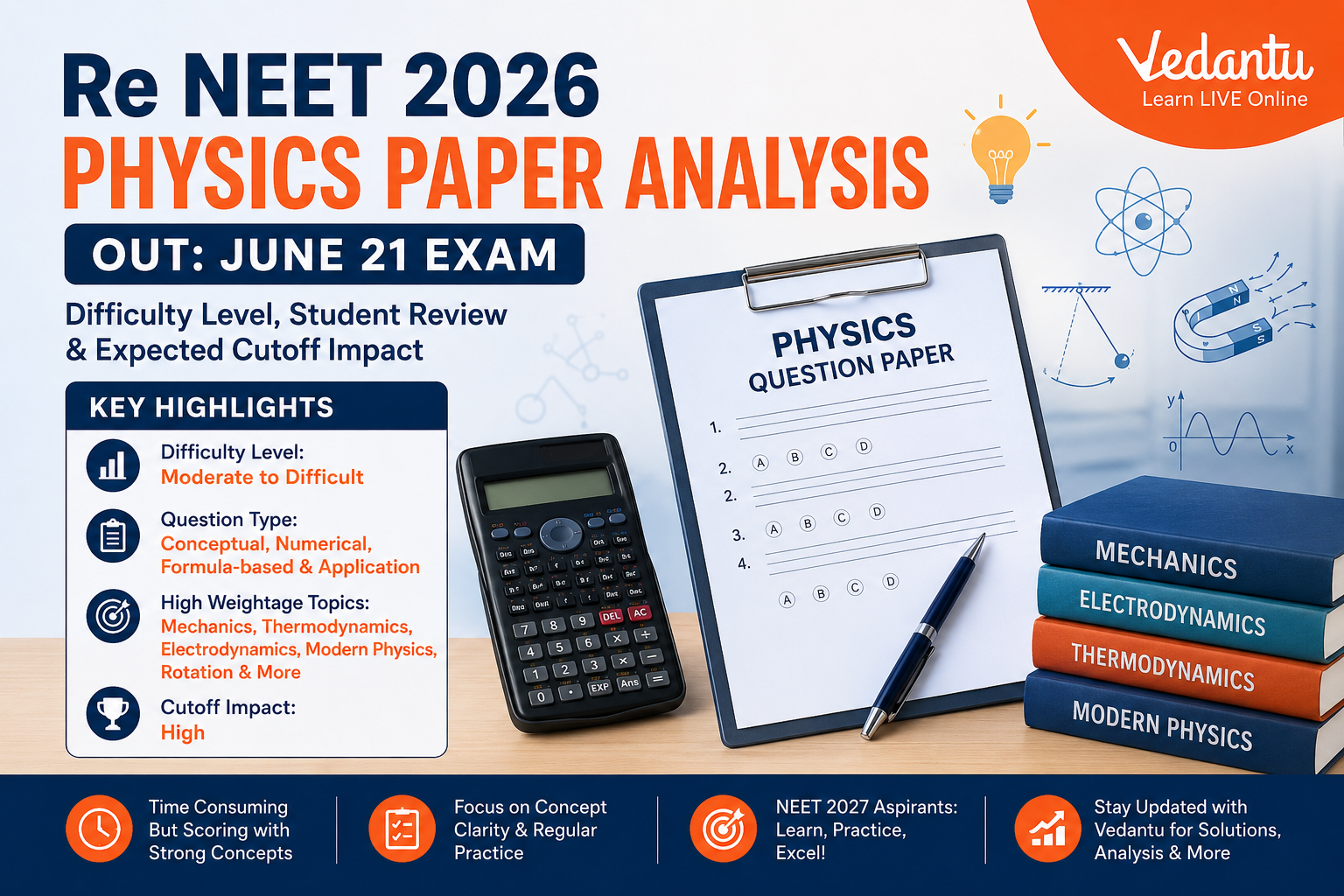
Re NEET 2026 Physics Paper Analysis OUT: June 21 Exam Difficulty Level, Student Review and Expected Cutoff Impact

ffImage
banner

Re NEET 2026 Physics Question Paper LIVE: Difficulty Level, Questions Asked and Student Feedback

The Re NEET 2026 exam was held on June 21, and Physics was one of the most discussed sections among students after the paper. Based on student reactions and memory-based feedback, the Physics section was moderate to difficult. Many students felt that it was more time-consuming than Biology and Chemistry because several questions required calculation, formula application, and conceptual understanding.


The Re NEET 2026 Physics paper was not completely direct. Students had to apply concepts carefully, especially in topics like Mechanics, Thermodynamics, Electrodynamics, Modern Physics and Rotation. For many candidates, Physics played an important role in deciding their overall score and expected cutoff range.

NEET Rank Predictor 2026


Re NEET 2026 Physics Paper Analysis

Re NEET 2026 Physics Difficulty Level

As per student feedback, the Physics section was lengthy and required strong problem-solving skills. Some questions were formula-based, while others were application-driven. Students who had practised numerical questions regularly found the section manageable, but candidates who depended only on direct formula revision found it challenging.


Subject

Difficulty Level

Student Feedback

Physics

Moderate to Difficult

Time-consuming, calculation-based and conceptual

Nature of Questions

Mixed

Formula-based, application-driven and numerical

Scoring Possibility

Moderate

Students with strong concepts could attempt better

Cutoff Impact

High

Physics may affect the final score difference among students


Re NEET 2026 Physics Question Paper with Solutions Review

The Physics paper in Re NEET 2026 tested both speed and accuracy. The questions were mainly based on the prescribed NEET Physics syllabus, but the approach was more conceptual in many places. Students reported that the section needed careful reading, correct formula selection and quick calculation.


Some questions were direct, but many required multi-step thinking. This made Physics more time-consuming compared to Biology and Chemistry. The section was especially important for students aiming for a high score because even a few incorrect answers could affect the overall rank.


Re NEET 2026 Physics Topics Asked

Students discussed several important Physics chapters after the June 21 exam. The topics were mostly from high-weightage areas that are commonly important in NEET.


Physics Topic

Type of Question Trend

Mechanics

Concept-based and numerical questions

Rotational Motion

Application-based questions

Thermodynamics

Formula-based and conceptual questions

Modern Physics

Direct and concept-linked questions

Electrodynamics

Numerical and formula-based questions

Ray Optics

Conceptual question reported

Vernier Caliper

Instrument-based concept question

Conduction

Concept-based question discussion

Electrostatics

Formula application-based questions

Gravitation

Basic concept and numerical possibility


Re NEET 2026 Physics Chapter-Wise Analysis

The Physics section included a mix of Class 11 and Class 12 topics. As per student feedback, Class 12 topics appeared important in the Physics paper, while Class 11 chapters also had a strong presence through Mechanics and Rotation-based questions.


Class

Important Physics Areas Discussed

Class 11

Mechanics, Rotation, Gravitation, Thermodynamics, Oscillations

Class 12

Modern Physics, Electrodynamics, Electrostatics, Optics, Current Electricity

Overall Trend

Class 12 topics were prominent, but Class 11 concepts were also important


Re NEET 2026 Physics Question Type

The Re NEET 2026 Physics paper was not based only on simple memory or direct formula recall. Students needed to understand the concept behind the question before solving it. This made the section slightly tricky for many candidates.


Question Type

Physics Paper Trend

Formula-Based Questions

Present in good number

Numerical Questions

Time-consuming for many students

Conceptual Questions

Important and slightly tricky

Application-Based Questions

Seen in topics like Mechanics and Electrodynamics

Direct Theory Questions

Fewer compared to numerical and application-based questions


Why Was Physics Tough in Re NEET 2026?

Physics was considered tough mainly because of the time required to solve the questions. Even when the questions were from the syllabus, students had to apply formulas correctly and avoid calculation mistakes. Some questions also tested deeper understanding, which made the section challenging.


Main reasons students found Physics difficult:


  • Questions were more calculation-based.

  • Some concepts needed multi-step solving.

  • Mechanics and Electrodynamics required strong basics.

  • Rotation-based questions felt tricky for many students.

  • The section took more time compared to Biology.

  • Formula application had to be accurate.

  • Conceptual clarity was more important than memorisation.


Re NEET 2026 Physics: Easy, Moderate and Difficult Areas

Difficulty Level

Physics Areas

Easy to Moderate

Modern Physics, Basic Optics, Instrument-based concepts

Moderate

Thermodynamics, Electrostatics, Current Electricity

Moderate to Difficult

Mechanics, Rotation, Electrodynamics

Time-Consuming Areas

Numerical questions, calculation-heavy topics and application-based problems


Re NEET 2026 Physics Analysis: Key Takeaways

The Re NEET 2026 Physics paper showed that students cannot depend only on memorising formulas. Regular numerical practice and conceptual understanding are important for scoring well in NEET Physics.


Key points from the Physics paper analysis:


  • Physics was moderate to difficult.

  • The section was time-consuming.

  • Questions were formula-based, numerical and application-driven.

  • Mechanics, Thermodynamics, Modern Physics and Electrodynamics were important.

  • Rotation-based questions were discussed by students.

  • Class 12 Physics topics appeared important in the paper.

  • Physics may influence the Re NEET 2026 cutoff and rank trends.


NEET 2027 Preparation Tips Based on Re NEET 2026 Physics Paper

The Re NEET 2026 Physics analysis gives a clear lesson for NEET 2027 aspirants. Students should focus on concept clarity, formula revision and regular numerical practice. Physics should not be prepared only through theory reading.


Preparation Area

What Students Should Do

NCERT Concepts

Revise basic theory and definitions clearly

Formula Practice

Make a formula sheet and revise it daily

Numerical Solving

Practise topic-wise and mixed numerical questions

Mechanics

Focus on laws of motion, work-energy, rotation and gravitation

Electrodynamics

Practise current electricity, electrostatics and magnetism questions

Modern Physics

Revise formulas, concepts and common NEET question patterns

Mock Tests

Solve full-length NEET mocks to improve speed

Error Analysis

Check mistakes after every test and revise weak topics


Final Verdict on Re NEET 2026 Physics Paper Analysis

The Re NEET 2026 Physics paper was moderate to difficult based on student reactions. The section was more time-consuming than Biology and Chemistry and included conceptual, formula-based and calculation-heavy questions. Students with strong basics and regular numerical practice found the section more manageable.


For NEET 2027 aspirants, this paper proves that Physics needs daily practice. Students should focus on Mechanics, Thermodynamics, Modern Physics, Electrodynamics, Optics and Rotation to build confidence for the next NEET exam.

FAQs on Re NEET 2026 Physics Paper Analysis OUT: June 21 Exam Difficulty Level, Student Review and Expected Cutoff Impact

1. Was Re NEET 2026 Physics paper difficult?

Yes, the Re NEET 2026 Physics paper was considered moderate to difficult by many students. The section was lengthy, calculation-based and required strong concept clarity. Students found Physics tougher than Biology and more time-consuming than Chemistry.

2. What was the difficulty level of Re NEET 2026 Physics?

The difficulty level of Re NEET 2026 Physics was moderate to difficult. Questions were a mix of formula-based, numerical, conceptual and application-driven problems. Students who had practised regular NEET Physics numericals found the section more manageable.

3. How was the Re NEET 2026 Physics question paper?

The Re NEET 2026 Physics question paper was not fully direct. It tested formula application, numerical accuracy and conceptual understanding. Many questions needed careful reading and multi-step solving, which made the section time-consuming for students.

4. Where can I download the Re NEET 2026 Physics question paper PDF?

Students can download the Re NEET 2026 Physics question paper PDF from Vedantu. The PDF will help students check questions asked, difficulty level, topic trends and expert-based solutions.

5. Which topics were asked in Re NEET 2026 Physics?

As per student feedback, important Physics topics discussed after the Re NEET 2026 exam included Mechanics, Rotational Motion, Thermodynamics, Modern Physics, Electrodynamics, Ray Optics, Vernier Caliper, Conduction, Electrostatics and Gravitation.

6. Was Re NEET 2026 Physics easier than the earlier NEET paper?

Many students felt that the overall Re NEET 2026 paper was manageable, but Physics was still challenging. Compared to Biology and Chemistry, Physics remained the toughest section because of calculation-heavy and application-based questions.

7. Which chapters were important in Re NEET 2026 Physics?

Important chapters in Re NEET 2026 Physics included Mechanics, Rotation, Thermodynamics, Modern Physics, Electrodynamics, Optics, Electrostatics, Current Electricity and Gravitation. These areas are also important for NEET 2027 preparation.

8. Did Re NEET 2026 Physics have JEE-level questions?

Some students felt that a few Physics questions required deeper conceptual thinking, similar to the approach used in JEE-level problems. However, this does not mean the paper was out of the NEET syllabus. The questions mainly tested application and clarity of concepts.

9. Will Physics affect the Re NEET 2026 cutoff?

Yes, Physics may affect the Re NEET 2026 cutoff because it was one of the tougher and more time-consuming sections. Students who performed well in Physics may get an advantage in overall marks, rank prediction and expected cutoff range.
