

Courses
Courses for Kids
Free study material
Offline Centres
More
Store Icon
Store

Re NEET 2026 Chemistry Question Paper with Solutions: Difficulty Level, Student Reactions and Questions Asked

ffImage
banner

Re NEET 2026 Chemistry Paper Analysis LIVE Updates: Subject-Wise Difficulty, Questions Asked and Student Feedback

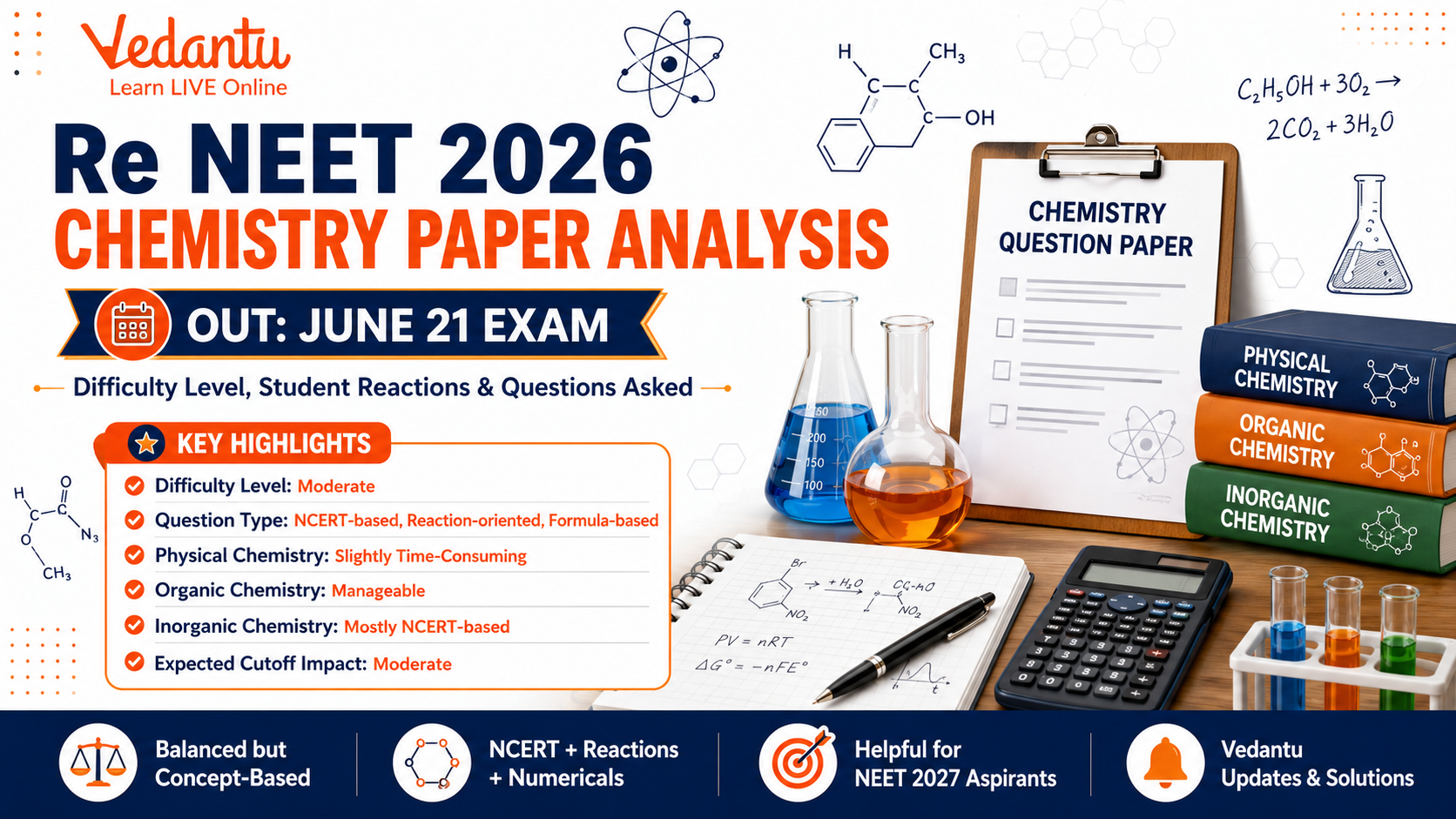
The Re NEET 2026 exam was conducted on June 21, and Chemistry was reported to be of moderate difficulty based on student feedback. The section was neither very easy nor too difficult, but some questions required careful reading and strong conceptual understanding.


Students shared that the Chemistry paper had a balanced mix of NCERT-based questions, reaction-based questions, formula-based problems, and assertion-reason-type questions. Physical Chemistry was slightly time-consuming for many candidates, while Organic Chemistry was more manageable for students who had properly revised reactions and mechanisms.

NEET Rank Predictor 2026


Re NEET 2026 Chemistry Paper Analysis

Re NEET 2026 Chemistry Difficulty Level

According to student feedback, the NEET 2026 Chemistry section was moderate. The questions were not entirely direct, but most were based on the NEET syllabus and NCERT concepts. Students who had a strong command of formulas, reactions, periodic trends and basic concepts found the section manageable.


Subject

Difficulty Level

Student Feedback

Chemistry

Moderate

Balanced paper with a mix of direct and tricky questions

Nature of Questions

Mixed

NCERT-based, reaction-oriented and concept-based

Time Required

Moderate

Physical Chemistry was slightly time-consuming

Scoring Possibility

Good

Students with NCERT revision and reaction practice could score well


Re NEET 2026 Chemistry Question Paper Review

The Chemistry paper in Re NEET 2026 tested both memory and application. Some questions were directly based on NCERT lines, while a few required a deeper understanding of concepts. Students had to be careful with statement-based and assertion-reason questions, as these needed proper conceptual clarity.


The paper was balanced across Physical Chemistry, Organic Chemistry and Inorganic Chemistry. Physical Chemistry included formula and calculation-based questions. Organic Chemistry was manageable but required a strong revision of reactions. Inorganic Chemistry was mostly NCERT-linked and depended on factual clarity.


Re NEET 2026 Chemistry Section-Wise Analysis

Chemistry Section

Difficulty Level

Question Trend

Physical Chemistry

Moderate to Time-Consuming

Formula-based, numerical and concept-based questions

Organic Chemistry

Moderate

Reaction-oriented and mechanism-based questions

Inorganic Chemistry

Easy to Moderate

Mostly NCERT-based factual and statement-type questions

Overall Chemistry

Moderate

Balanced mix of NCERT, reactions and concepts


Re NEET 2026 Chemistry Topics Asked

Students discussed several Chemistry topics after the June 21 re-exam. The paper included questions from key areas commonly seen in NEET Chemistry.


Chemistry Area

Topic Trend

Physical Chemistry

Numerical and formula-based questions

Organic Chemistry

Reaction-based and concept-linked questions

Inorganic Chemistry

NCERT-based factual questions

Chemical Equilibrium

Concept and formula application

Thermodynamics

Calculation and theory-based questions

Electrochemistry

Formula-based questions

Coordination Compounds

NCERT-based conceptual questions

Chemical Bonding

Theory and concept-based questions

Periodic Table

Trend-based questions

Biomolecules and Polymers

Direct NCERT-linked questions


Re NEET 2026 Chemistry Question Type

The Re NEET 2026 Chemistry paper included different types of questions. Students had to use NCERT knowledge, apply formulas, and understand reactions.


Question Type

Chemistry Paper Trend

NCERT-Based Questions

Present in good number

Assertion-Reason Questions

Asked to test conceptual clarity

Statement-Based Questions

Seen in Inorganic and Organic Chemistry

Reaction-Oriented Questions

Important in Organic Chemistry

Formula-Based Questions

Seen mainly in Physical Chemistry

Numerical Questions

Moderate but time-consuming in some areas


Re NEET 2026 Chemistry Analysis: Key Takeaways

The Re NEET 2026 Chemistry paper showed that NCERT preparation is still very important for NEET. However, students also need to practise numerical questions, reactions and assertion-reason formats to score well. 


Key points from the Chemistry paper analysis:


  • Chemistry was moderate overall.

  • The paper was balanced and manageable.

  • Physical Chemistry was slightly time-consuming.

  • Organic Chemistry was reaction-oriented but manageable.

  • Inorganic Chemistry was mostly NCERT-based.

  • Statement-based and assertion-reason questions were asked.

  • Strong NCERT revision helped students attempt better.

  • Chemistry could help balance marks lost in Physics.


NEET 2027 Preparation Tips Based on Re NEET 2026 Chemistry Paper

The Re NEET 2026 Chemistry analysis gives useful guidance for NEET 2027 aspirants. Students should not prepare Chemistry only through short notes. NCERT reading, formula practice, reaction revision and mock tests are all important.


Preparation Area

What Students Should Do

NCERT Reading

Read NCERT line by line for Inorganic and Organic Chemistry

Physical Chemistry

Practise numerical questions and formulas regularly

Organic Chemistry

Revise named reactions, mechanisms and conversions

Inorganic Chemistry

Focus on NCERT facts, trends and exceptions

Assertion-Reason Questions

Practise statement-based and reason-based formats

Formula Revision

Maintain a formula sheet for quick revision

Mock Tests

Attempt full-length NEET tests to improve speed

Error Analysis

Review wrong answers after every test


Final Verdict on Re NEET 2026 Chemistry Paper Analysis

The Re NEET 2026 Chemistry paper was moderate based on student feedback. The section had a balanced mix of NCERT-based, reaction-oriented, formula-based and assertion-reason questions. Physical Chemistry was slightly time-consuming, Organic Chemistry was manageable, and Inorganic Chemistry was mostly NCERT-linked.


For NEET 2027 aspirants, this paper shows that Chemistry can be a scoring subject when prepared properly. Students should focus on NCERT, practise Physical Chemistry numericals, revise Organic reactions, and strengthen Inorganic concepts to perform better in the next NEET exam.

FAQs on Re NEET 2026 Chemistry Question Paper with Solutions: Difficulty Level, Student Reactions and Questions Asked

1. Was Re NEET 2026 Chemistry paper difficult?

The Re NEET 2026 Chemistry paper was moderate in difficulty. Students found the section balanced, with a mix of NCERT-based, formula-based, reaction-oriented and assertion-reason questions. Physical Chemistry was slightly time-consuming, while Organic and Inorganic Chemistry were more manageable for well-prepared students. 

2. What was the difficulty level of Re NEET 2026 Chemistry?

The difficulty level of Re NEET 2026 Chemistry was moderate. The paper was not very easy, but it was not extremely difficult either. Students with strong NCERT revision, formula practice and reaction clarity were able to attempt the section with good accuracy.

3. How was the Re NEET 2026 Chemistry question paper?

The Re NEET 2026 Chemistry question paper was balanced and concept-based. Some questions were directly from NCERT, while others required application of formulas, reactions and conceptual understanding. Statement-based and assertion-reason questions made the section slightly tricky. 

4. Where can I download Re NEET 2026 Chemistry question paper with solutions PDF?

Students can download the Re NEET 2026 Chemistry question paper with solutions PDF from Vedantu. The PDF will help students check questions asked, correct answers, topic-wise trends and difficulty level.

5. Which topics were asked in Re NEET 2026 Chemistry?

Important topics discussed in Re NEET 2026 Chemistry included Physical Chemistry numericals, Organic Chemistry reactions, Inorganic Chemistry NCERT facts, Chemical Equilibrium, Thermodynamics, Electrochemistry, Coordination Compounds, Chemical Bonding, Periodic Table, Biomolecules and Polymers.

6. Was Re NEET 2026 Chemistry NCERT-based?

Yes, a good number of Re NEET 2026 Chemistry questions were based on NCERT concepts. Inorganic Chemistry was strongly linked to NCERT facts and lines, while Organic and Physical Chemistry required both NCERT understanding and regular question practice.

7. Which part of Chemistry was toughest in Re NEET 2026?

Physical Chemistry was slightly more time-consuming compared to Organic and Inorganic Chemistry. It included formula-based and numerical questions where students had to calculate carefully. Some assertion-reason and statement-based questions also needed close reading.

8. Was Organic Chemistry easy in Re NEET 2026?

Organic Chemistry was moderate and manageable for students who had revised reactions, named reactions, mechanisms and conversions properly. The section was reaction-oriented and required conceptual clarity rather than only memorisation.

9. Was Inorganic Chemistry easy in Re NEET 2026?

Inorganic Chemistry was easy to moderate and mostly NCERT-based. Students who had revised NCERT lines, periodic trends, exceptions, chemical bonding and coordination compounds found this part more scoring.

10. Were assertion-reason questions asked in Re NEET 2026 Chemistry?

Yes, assertion-reason and statement-based questions were seen in Re NEET 2026 Chemistry. These questions tested conceptual clarity and careful reading. Students preparing for NEET 2027 should practise these formats regularly.

11. Will Chemistry affect the Re NEET 2026 cutoff?

Chemistry may affect the Re NEET 2026 cutoff because it was a scoring section for students who attempted it accurately. Since Physics was tougher for many candidates, good performance in Chemistry could help students balance their total score.

12. How many questions are asked in NEET Chemistry?

The NEET Chemistry section has 45 questions for 180 marks. Each correct answer gives 4 marks, and 1 mark is deducted for every incorrect answer. Chemistry includes Physical Chemistry, Organic Chemistry and Inorganic Chemistry.

13. How should NEET 2027 students prepare Chemistry after Re NEET 2026 analysis?

NEET 2027 students should read NCERT line by line, practise Physical Chemistry numericals, revise Organic reactions regularly and strengthen Inorganic Chemistry facts. They should also practise assertion-reason, statement-based and mixed concept questions.

14. Will Vedantu provide Re NEET 2026 Chemistry solutions?

Yes, Vedantu will provide Re NEET 2026 Chemistry solutions, question paper PDF, difficulty level review, topic-wise analysis, student reactions and expert feedback. Students can use these updates to check their performance and understand the paper pattern.
