








Types of Hormones and Their Functions in NEET Biology
Hormones are chemical messengers that play a crucial role in controlling various physiological processes in living organisms. Understanding hormones is essential for NEET aspirants because many biology questions test your grasp of how the body maintains balance and responds to its environment. Mastering this concept helps you build a strong foundation in human physiology, a core area in NEET Biology.
What Are Hormones? - Clear Meaning and Concept
Hormones are organic substances produced and secreted by specific cells or glands in the body, especially the endocrine glands. These chemicals travel through body fluids, mostly blood, to reach target organs or tissues, where they regulate and coordinate various physiological activities. Unlike nerve impulses that act quickly and locally, hormones provide long-lasting and widespread control over body functions.
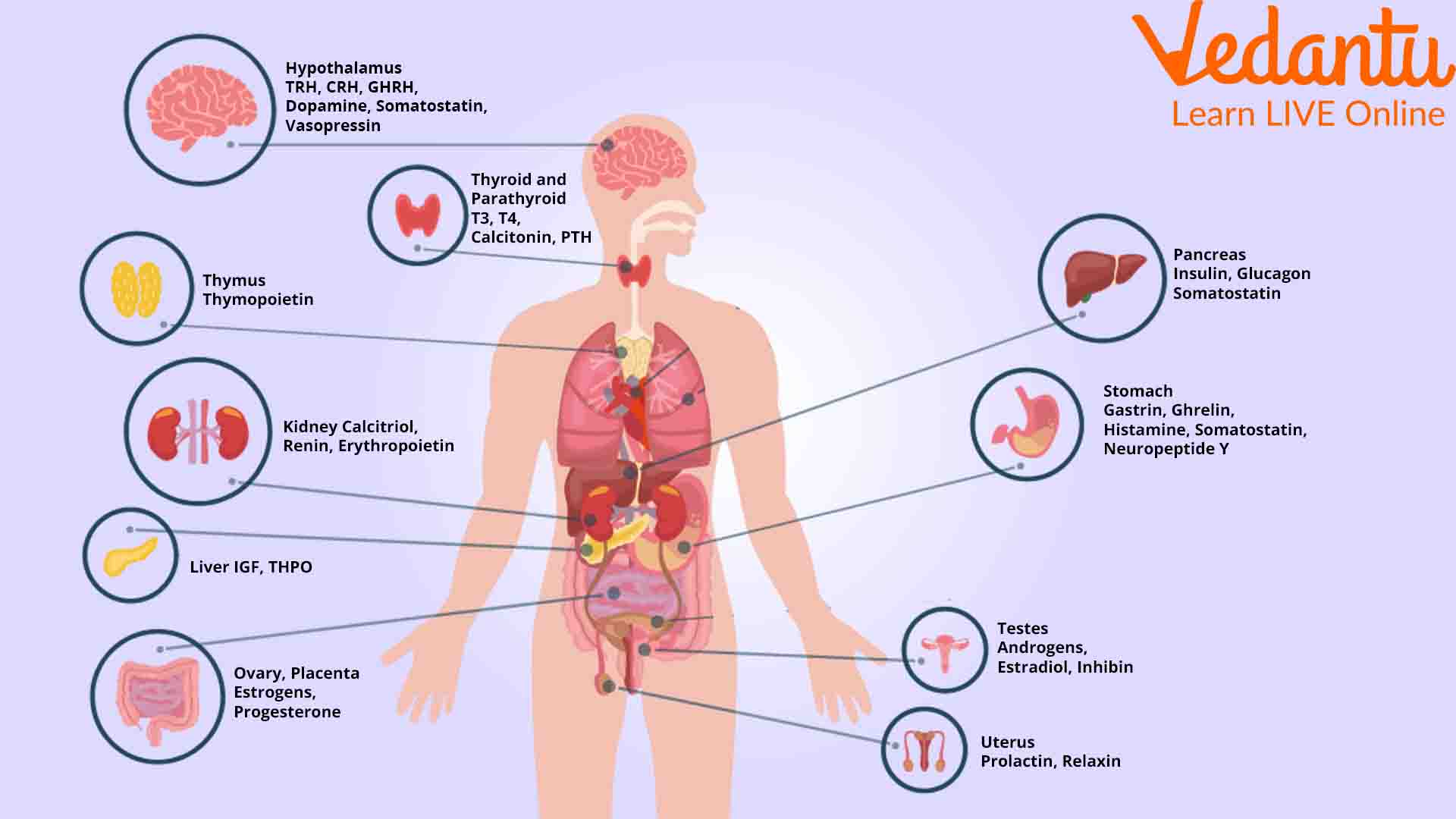
Core Ideas and Fundamentals of Hormones
Basic Principles of Hormonal Action
Hormones work as signaling molecules. They are secreted in minuscule amounts and act on distant organs or tissues (target sites). Each hormone has its own specific target, and the effect depends on the sensitivity and presence of receptors in those target cells. Their main job is to maintain homeostasis (the internal balance of the body) by regulating growth, metabolism, development, reproduction, and stress responses.
Endocrine vs. Exocrine Glands
Endocrine glands release hormones directly into the bloodstream (e.g., pituitary, thyroid), while exocrine glands secrete substances via ducts to specific locations (like sweat or saliva). For NEET, it's vital to identify which glands are endocrine and which are not.
Hormones are Specific
Each hormone is specific in its action - only cells with the appropriate receptor can respond to a given hormone. This specificity ensures precise regulation of body processes.
Important Sub-Concepts Related to Hormones
Types of Hormones
Hormones can be classified based on their chemical nature:
- Peptide/Protein hormones - e.g., insulin, growth hormone
- Steroid hormones - e.g., cortisol, sex hormones
- Amino acid derivatives - e.g., adrenaline, thyroxine
Endocrine Glands and Their Major Hormones
Some of the chief endocrine glands and examples of hormones they produce:
- Pituitary gland - growth hormone, ACTH
- Thyroid gland - thyroxine (T4), triiodothyronine (T3)
- Adrenal glands - adrenaline, cortisol
- Pancreas (Islets of Langerhans) - insulin, glucagon
- Gonads - testosterone, estrogen, progesterone
Hormone Functions
Hormones regulate:
- Growth and development
- Metabolism of carbohydrates, proteins, and fats
- Reproductive processes and sexual characteristics
- Response to stress and injury
- Homeostasis (water, salt, and temperature balance)
Important Principles, Rules, and Relationships
Several important principles govern hormone action:
- Feedback Mechanism: Most hormones work under negative feedback - when the effect is achieved, hormone secretion decreases (e.g., blood sugar regulation by insulin and glucagon).
- Antagonistic Actions: Some hormones have opposite effects on the same process (e.g., insulin lowers and glucagon raises blood glucose).
- Hierarchy of Control: Hormonal secretion is often controlled via a hierarchy of glands - for example, the hypothalamus regulates the pituitary, which then controls other glands.
Functions and Importance of Hormones in Organisms
Hormones carry out essential functions that ensure our survival and well-being. They:
- Control growth and physical development
- Regulate metabolism and energy balance
- Coordinate the body's reaction to stress and injuries
- Play a vital role in reproduction and sexual development
- Help keep the internal environment of the body stable (homeostasis)
Why Is the Concept of Hormones Important for NEET?
Hormones and their functions form a high-yield topic in NEET Biology because questions often test your ability to connect structure, secretion, and physiological effects. Understanding hormonal control is helpful not just for direct questions, but also for case-based or situation-type MCQs. In-depth knowledge supports your learning in human physiology, growth, development, reproductive health, genetics, and other related topics. A good grasp of this concept improves reasoning and speeds up problem-solving during the exam.
How to Study Hormones Effectively for NEET
- Read the NCERT and reference books to get a conceptual overview of each hormone and its source.
- Create summary tables grouping hormones by gland, function, or type for quick comparison.
- Draw and label simple diagrams of the endocrine system to improve memory recall.
- Practice MCQs on hormone-related disorders and feedback mechanisms.
- Review case-based or scenario-based questions to test conceptual clarity.
- Revise frequently using flashcards or short notes focused on hormone functions and target organs.
- Revisit tricky areas, such as differences between hormone types, antagonistic pairs, and feedback regulation.
Common Mistakes Students Make in Hormones Concept
- Confusing endocrine and exocrine functions of glands
- Mixing up hormones with similar names or overlapping functions
- Forgetting the difference between negative and positive feedback mechanisms
- Ignoring the specificity of hormone action and target cells
- Missing the connection between hormone imbalance and disease (e.g., diabetes, hypothyroidism)
Quick Revision Points - Hormones
- Hormones are chemical messengers secreted by endocrine glands.
- They act at distant target organs via the bloodstream.
- Major types: protein/peptide, steroid, amino acid derivative.
- Negative feedback mechanisms commonly regulate hormone secretion.
- Pituitary, thyroid, adrenal, pancreas, and gonads are key endocrine glands for NEET.
- Hormonal imbalance leads to various disorders (e.g., diabetes, goiter).
- Revise hormone functions, sources, and target sites regularly.
FAQs on Biology Hormones for NEET: Complete Overview and Functions
1. What are hormones in biology for NEET?
Hormones are special chemical messengers secreted by endocrine glands to regulate various physiological processes in the body, vital for NEET exam preparation.
Key features of hormones include:
- Produced by ductless (endocrine) glands
- Released directly into the bloodstream
- Regulate growth, metabolism, reproduction, and homeostasis
- Act on specific target organs or tissues
2. What is the function of hormones in the human body for NEET students?
Hormones control and coordinate vital body functions, which is a key concept in NEET biology.
Main functions include:
- Regulation of metabolism
- Control of growth and development
- Maintenance of homeostasis
- Facilitating reproduction
- Responding to stress and environmental changes
3. Which glands secrete hormones for NEET exam?
Endocrine glands secrete most of the major hormones, and their identification is crucial for NEET aspirants.
Primary endocrine glands:
- Pituitary gland
- Thyroid gland
- Adrenal gland
- Pancreas (islets of Langerhans)
- Parathyroid glands
- Gonads (ovaries and testes)
4. What is the difference between endocrine and exocrine glands NEET?
Endocrine glands are ductless glands that release hormones directly into the bloodstream, while exocrine glands have ducts and secrete substances onto epithelial surfaces.
Main differences:
- Endocrine glands: Ductless, secrete hormones, e.g., thyroid, pituitary
- Exocrine glands: Have ducts, secrete enzymes or fluids, e.g., salivary, sweat glands
5. What are the types of hormones based on chemical nature for NEET syllabus?
Hormones are classified by their chemical structure, a key point in NEET biology.
Main types are:
- Peptide/Protein hormones: e.g., insulin, growth hormone
- Steroid hormones: e.g., cortisol, estrogen
- Amino acid derivative hormones: e.g., adrenaline, thyroxine
6. How do hormones act on target cells in NEET biology?
Hormones act on target cells by binding to specific receptors, triggering particular cellular responses, crucial for NEET understanding.
Key steps:
- Hormone is secreted into the blood
- Travels to target cell with specific receptor
- Hormone binds to receptor (surface or inside cell)
- Activates signal transduction pathways
- Initiates desired effect (e.g., protein synthesis, metabolism)
7. What are the main hormones secreted by the pituitary gland for NEET?
The pituitary gland is called the 'master gland' as it secretes several key hormones vital for NEET students to remember.
Main pituitary hormones include:
- Growth Hormone (GH)
- Thyroid-stimulating Hormone (TSH)
- Adrenocorticotropic Hormone (ACTH)
- Follicle-stimulating Hormone (FSH)
- Luteinising Hormone (LH)
- Prolactin
- Antidiuretic Hormone (ADH)
- Oxytocin
8. Name one hormone secreted by the pancreas and its function NEET.
Insulin is a major hormone secreted by the pancreas (islets of Langerhans) and is highly important for NEET.
Key points about insulin:
- Controls blood glucose levels
- Promotes uptake of glucose by body cells
- Helps convert glucose to glycogen in liver
- Prevents hyperglycemia (high blood sugar)
9. What happens if there is an imbalance of hormones in the body?
Hormonal imbalances cause various disorders and health problems, which is an important area for NEET biology.
Some examples:
- Diabetes mellitus: due to deficiency of insulin
- Goitre: from insufficient thyroxine
- Dwarfism or Gigantism: due to inappropriate growth hormone levels
- Menstrual irregularities: because of altered sex hormone balance
10. What is a feedback mechanism in hormone action NEET?
Feedback mechanisms help maintain hormone balance by regulating their production, a concept commonly asked in NEET.
Main points:
- Negative feedback decreases hormone production when levels are high (e.g., thyroid hormones regulate TSH)
- Positive feedback increases hormone production in response to a stimulus (e.g., oxytocin during childbirth)
11. State any two functions of hormones in plants.
Plant hormones or phytohormones control growth and development, a topic included for NEET.
Main functions include:
- Promoting cell elongation (e.g., auxins)
- Ripening of fruits (e.g., ethylene)
- Cell division (cytokinins)
- Dormancy (abscisic acid)
12. Name one male and one female sex hormone and mention one function each.
The main male sex hormone is testosterone, and the main female sex hormone is estrogen, which are important for NEET learners.
Functions:
- Testosterone: Promotes male secondary sexual characters and sperm production
- Estrogen: Regulates female secondary sexual characters and menstrual cycle
