






NEET UG 2026 AYUSH Courses: BAMS, BHMS, BUMS, BSMS Eligibility & Counselling
AYUSH courses have become a popular option for NEET aspirants who want to build a career in traditional and holistic healthcare. In India, undergraduate AYUSH admissions for courses such as BAMS, BHMS, BUMS, and BSMS are conducted through NEET UG, and counselling for major All India seats is handled by AACCC under the Ministry of Ayush.
AACCC manages:
15% All India Quota (AIQ) seats in government and government-aided AYUSH institutes
100% seats in deemed universities
100% seats in central universities and national institutes
The remaining eligible seats are filled through state counselling authorities.
This guide explains the AYUSH courses under NEET, course duration, eligibility, counselling process, and career opportunities, so students can decide whether AYUSH is the right medical pathway after Class 12.
What is AYUSH?
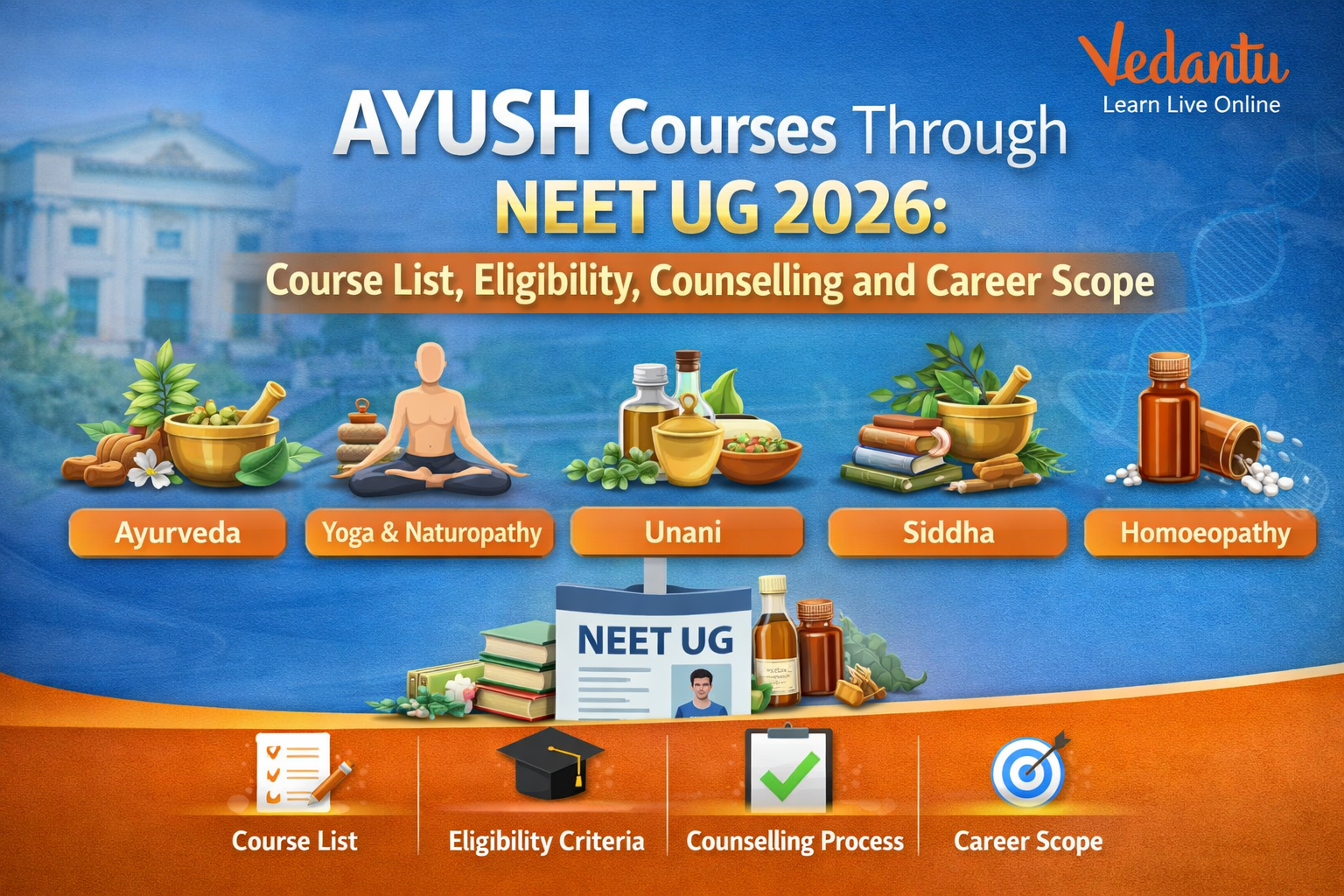
AYUSH is an acronym for India’s traditional systems of medicine:
Ayurveda
Yoga and Naturopathy
Unani
Siddha
Homoeopathy
These systems are regulated by the Ministry of Ayush and form a major part of India’s traditional and integrative healthcare ecosystem. Through NEET UG, students can pursue structured, government-recognised undergraduate degrees in these disciplines.
AYUSH Courses Under NEET UG
For undergraduate AYUSH admission through NEET, the main degree programmes are:
These programmes generally include:
4.5 years of academic study
1 year of compulsory rotatory internship
Curricula typically cover foundational medical sciences, system-specific subjects (like Ayurvedic or Homoeopathic pharmacology), clinical postings, and hands-on training in hospitals attached to the colleges.
Is NEET Required for AYUSH Courses?
If you are asking, “Is NEET compulsory for AYUSH courses?”, the answer is:
Yes. NEET UG is the primary entrance exam used for admission to major undergraduate AYUSH courses such as BAMS, BHMS, BUMS, and BSMS under both AACCC and state counselling systems.
AACCC’s official UG counselling framework lists these courses for centralised counselling. Most government, government-aided, and many private AYUSH colleges use NEET UG scores as the basis for admission.
Who Conducts AYUSH Counselling?
AYUSH counselling happens at two levels: central (AACCC) and state counselling authorities.
1. AACCC Counselling (Central-Level)
The Ayush Admissions Central Counselling Committee (AACCC) conducts NEET AYUSH counselling for:
15% AIQ seats in government and government-aided AYUSH colleges
100% seats in deemed universities
100% seats in central universities and national institutes
AIQ B.Pharm (Ay) seats at ITRA, Jamnagar
AACCC publishes detailed information bulletins, schedules, seat matrices, and counselling guidelines for each academic year on its official website.
2. State AYUSH Counselling
The remaining seats are handled through state-level AYUSH counselling, typically by the respective state counselling authorities. These usually include:
State quota seats in government AYUSH colleges
Seats in private AYUSH colleges affiliated to state universities
Eligibility, domicile rules, fee structures, and reservation policies may vary from state to state, so candidates must carefully check state-specific notifications.
AYUSH Admission Process Through NEET UG
The AYUSH NEET UG admission process broadly follows this sequence:
1. Appear for NEET UG
Sit for the NEET UG exam conducted by NTA in the relevant year.
2. Qualify NEET UG and Check Score/Rank
Ensure you meet the NEET qualifying cutoff for your category and note your score and All India Rank.
3. Register for Counselling
For All India seats and central/deemed institutes, register on the AACCC counselling portal.
For state quota and many private colleges, register on the respective state counselling portal.
4. Fill and Lock Choices
Select and prioritise AYUSH colleges and courses (BAMS/BHMS/BUMS/BSMS) based on your NEET score, category, and preference.
5. Seat Allotment
Seats are allotted according to NEET rank, reservation rules, preferences, and seat availability. Allotment lists are published round-wise.
6. Document Verification and Reporting
If allotted a seat, report to the assigned college within the deadline with the required documents and complete admission formalities.
AACCC’s official UG counselling information bulletin outlines the rounds of counselling, upgrade options, mop-up, and stray vacancy processes for each year.
Eligibility for AYUSH Courses After NEET UG
Educational Qualification: Must have passed Class 12 or equivalent from a recognised board.
Subjects in Class 12: Must have studied Physics, Chemistry, Biology/Biotechnology, and English.
NEET Qualification: Must qualify for NEET UG by scoring at or above the prescribed category-wise cutoff.
Counselling Rules: Must meet the applicable age limits, reservation norms, and other admission conditions mentioned in AACCC or state AYUSH counselling notifications.
Note: Exact PCB percentage requirements, age criteria, and reservation details can vary by year, course, and state. Always refer to the latest official information bulletin of AACCC or the concerned state authority for precise rules.
Can I Get AYUSH with a Low NEET Score?
Cutoffs for AYUSH courses are generally lower than MBBS/BDS in many regions, but they still vary widely depending on:
Number of applicants in your category
Type of college (government, government-aided, private, deemed)
State and category-specific reservation policies
Even with a relatively lower NEET score, some students may get opportunities in private AYUSH colleges or certain states. However, you should always check previous years’ AYUSH cutoffs from official sources for realistic expectations.
Why Students Choose AYUSH After NEET
AYUSH is increasingly becoming a deliberate first choice, not just an alternative to MBBS. Many students prefer AYUSH courses after NEET because they want:
A medical career in traditional systems like Ayurveda, Homoeopathy, Unani, or Siddha
A focus on preventive, holistic, and lifestyle-based healthcare
Opportunities across clinical practice, wellness, and integrative medicine
Scope to work in public health, research, and health education
For aspirants who are passionate about traditional and integrative healthcare, AYUSH offers a structured, regulated professional path through NEET UG.
Career Scope After AYUSH Courses
After completing an AYUSH degree and internship, graduates can explore multiple career paths, such as:
Clinical Practice: Start a private clinic or work in AYUSH hospitals, wellness centres, and integrative medicine setups.
Hospitals and Wellness Centres: Work in multi-speciality hospitals, AYUSH wings, spas, wellness resorts, and rehabilitation centres.
Teaching and Academics: After meeting eligibility norms and often pursuing a postgraduate AYUSH degree, join AYUSH colleges as teaching and academic staff.
Research and Public Health: Contribute to research projects, clinical trials, and public health initiatives in AYUSH and integrative medicine.
Pharmaceutical and Herbal Industry: Work with companies manufacturing herbal medicines, nutraceuticals, and Ayurvedic/Homoeopathic products.
Higher Studies: Pursue MD/MS in AYUSH disciplines, specialised diplomas, or higher degrees in areas like hospital management, public health, or clinical research.
With increasing emphasis on holistic wellness, lifestyle diseases, and integrative care, the career scope after AYUSH courses continues to grow across clinical, academic, and industry roles.
FAQs on AYUSH Courses Through NEET UG 2026: Course List, Eligibility, Counselling and Career Scope
1. Is NEET required for AYUSH courses like BAMS, BHMS, BUMS and BSMS?
Yes. NEET UG is compulsory for admission to major AYUSH courses such as BAMS, BHMS, BUMS and BSMS in most government, government-aided, deemed and many private colleges.
2. Which AYUSH courses are offered through NEET UG 2026?
Through NEET UG 2026, students can get admission to BAMS (Ayurveda), BHMS (Homoeopathy), BUMS (Unani) and BSMS (Siddha) under AACCC and state AYUSH counselling.
3. Who conducts AYUSH NEET UG counselling?
AYUSH counselling is conducted by AACCC at the central level for AIQ, deemed and central universities, and by respective state counselling authorities for state quota and many private AYUSH colleges.
4. What is the eligibility for AYUSH courses through NEET UG?
Candidates must pass Class 12 with Physics, Chemistry, Biology/Biotechnology and English, qualify NEET UG with the required cutoff, and meet AACCC/state-specific age and reservation rules.
5. Can I get an AYUSH seat with a low NEET score?
In some states and private AYUSH colleges, cutoffs for BAMS, BHMS, BUMS and BSMS may be lower than MBBS/BDS, but they vary by state, category and college type, so you should check previous-year AYUSH cutoffs.
6. What is the admission process for AYUSH courses through NEET UG?
First qualify NEET UG, then register for AACCC and/or state AYUSH counselling, fill and lock college-course choices, check seat allotment, and finally complete document verification and reporting at the allotted college.
7. Is there a separate AYUSH entrance exam apart from NEET UG?
For most recognised undergraduate AYUSH seats (BAMS, BHMS, BUMS, BSMS), NEET UG is the common entrance exam; always verify any state-specific exceptions in the latest official notifications.
8. What are the fees for AYUSH courses through NEET?
AYUSH fees vary widely: government and government-aided colleges usually have lower fees, while private and deemed AYUSH colleges often charge higher tuition; check each college’s official fee structure before filling choices.
9. Are AYUSH courses a good option after not getting MBBS through NEET?
Yes, for students interested in traditional and holistic medicine, AYUSH offers a strong career path in Ayurveda, Homoeopathy, Unani and Siddha across clinical practice, wellness, research, teaching and public health.
10. Can I do postgraduate studies after completing an AYUSH UG course?
Yes. After BAMS, BHMS, BUMS or BSMS and internship, you can pursue MD/MS in AYUSH disciplines or other higher studies like public health, hospital management and clinical research, based on eligibility and entrance criteria.
