






NCERT Solutions For Class 7 Maths Chapter 10 Algebraic Expressions Exercise 10.1 - 2025-26
In NCERT Solutions Class 7 Maths Chapter 10 Exercise 10 1, you’ll explore the world of algebraic expressions—learning about terms, coefficients, constants, and how to write expressions using variables. This chapter teaches you what like and unlike terms are, and how to tell the difference, making algebra feel much easier!
 Table of Content
If you ever find algebra confusing, don’t worry. With step-by-step NCERT Solutions and clear explanations, Vedantu helps you build confidence and master each concept. You’ll find all answers for this exercise arranged neatly, perfect for quick revision and homework. Download the free PDF for convenient offline practice anytime. If you want to know what topics are part of your syllabus, check the Class 7 Maths syllabus here.
Practising with these solutions not only makes your basics strong but also prepares you for any type of question in the exam. You can see all NCERT Solutions for Class 7 Maths to boost your preparation further.
Exercise 10.1
1. Get the algebraic expressions in the following cases using variables, constants and arithmetic operations:
(i) Subtraction of \[z\] from \[y\].
Ans: It is given that the first term is \[y\] and the second term is \[z\]. The operation performed on them is ‘subtraction, therefore
Thus the expression is \[y - z\].
(ii) One-half of the sum of numbers \[x\] and \[y\].
Ans: It is given that the first term is \[x\] and the second term is \[y\]. Operation performed on them is ‘addition’ and then ‘one-half of the sum’, therefore
Thus the expression is \[\dfrac{1}{2}\left( {x + y} \right)\].
(iii) The number \[z\] multiplied by itself.
Ans: It is given that the first term is \[z\] and the second term is \[z\]. Operation performed on them is ‘multiplication’, therefore
Thus the expression is \[z * z = {z^2}\].
(iv) One-fourth of the product of numbers \[p\] and \[q\].
Ans: It is given that the first term is \[p\] and the second term is \[q\]. Operation performed on them is ‘multiplication’ and then ‘one-fourth of the product’, therefore
Thus the expression is\[\dfrac{1}{4}\left( {pq} \right)\].
(v) Numbers \[x\] and \[y\] both squared and added.
Ans: (a) The first term is \[x\] and the second term is \[x\]. Operation performed on them is ‘multiplication’, therefore
(b) The First term is \[y\] and the second term is\[y\]. Operation performed on them is ‘multiplication’, therefore
(c) Now, the first term is \[{x^2}\] and the second term is \[{y^2}\]. Operation performed on them is ‘addition’, therefore
Thus the expression is \[{x^2} + {y^2}\].
(vi) Number \[5\] added to three times the product of \[m\] and \[n\].
Ans: (a) The first term is \[m\] and the second term is \[n\]. Operation performed on them is ‘addition’, therefore
(b) The first term is \[m + n\] and the second term is \[3\]. Operation performed on them is ‘multiplication’, therefore
(c) Now the first term is \[3\left( {m + n} \right)\] and the second term is \[5\]. Operation performed on them is ‘addition’, therefore
Thus the expression is \[3\left( {m + n} \right) + 5\].
(vii) Product of numbers \[y\] and \[z\] subtracted from \[10\].
Ans: (a) The first term is \[y\] and the second term is \[z\] . Operation performed on them is ‘multiplication’, therefore
(ii) The first term is \[y + z\] and the second term is \[10\]. Operation performed on them is ‘multiplication’, therefore
Thus the expression is \[ 10 - yz\].
(viii) Sum of numbers \[a\] and \[b\] subtracted from their product.
Ans: (i) The first term is \[a\] and the second term is \[b\] . Operation performed on them is ‘addition’, therefore
(ii) The first term is \[a\] and the second term is \[b\]. Operation performed on them is ‘multiplication’, therefore
(iii) Now, the first term is \[a*b = ab\] and the second term is \[a + b\]. Operation performed on them is ‘subtraction’, therefore
Thus the expression is \[ab - \left( {a + b} \right)\].
2. (i) Identify the terms and their factors in the following expressions, show the terms and factors by tree diagram:
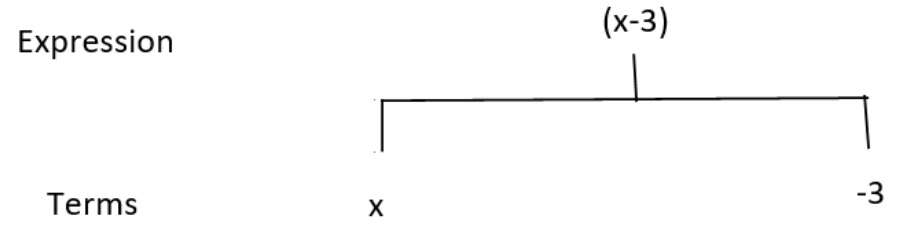
(a) \[x - 3\]
Ans: Tree diagram of \[x - 3\] will be:
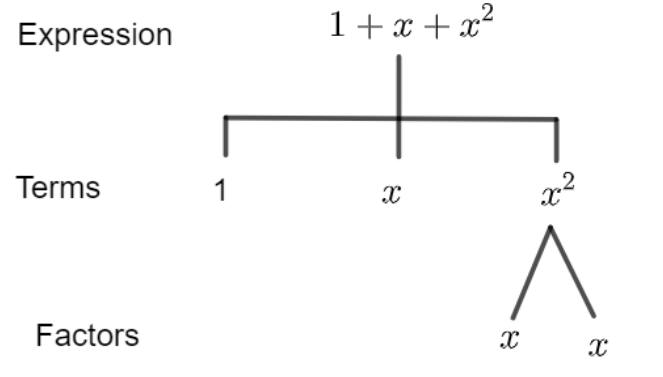
(b) \[1 + x + {x^2}\]
Ans: Tree diagram of \[1 + x + {x^2}\] will be:
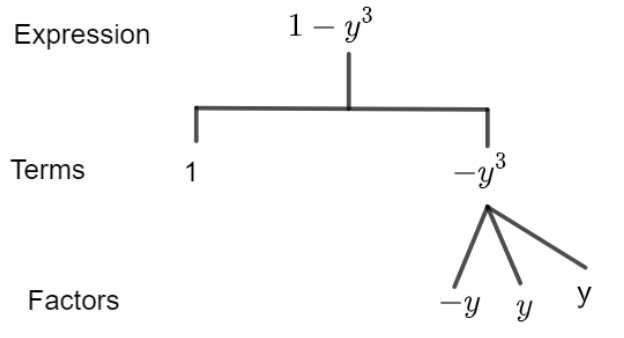
(c) \[y - {y^3}\]
Ans: Tree diagram of \[y - {y^3}\] will be:
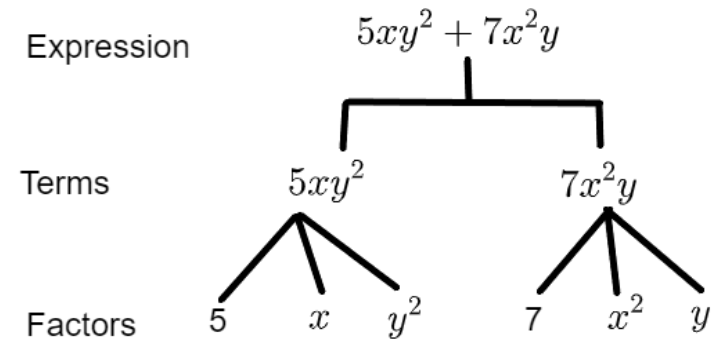
(d) \[5x{y^2} + 7{x^2}y\]
Ans: Tree diagram of \[5x{y^2} + 7{x^2}y\] will be:
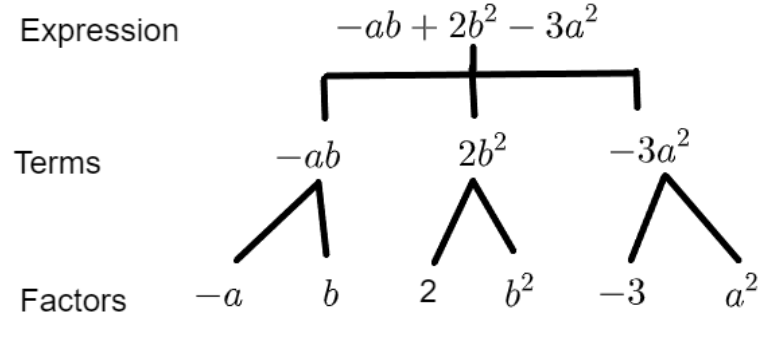
(e) \[ - ab + 2{b^2} - 3{a^2}\]
Ans: Tree diagram of \[ - ab + 2{b^2} - 3{a^2}\] will be:
(ii) Identify the terms and factors in the expressions given below:
(a) \[ - 4x + 5\]
Ans: The given expression \[ - 4x + 5\]is achieved when \[ - 4x\] and \[5\] are added, therefore terms of the expression \[ { - 4x + 5} \]are \[ - 4x\] and \[5\].
\[ - 4x\] is achieved by multiplication \[ - 4\] and \[x\]. Therefore, factors of \[ - 4x\] are \[ - 4\] and \[x\].
(b) \[ { - 4x + 5y} \]
Ans: The given expression\[ - 4x + 5y\] is achieved when \[ - 4x\] and \[5y\] are added, therefore terms of the expression \[ - 4x + 5y\] are \[ - 4x\] and \[5y\].
\[ - 4x\] is achieved by multiplication \[ - 4\] and \[x\]. Similarly, \[5y\] is achieved by multiplication \[5\] and \[y\]. Therefore, factors of \[ - 4x\] are \[ - 4\] and \[x\] and of \[5y\] are \[5\] and \[y\].
(c) \[5y + 3{y^2}\]
Ans: Given expression \[5y + 3{y^2}\] is achieved when \[5y\] and \[3{y^2}\] are added, therefore terms of the expression \[5y + 3{y^2}\] are \[5y\] and \[3{y^2}\].
\[5y\] is achieved by multiplication \[5\] and \[y\]. Similarly, \[3{y^2}\] is achieved by multiplication of \[3\], \[y\] and \[y\]. Therefore, factors of \[5y\] are \[5\] and \[y\] and of \[3{y^2}\] are \[3\], \[y\] and \[y\].
(d) \[xy + 2{x^2}{y^2}\]
Ans: Given expression \[xy + 2{x^2}{y^2}\] is achieved when \[xy\] and \[2{x^2}{y^2}\] are added , therefore terms of the expression \[xy + 2{x^2}{y^2}\] are \[xy\] and \[2{x^2}{y^2}\].
\[xy\] is achieved by multiplication \[x\] and \[y\]. Similarly, \[2{x^2}{y^2}\] is achieved by multiplication of \[2\], \[x\], \[x\], \[y\] and \[y\]. Therefore, factors of \[xy\] are \[x\] and \[y\] and of \[2{x^2}{y^2}\] are \[2\], \[x\], \[x\], \[y\] and \[y\].
(e) \[pq + q\]
Ans: The given expression \[pq + q\] is achieved when \[pq\] and \[q\] are added , therefore terms of the expression \[pq + q\] are \[pq\] and \[q\].
\[pq\] is achieved by multiplication\[p\] and \[q\]. Therefore, factors of \[pq\] are \[p\] and \[q\].
(f) \[1.2ab - 2.4b + 3.6a\]
Ans: The given expression \[1.2ab - 2.4b + 3.6a\] is achieved when \[1.2ab\], \[ - 2.4b\] and \[3.6a\] are added , therefore terms of the expression \[1.2ab - 2.4b + 3.6a\] are \[1.2ab\], \[ - 2.4b\] and \[3.6a\].
\[1.2ab\] is achieved by multiplication of \[1.2\], \[a\] and \[b\], similarly \[ - 2.4b\] is achieved by multiplication of \[ - 2.4\] and \[b\] and similarly \[3.6a\] is achieved by multiplication of \[3.6\] and \[a\]. Therefore, factors of \[1.2ab\] are \[1.2\], \[a\] and \[b\], factors of \[ - 2.4b\] are \[ - 2.4\] and \[b\] and of \[3.6a\] are \[3.6\] and \[a\].
(g) \[\dfrac{3}{4}x + \dfrac{1}{4}\]
Ans: The given expression \[\dfrac{3}{4}x + \dfrac{1}{4}\] is achieved when \[\dfrac{3}{4}x\] and \[\dfrac{1}{4}\] are added, therefore terms of the expression \[\dfrac{3}{4}x + \dfrac{1}{4}\] are \[\dfrac{3}{4}x\] and \[\dfrac{1}{4}\].
\[\dfrac{3}{4}x\] is achieved by multiplication of \[\dfrac{3}{4}\] and \[x\]. Therefore, factors of \[\dfrac{3}{4}x\] are \[\dfrac{3}{4}\] and \[x\].
(g) \[0.1{p^2} + 0.2{q^2}\]
Ans: The given expression \[0.1{p^2} + 0.2{q^2}\] is achieved when \[0.1{p^2}\] and \[0.2{q^2}\] are added, therefore terms of the expression \[0.1{p^2} + 0.2{q^2}\] are \[0.1{p^2}\] and \[0.2{q^2}\].
\[0.1{p^2}\] is achieved by multiplication of \[0.1\], \[p\] and \[p\]. \[0.2{q^2}\] is achieved by multiplication of \[0.2\], \[q\] and \[q\]. Therefore, factors of \[0.1{p^2}\] are \[0.1\], \[p\] and \[p\] and of \[0.2{q^2}\] are \[0.2\], \[q\] and \[q\].
3. Identify the numerical coefficients of terms (other than constants) in the following expressions:
(i) \[5 - 3{t^2}\]
Ans: In the expression \[5 - 3{t^2}\], \[5\] is the constant term and \[ - 3{t^2}\] is the term other than the constant. Coefficient of \[ - 3{t^2}\] is \[ - 3\].
(ii) \[1 + t + {t^2} + {t^3}\]
Ans: In the expression \[1 + t + {t^2} + {t^3}\], \[1\] is the constant term and \[t\], \[{t^2}\] and \[{t^3}\] are the terms other than the constant. Coefficient of \[t\] is \[1\], of \[{t^2}\] is \[1\] and of \[{t^3}\] is \[1\].
(iii) \[x + 2xy + 3y\]
Ans: In the expression \[x + 2xy + 3y\], there is no constant term and \[x\], \[2xy\] and \[3y\] are the terms other than the constant. Coefficient of \[x\] is \[1\], of \[2xy\] is\[2\] and of \[3y\] is \[3\].
(iv) \[100m + 1000n\]
Ans: In the expression \[100m + 1000n\], there is no constant term and \[100m\] and \[1000n\] are the terms other than the constant. Coefficient of \[100m\] is \[100\] and of \[1000n\] is \[1000\].
(v) \[ - {p^2}{q^2} + 7pq\]
Ans: In the expression \[ - {p^2}{q^2} + 7pq\], there is no constant term and \[ - {p^2}{q^2}\] and \[7pq\] are the terms other than the constant. Coefficient of \[ - {p^2}{q^2}\] is \[ - 1\] and of \[7pq\] is \[7\].
(vi) \[1.2a + 0.8b\]
Ans: In the expression \[1.2a + 0.8b\], there is no constant term and \[1.2a\] and \[0.8b\] are the terms other than the constant. Coefficient of \[1.2a\] is \[1.2\] and of \[0.8b\] is \[0.8\].
(vii) \[3.14{r^2}\]
Ans: In the expression \[3.14{r^2}\], there is no constant term and \[3.14{r^2}\] is the term other than the constant. Coefficient of \[3.14{r^2}\] is \[3.14\].
(viii) \[2\left( {l + b} \right) = 2l + 2b\]
Ans: In the expression \[2\left( {l + b} \right) = 2l + 2b\], there is no constant term and \[2l\] and \[2b\] are the terms other than the constant. Coefficient of \[2l\] is \[2\] and of \[2b\] is \[2\].
(ix) \[0.1y + 0.01{y^2}\]
Ans: In the expression \[0.1y + 0.01{y^2}\], there is no constant term and \[0.1y\] and \[0.01{y^2}\] are the terms other than the constant. Coefficient of \[0.1y\] is \[0.1\] and of \[0.01{y^2}\] is \[0.01\].
4. (a) Identify terms which contain \[x\] and give the coefficient of \[x\].
(i) \[{y^2}x + y\].
Ans: In the expression \[{y^2}x + y\], the term which contains \[x\] is \[{y^2}x\]. The coefficient of \[x\] in \[{y^2}x\] is \[{y^2}\].
(ii) \[13{y^2} - 8yx\].
Ans: In the expression \[13{y^2} - 8yx\], the term which contains \[x\] is \[ - 8yx\]. The coefficient of \[x\]in \[ - 8yx\] is \[ - 8y\].
(iii) \[x + y + 2\].
Ans: In the expression \[x + y + 2\], the term which contains \[x\] is \[x\]. The coefficient of \[x\] in \[x\] is \[1\].
(iv) \[5 + z + zx\].
Ans: In the expression \[5 + z + zx\], the term which contains \[x\] is \[zx\]. The coefficient of \[x\] in \[zx\] is \[z\].
(v) \[1 + x + xy\].
Ans: In the expression \[1 + x + xy\], terms which contain \[x\] are \[x\] and \[xy\]. The coefficient of \[x\] in \[x\] is \[1\] and in \[xy\] is\[y\].
(vi) \[12x{y^2} + 25\].
Ans: In the expression \[12x{y^2} + 25\], the term which contains \[x\] is \[12x{y^2}\]. The coefficient of \[x\] in \[12x{y^2}\] is \[12{y^2}\].
(vii) \[7x + x{y^2}\].
Ans: In the expression \[7x + x{y^2}\], terms which contain \[x\] are \[x{y^2}\] and \[7x\]. The coefficient of \[x\] in \[x{y^2}\] is \[{y^2}\] and in \[7x\] is \[7\].
(b) Identify terms which contain \[{y^2}\] and give the coefficient of \[{y^2}\].
(i) \[8 - x{y^2}\]
Ans: In the expression \[8 - x{y^2}\], the term which contains \[{y^2}\] is \[ - x{y^2}\]. The coefficient of \[{y^2}\] in \[ - x{y^2}\] is \[ - x\].
(ii) \[5{y^2} + 7x\]
Ans: In the expression \[5{y^2} + 7x\], the term which contains \[{y^2}\] is \[5{y^2}\]. The coefficient of \[{y^2}\]in \[5{y^2}\] is \[5\].
(iii) \[2{x^2}y - 15x{y^2} + 7{y^2}\]
Ans: In the expression \[2{x^2}y - 15x{y^2} + 7{y^2}\], terms which contain \[{y^2}\] are \[ - 15x{y^2}\] and \[7{y^2}\]. The coefficient of \[{y^2}\] in \[ - 15x{y^2}\] is \[ - 15x\] and in \[7{y^2}\] is \[7\].
5. Classify into monomials, binomials and trinomials:
(i) \[4y - 7x\]
Ans: The expression \[4y - 7x\] consists of two terms, i.e., \[4y\] and \[ - 7x\] . Because \[4y - 7x \] consists of two terms. Therefore, \[4y - 7x\] is a binomial.
(ii) \[{y^2}\]
Ans: The expression \[{y^2}\] consists of one term, i.e., \[{y^2}\]. Because \[{y^2}\] consists of one term. Therefore, \[{y^2}\] is a monomial.
(iii) \[x + y - xy\]
Ans: The expression \[x + y + xy\], consists of three terms, i.e., \[x\], \[y\] and \[ - xy\]. Because \[x + y + xy\] consists of three terms. Therefore, \[x + y + xy\] is a trinomial.
(iv) \[100\]
Ans: The expression \[100\] consists of one term, i.e., \[100\]. Because \[100\] consists of one term. Therefore, \[100\] is a monomial.
(v) \[ab - a - b\]
Ans: The expression \[ab - a - b\] consists of three terms, i.e., \[ab\], \[ - a\] and \[ - b\]. Because \[ab - a - b\] consists of three terms. Therefore, \[ab - a - b\] is a trinomial.
(vi) \[5 - 3t\]
Ans: The expression \[5 - 3t\] consists of two terms, i.e., \[5\] and \[ - 3t\]. Because \[5 - 3t\] consists of two terms. Therefore, \[5 - 3t\] is a binomial.
(vii) \[4{p^2}q - 4p{q^2}\]
Ans: The expression \[4{p^2}q - 4p{q^2}\] consists of two terms, i.e., \[4{p^2}q\] and \[ - 4p{q^2}\]. Because \[4{p^2}q - 4p{q^2}\] consists of two terms. Therefore, \[4{p^2}q - 4p{q^2}\] is a binomial.
(viii) \[7mn\]
Ans: The expression \[7mn\] consists of one term, i.e., \[7mn\]. Because \[7mn\] consists of one term. Therefore, \[7mn\] is a monomial.
(ix) \[{z^2} - 3z + 8\]
Ans: The expression \[{z^2} - 3z + 8\] consists of three terms, i.e., \[{z^2}\], \[ - 3z\] and \[8\]. Because \[{z^2} - 3z + 8\] consists of three terms. Therefore,\[{z^2} - 3z + 8\] is a trinomial.
(x) \[{a^2} + {b^2}\]
Ans: The expression \[{a^2} + {b^2}\] consists of two terms, i.e., \[{a^2}\] and \[{b^2}\]. Because \[{a^2} + {b^2}\] consists of two terms. Therefore, \[{a^2} + {b^2}\] is a binomial.
(xi) \[{z^2} + z\]
Ans: The expression \[{z^2} + z\] consists of two terms, i.e., \[{z^2}\] and \[z\] . Because \[{z^2} + z\] consists of two terms. Therefore, \[{z^2} + z\] is a binomial.
(xii) \[1 + x + {x^2}\]
Ans: The expression \[1 + x + {x^2}\] consists of three terms, i.e., \[1\], \[x\] and \[{x^2}\]. Because \[1 + x + {x^2}\] consists of three terms. Therefore, \[1 + x + {x^2}\] is a trinomial.
6. State whether a given pair of terms is of like or unlike terms:
(i) \[1,{\text{ }}100\]
Ans: Factor of \[1\] is \[1\].
Factor of \[100\] is \[100\].
Algebraic factor \[1\] and \[100\] is none, i.e., and have the same algebraic factor. Therefore, \[1\] and \[100\] are like terms.
(ii) \[ - 7x,{\text{ }}\dfrac{5}{2}x\]
Ans: Factors of \[ - 7x\] are \[ - 7\] and \[x\].
Factors of \[\dfrac{5}{2}x\] are \[\dfrac{5}{2}\] and \[x\] .
Algebraic factor of \[ - 7x\] is \[x\] and of \[\dfrac{5}{2}x\] is \[x\]. Because \[ - 7x\] and \[\dfrac{5}{2}x\] have the same algebraic factor. Therefore, \[ - 7x\] and \[\dfrac{5}{2}x\] are like terms.
(iii) \[ - 29x,{\text{ }} - 29y\]
Ans: Factors of \[ - 29x\] are \[ - 29\] and \[x\].
Factors of \[ - 29y\] are \[ - 29\] and \[y\].
Algebraic factor of \[ - 29x\] is \[x\] and of \[ - 29y\] is \[y\]. Because \[ - 29x\] and \[ - 29y\] do not have the same algebraic factor. Therefore, \[ - 29x\] and \[ - 29y\] are unlike terms.
(iv) \[14xy,{\text{ }}42yx\]
Ans: Factors of \[14xy\] are \[14\], \[x\] and \[y\].
Factors of \[42yx\] are \[42\], \[y\] and \[x\].
Algebraic factors of \[14xy\] are \[x\] and \[y\] and of \[42yx\] are \[y\] and \[x\]. Because \[14xy\] and \[42yx\] have the same algebraic factor, i.e., \[x\] and \[y\]. Therefore, \[14xy\] and \[42yx\] are like terms.
(v) \[4{m^2}p,{\text{ }}4m{p^2}\]
Ans: Factors of \[4{m^2}p\] are \[4\], \[m\], \[m\] and \[p\].
Factors of \[4m{p^2}\] are \[4\], \[m\], \[p\] and \[p\].
Algebraic factors of \[4{m^2}p\] are \[m\], \[m\] and \[p\] and of \[4m{p^2}\] are \[m\], \[p\] and \[p\]. Because \[4{m^2}p\] and \[4m{p^2}\] have different algebraic factors. Therefore, \[4{m^2}p\] and \[4m{p^2}\] are unlike terms.
(vi) \[12xz,{\text{ }}12{x^2}{z^2}\]
Ans: Factors of \[12xz\] are \[12\], \[x\] and \[z\].
Factors of \[12{x^2}{z^2}\] are \[12\], \[x\], \[x\], \[z\] and \[z\].
Algebraic factors of \[12xz\] are \[x\] and \[z\] and of \[12{x^2}{z^2}\] are \[x\], \[x\], \[z\] and \[z\]. Because \[12xz\] and \[12{x^2}{z^2}\] have different algebraic factors. Therefore, \[12xz\] and \[12{x^2}{z^2}\] are unlike terms.
7. Identify like terms in the following:
(a) \[ - x{y^2}, - 4y{x^2},8{x^2},2x{y^2},7y, - 11{x^2}, - 100x, - 11yx,20{x^2}y, - 6{x^2},y,2xy,3x\]
Ans: Factors of \[ - x{y^2}\] are\[ - 1\], \[x\], \[y\] and \[y\]. Algebraic factors of \[ - x{y^2}\] are \[x\], \[y\] and \[y\].
Factors of \[ - 4y{x^2}\] are \[ - 4\], \[y\], \[x\] and \[x\]. Algebraic factors of \[ - 4y{x^2}\] are \[y\], \[x\] and \[x\].
Factors of \[8{x^2}\] are \[8\], \[x\], and \[x\]. Algebraic factors of \[8{x^2}\] are \[x\] and \[x\].
Factors of \[2xy\] are \[2\], \[x\] and \[y\]. Algebraic factors of \[2xy\] are \[x\] and \[y\].
Factors of \[7y\] are \[7\] and \[y\]. Algebraic factor of \[7y\] is \[y\].
Factors of \[ - 11{x^2}\] are \[ - 11\], \[x\] and \[x\]. Algebraic factors of \[ - 11{x^2}\] are \[ - 11\], \[x\] and \[x\].
Factors of \[ - 100x\] are \[ - 100\] and \[x\]. Algebraic factor of \[ - 100x\] is \[x\].
Factors of \[ - 11yx\] are \[ - 11\], \[x\] and \[y\]. Algebraic factors of \[ - 11yx\] are \[x\] and \[y\].
Factors of \[20{x^2}y\] are \[20\], \[x\], \[x\] and \[y\]. Algebraic factors of \[20{x^2}y\] are \[x\], \[x\] and \[y\].
Factors of \[ - 6{x^2}\] are \[ - 6\], \[x\] and \[x\]. Algebraic factors of \[ - 6{x^2}\] are \[x\] and \[x\].
Factor of \[y\] is \[y\]. Algebraic factor of \[y\] is \[y\].
Factors of \[2xy\] are \[2\], \[x\] and \[y\]. Algebraic factors of \[2xy\] are \[x\] and \[y\].
Factors of \[3x\] are \[3\] and \[x\]. Algebraic factor of \[3x\] is \[x\].
One can observe that the following pairs have same algebraic variable, i.e., they are like terms:
\[ - x{y^2} \] and \[ 2x{y^2} \]
\[ - 4y{x^2}\] and \[20{x^2}y\]
\[y\] and \[7y\]
\[ - 100x\] and \[3x\]
\[ - 11yx\] and \[2xy\]
\[8{x^2}\], \[ - 6{x^2}\] and \[ - 11{x^2}\]
(b) \[10pq,7p,8q, - {p^2}{q^2}, - 7pq, - 100q, - 23,12{q^2}{p^2}, - 5{p^2},41,2405p,78pq,13{p^2}q,q{p^2},701{p^2}\]
Ans: Factors of \[10pq\] are \[p\], \[10\] and \[q\]. Algebraic factors of \[10pq\] are \[p\] and \[q\].
Factors of \[7p\] are \[7\] and \[p\]. Algebraic factor of \[7p\] is \[p\].
Factors of \[8q\] are \[8\] and \[q\]. Algebraic factor of \[8q\] is \[q\].
Factors of \[ - {p^2}{q^2}\] are \[ - 1\], \[p\],\[p\] , \[q\] and \[q\]. Algebraic factors of \[ - {p^2}{q^2}\] are \[p\], \[p\], \[q\] and \[q\].
Factors of \[ - 7pq\] are \[ - 7\] , \[q\] and \[p\]. Algebraic factors of \[ - 7pq\]are \[q\] and \[p\].
Factors of \[ - 100q\] are \[ - 100\] and \[q\]. Algebraic factor of \[ - 100q\] is \[q\].
Factor of \[ - 23\] is \[ - 23\]. Algebraic factor of \[ - 23\] is none.
Factors of \[12{p^2}{q^2}\] are \[12\] , \[q\], \[q\], \[p\] and \[p\]. Algebraic factors of \[12{p^2}{q^2}\] are \[q\], \[q\], \[p\]and \[p\].
Factors of \[ - 5{p^2}\] are \[ - 5\], \[p\] and \[p\]. Algebraic factors of \[ - 5{p^2}\] are \[p\] and \[p\].
Factor of \[41\] is \[41\]. Algebraic factor of \[41\] is\[41\].
Factors of \[2405p\] are \[2405\] and \[p\]. Algebraic factor of \[2405p\] is \[p\].
Factors of \[78pq \] are \[78\] , \[p\] and \[q\]. Algebraic factors of \[78pq\]are \[p\] and \[q\].
Factors of \[13{p^2}q\] are \[13\],\[p\],\[p\] and \[q\]. Algebraic factors of \[13{p^2}q\] is \[p\],\[p\] and \[q\].
Factors of \[q{p^2}\] are \[p\], \[p\] and \[q\]. Algebraic factors of \[q{p^2}\] are \[p\], \[p\] and \[q\].
Factors of \[701{p^2}\] are \[701\], \[p\] and \[p\]. Algebraic factors of \[701{p^2}\] are \[p\] and \[p\].
One can observe that the following pairs have same algebraic variable, i.e., they are like terms:
\[ - 7pq\], \[78pq\] and \[10pq\]
\[2405p\] and \[7p\]
\[ - 100q\] and \[8q\]
\[41\] and \[ - 23 \]
\[701{p^2}\] and \[ - 5{p^2}\]
\[q{p^2}\] and \[13{p^2}q\]
\[ - {p^2}{q^2}\] and \[12{p^2}{q^2}\]
Conclusion
Class 7 Maths Chapter 10 Exercise 10.1 Solutions Algebraic Expressions has laid a strong foundation for understanding the basics of algebra. Through Class 7 Chapter 10 Maths Exercise 10.1, students have learned to identify and construct algebraic expressions, recognize terms, coefficients, and constants, and differentiate between like and unlike terms. Understanding these fundamental concepts is essential for progressing in algebra and developing problem-solving skills. By practising these problems, students are well-prepared to tackle more complex algebraic operations in future exercises.
Class 7 Maths Chapter 10: Exercises Breakdown
CBSE Class 7 Maths Chapter 10 Other Study Materials
Chapter-Specific NCERT Solutions for Class 7 Maths
Given below are the chapter-wise NCERT Solutions for Class 7 Maths. Go through these chapter-wise solutions to be thoroughly familiar with the concepts.
Important Related Links for NCERT Class 7 Maths
Access these essential links for NCERT Class 7 Maths, offering comprehensive solutions, study guides, and additional resources to help students master language concepts and excel in their exams.

FAQs on NCERT Solutions For Class 7 Maths Chapter 10 Algebraic Expressions Exercise 10.1 - 2026-27 Free PDF Download (Sign-in Required)
1. What is the correct method to find solutions for the exercises in NCERT Class 7 Maths Chapter 10, Algebraic Expressions?
The best method is to first attempt the problems yourself to test your understanding. Afterwards, you can refer to our detailed, step-by-step NCERT Solutions. This approach helps you identify errors, understand the correct CBSE methodology for the 2025-26 session, and reinforce your learning, rather than just copying the answers.
2. How do the NCERT solutions explain identifying terms, factors, and coefficients in an algebraic expression?
NCERT Solutions demonstrate this by breaking down an expression. For example, in the expression 7xy - 5x, the solutions identify the parts as follows:
- Terms: These are the parts separated by '+' or '-' signs, so the terms are '7xy' and '-5x'.
- Factors: These are the parts that are multiplied to form a term. The factors of '7xy' are 7, x, and y.
- Coefficient: This is the numerical factor of a term. In '7xy', the coefficient is 7.
3. What is the step-by-step process for adding or subtracting algebraic expressions as per the NCERT Class 7 Maths solutions?
The solutions outline a clear, three-step process:
1. First, write down the expressions, preferably one below the other, aligning the like terms in the same column.
2. Next, for addition, add the coefficients of the like terms in each column. For subtraction, change the sign of every term in the expression being subtracted and then add.
3. Finally, write the resulting simplified expression.
4. What is a common mistake made when subtracting algebraic expressions, and how do the NCERT solutions help avoid it?
A very common mistake is forgetting to change the sign of every term in the expression being subtracted. For example, when subtracting (2a - 3b) from (5a + 4b), students often incorrectly calculate 5a - 2a and 4b - 3b. The NCERT solutions prevent this by emphasising the correct method: change the signs of the second expression to get (5a + 4b) + (-2a + 3b) and then add the like terms.
5. How do you find the value of an expression for a specific variable value, as shown in the solved examples for Chapter 10?
The correct method shown in NCERT solutions involves two main steps. First, you substitute the given numerical value in place of the variable in the expression. For instance, to find the value of 3m - 5 for m = 2, you replace 'm' with '2' to get 3(2) - 5. Second, you simplify the resulting arithmetic expression using the order of operations (BODMAS) to get the final answer, which would be 6 - 5 = 1.
6. Why is it essential to group like terms before simplifying an algebraic expression?
It is essential to group like terms because addition and subtraction can only be performed on terms that have the exact same variable part raised to the same power. Think of it as adding similar objects; you can add 3 apples and 4 apples to get 7 apples, but you cannot add 3 apples and 4 oranges. Grouping like terms, such as 5x and 2x, ensures we combine only compatible quantities to achieve a correct and fully simplified result.
7. How do NCERT Solutions help translate word problems into algebraic expressions in Chapter 10?
NCERT Solutions provide a structured approach to decoding word problems. They show how to:
1. Identify the unknown quantity and assign it a variable (e.g., let the number be 'x').
2. Translate keywords into mathematical operations (e.g., 'sum of' means addition, 'product of' means multiplication).
3. Combine these parts to form a complete and accurate algebraic expression as per the problem statement.
8. According to the NCERT syllabus, what is the main difference between a monomial, a binomial, and a trinomial?
The difference lies in the number of unlike terms each expression contains. The NCERT solutions for Chapter 10 clarify this as:
- A monomial is an algebraic expression with only one term (e.g., 4x²).
- A binomial is an algebraic expression with two unlike terms (e.g., 4x² + 3y).
- A trinomial is an algebraic expression with three unlike terms (e.g., 4x² + 3y + 5z).
9. How does mastering the methods in NCERT Solutions for Algebraic Expressions prepare me for future topics in Maths?
Mastering the methods in Chapter 10 is crucial as they form the foundation of algebra. The skills you learn, such as combining like terms, simplifying expressions, and substituting values, are directly applied in more advanced topics. These include solving linear equations in one variable (Chapter 4), and later, working with complex polynomials and identities in Class 8 and beyond.
