









How to Solve Decimal Multiplication Word Problems Step by Step with Examples
Before learning about the multiplication of decimal numbers, sit back and think about where you saw decimals earlier. Have you seen it while buying your favourite candy? Probably! Have you seen it on the weighing scale while buying potatoes? Maybe! A decimal is a proper fraction whose denominator is a power of 10. Such fractions are represented in the form of numbers, which can be identified by a (.) full stop in between the digits. Let’s learn about decimal numbers and the process of decimal multiplication.
Decimal Numbers
As said above, decimal numbers are numbers that have numbers like 10, 100, and 1000 in the denominator. Have a look below at the image.
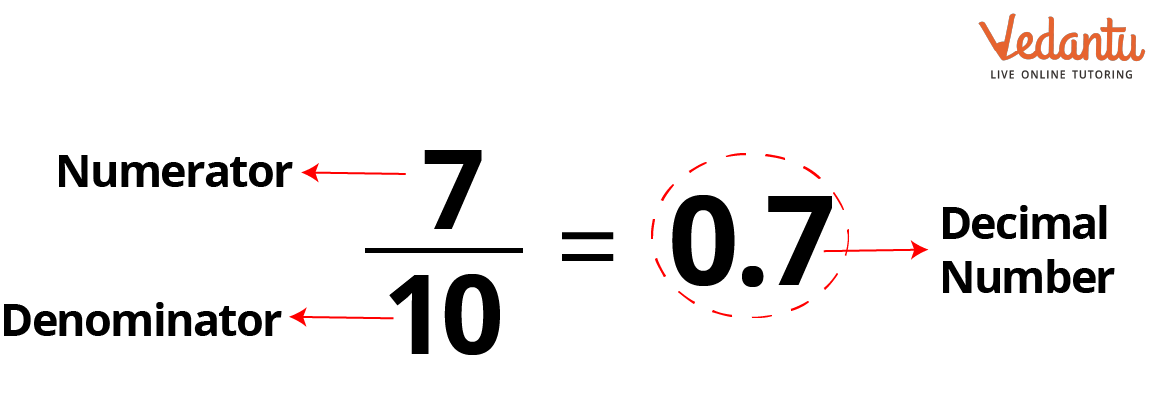
Decimal number representation
Let’s learn how to perform the multiplication of such decimal numbers.
Rules to Solve Problems on Multiplication of Decimal Numbers
Solving decimal addition and subtraction is easy, as you do not have to change the decimal place. However, you have to change the place of the decimal when you perform multiplication or division on decimal numbers or numbers. Let’s understand decimal multiplication word problems with a practical example.
Suppose you went to buy your favourite candy, which costs Rs. 0.50 for one piece. You want to buy four candies. So how will you calculate the amount you have to pay the shopkeeper?

Four candies
So, you can calculate the amount by multiplication. You can see that the full stop, or period symbol, between 0 and 5 makes the number decimal. So here, you have to multiply. To perform decimal multiplication, you have to follow certain rules.
Here are the rules you must follow:
First, multiply the number by ignoring the decimal place.
The next step is to place the decimal point in the product after counting the number of digits before the decimal point in the multiplicand.
Let’s solve the candy problem by using these two rules.
The price of one piece = Rs. 0.50
The price of four pieces will be the price of one piece multiplied by 4, which is =$0.50 \times 4$.
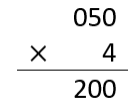
First step of decimal multiplication
The next step is to place the decimal point by counting the number of digits before the decimal point in the multiplicand. Here, the multiplicand is 0.50. Hence, we place the decimal point by putting the decimal point after 0 in the product.
Note: Always start from the right side of the digits in the product.
There are two digits in front of the decimal point in the multiplicand. Hence, the result will be Rs. 2.00 as shown below.
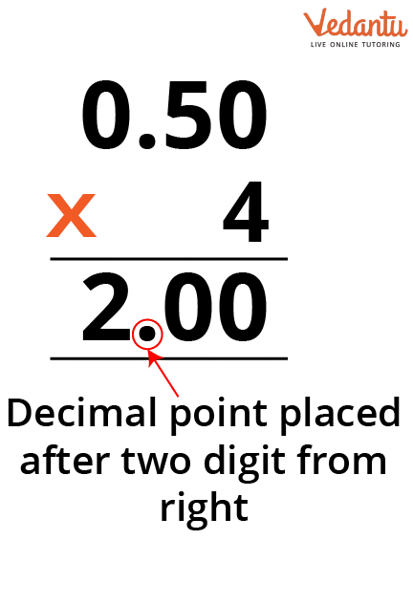
Decimal placement after multiplication
So, this is how you can perform multiplication on decimal numbers.
Solved Examples of Decimal Multiplication
Find the product of 12.25 and 2.
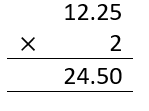
Here, the multiplicand contains two digits after the decimal point. So in the solution, the product also has the decimal place after two digits from the right.
Determine the product of 14.3 and 4.
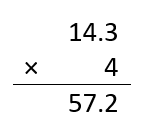
Here, the multiplicand contains two digits after the decimal point. So in the solution, the product also has the decimal place after two digits from the right.
Find the product of 25.5 and 2.
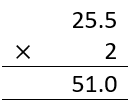
Here, the multiplicand contains one digit after the decimal point. So, in the solution, the product also has the decimal place after one digit from the right.
Decimal Multiplication Worksheet
The questions in the decimal multiplication worksheet given below, along with the answers, will help you practice decimal multiplication much better.
- Find the product of 42.5 and 4
Ans: 170.00
- Find the product of 20.5 and 3
Ans: 61.50
- Find the product of 10.5 and 6
Ans: 63.00
- Find the product of 23.1 and 10
Ans: 231.00
Conclusion
In this article, you have learnt about decimal numbers. The uses of decimals in daily life and the rules that must be followed while performing decimal multiplication. You have learnt that when performing decimal multiplication, you must take care of the number of digits present in front of the decimal point. Apart from these, you have also learnt to solve decimal multiplication questions.
FAQs on Word Problems on Multiplication of Decimals Explained Clearly
1. What are word problems on multiplication of decimals?
Word problems on multiplication of decimals are real-life questions where you multiply decimal numbers to find a total, cost, area, or product. These problems often involve money, measurements, or quantities with decimal values.
- They require identifying the numbers to multiply.
- Convert the situation into a mathematical equation.
- Multiply the decimals and place the decimal point correctly.
2. How do you solve word problems involving multiplication of decimals?
To solve word problems involving multiplication of decimals, first write the situation as a decimal multiplication equation and then multiply carefully. Follow these steps:
- Read the problem and identify the decimal numbers.
- Write the multiplication expression.
- Multiply as whole numbers.
- Place the decimal point based on total decimal places.
3. What is the rule for multiplying decimals in word problems?
The rule for multiplying decimals is to multiply as whole numbers and then place the decimal point according to the total number of decimal places in the factors. For example:
- Count decimal places in both numbers.
- Multiply ignoring decimal points.
- Insert the decimal point in the product.
4. Can you give an example of a word problem on multiplication of decimals?
Yes, a common example is finding total cost when prices are in decimals. Example: A pen costs 1.75 dollars. What is the cost of 5 pens?
- Write the equation: 1.75 × 5
- Multiply: 175 × 5 = 875
- Place two decimal places → 8.75
5. How do you multiply decimals with different decimal places in word problems?
To multiply decimals with different decimal places, count the total decimal places in both numbers and place the decimal accordingly in the product. Example:
- Multiply 2.4 × 0.35
- 24 × 35 = 840
- Total decimal places = 3
- Final answer = 0.840 or 0.84
6. What are common mistakes in decimal multiplication word problems?
The most common mistake in decimal multiplication word problems is placing the decimal point incorrectly in the final answer. Other frequent errors include:
- Forgetting to count total decimal places.
- Misreading the word problem.
- Not checking if the answer is reasonable.
7. How do you estimate answers in decimal multiplication word problems?
To estimate decimal multiplication, round the decimals to the nearest whole number before multiplying. Estimation helps check if your exact answer is reasonable.
- Round each decimal.
- Multiply the rounded numbers.
8. How are decimal multiplication word problems used in real life?
Decimal multiplication word problems are used in real life for calculating money, measurements, and area. Common applications include:
- Finding total cost (price × quantity).
- Calculating area (length × width).
- Measuring distances or weights.
9. How do you solve money word problems with multiplication of decimals?
To solve money word problems, multiply the price per item by the number of items and express the answer in currency form. Steps:
- Write the multiplication expression.
- Multiply carefully.
- Place the decimal point correctly.
10. What is the difference between multiplying whole numbers and multiplying decimals in word problems?
The difference is that multiplying decimals requires correct placement of the decimal point in the final product. In both cases, you multiply the digits the same way, but with decimals:
- Count total decimal places in the factors.
- Insert the decimal in the product.
