









How To Round Off A Number To The Nearest Hundredth With Step By Step Examples
What is the Concept Behind Rounding-off?
The concept of rounding-off was developed to get the approximate value of numbers in decimal because any number like 23.1345 would look odd but when we can make it simpler to 23.13 i.e., to the nearest hundredth value. Thus, rounding off makes the long decimal numbers easier to remember.
We stated that rounding-off is similar to approximation and we represent it by a symbol ≈, which is a short way to display the round-off of any number because the math works more on symbols than prolonged statements.
Now, let us get through the process of finding the round-off of a number to the nearest hundredth with solved examples.
Process to Round-off to the Nearest Hundredth
In Maths, the decimal numbers are the numbers that rely on the powers of 10, which means when we move from left to right, the place value of the number gets divided by 10.
Hence, the place value system is the best method to determine the tenths, hundredths, thousandths, and so on of the digits of any given number.
Here, tenth means 1/10, hundredth means 1/100, thousandth means 1/1000, and so on.
What is the Hundredth of a Number?
The image you can see below clearly shows the place value of a decimal number.
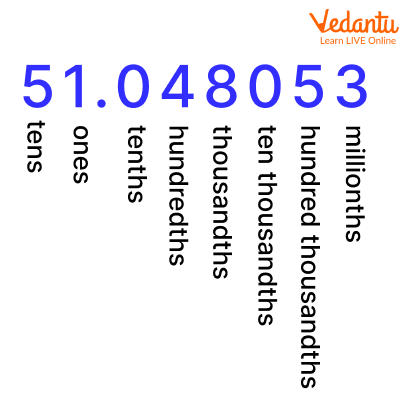
Representation of the hundredth place of a decimal number?
So, the digits to the left are 5 and 1, where 1 is at the one’s place and 5 is at the tens place, which means from right to left, the place value increases. Whereas going from left to right after the decimal point, we notice that the place value of ‘0’ is at tenths place or1/10, 4 at hundredths place or 4/100, 8 is at thousandths place or 8/1000, and so on.
While rounding the number to its nearest hundredth place, we must follow the given steps:
Let us assume a decimal number: 3.1736
Now, we have to round off the number 3. 1736 to its nearest hundredth value.
Step 1: Firstly, we need to recognise the hundredth digit. (Here, 7 is the digit in the hundredth position or it has the hundredth place value)
Step 2: Now, we proceed with the digit that is just next to the hundredth digit. (Here, 3 is the digit, which is just after the hundredth digit)
Step 3: Now, we need to check whether the digit next to the hundredth place is greater than or equal to 5, round up the hundredth digit, or else round down the hundredth digit. (Here, we notice that 3 is less than 5, so we round down).
Step 4: Since the digit after the hundredth place was lesser than 5 so the digit at the hundredth place remains the same as 6, as 2 is less than 5.
Hence, the number 3.1736 rounds off to its nearest hundredth as 3.17.
Examples of Rounding off to the Nearest Hundredth
6. 1234
Here, 2 is the digit at the hundredth place and the digit just after it is ‘3’ which is lesser than 5, so the 6.1234 rounds off to 6.12
5.1289
Here, 2 is at the hundredth place and 8 is at the thousandth place which is greater than 5, so here we have a new case when 8 > 5 and ‘2’ at the hundredth place changes to ‘3’. Hence, the round-off to the nearest hundredth becomes 5.13 for 5.1289.
A Fact to Remember:
Approximately equal to sign is often used to indicate rounding of exact numbers, e.g., 9.98 ≈ 10. This sign was introduced by Alfred George Greenhill in 1892.
So, this was all about the round-off concept. The above context explains to us that if the digit at the thousandth place is lesser than 5 then we just take two places after the decimal as such (we did in an example 3.1736). However, when the same digit is greater than 5, we increase the value of the digit at the hundredths place by 1, as we did in the example of 5.1289.
FAQs on Round Off Number To The Nearest Hundredth Made Simple
1. What does it mean to round off a number to the nearest hundredth?
Rounding off a number to the nearest hundredth means adjusting the number to two decimal places based on standard rounding rules. The hundredth place is the second digit to the right of the decimal point.
- Look at the digit in the thousandth place (third decimal place).
- If it is 5 or more, increase the hundredth digit by 1.
- If it is less than 5, keep the hundredth digit the same.
2. How do you round a decimal to the nearest hundredth?
To round a decimal to the nearest hundredth, check the digit in the thousandth place and apply the rounding rule. Follow these steps:
- Identify the hundredth digit (second decimal place).
- Look at the digit to its right (thousandth place).
- If it is 5 or more, add 1 to the hundredth digit.
- If it is less than 5, leave the hundredth digit unchanged.
3. What is the hundredth place in a decimal number?
The hundredth place is the second digit to the right of the decimal point in a decimal number. In place value terms:
- First digit after decimal = tenths
- Second digit after decimal = hundredths
- Third digit after decimal = thousandths
4. Can you give an example of rounding to the nearest hundredth?
Yes, rounding 12.347 to the nearest hundredth gives 12.35. Here is how:
- Hundredth digit = 4
- Thousandth digit = 7
- Since 7 ≥ 5, increase the hundredth digit by 1.
5. What happens if the thousandth digit is 5 when rounding to the nearest hundredth?
If the thousandth digit is 5 or greater, you round the hundredth digit up by 1. This follows the standard rounding rule used in mathematics.
- Example: 9.245
- Hundredth digit = 4
- Thousandth digit = 5
- Since it is 5, round up → 9.25
6. How do you round a whole number to the nearest hundredth?
To round a whole number to the nearest hundredth, write it with two decimal places, which does not change its value. A whole number already has zero in the tenths and hundredths places.
- Example: 8 → 8.00
- Example: 15 → 15.00
7. What is the difference between rounding to the nearest tenth and nearest hundredth?
The difference is the place value you round to—tenths is one decimal place, while hundredths is two decimal places.
- Nearest tenth: Look at the hundredth digit.
- Nearest hundredth: Look at the thousandth digit.
- Nearest tenth → 4.4
- Nearest hundredth → 4.38
8. How do you round negative numbers to the nearest hundredth?
To round a negative number to the nearest hundredth, apply the same rounding rules and keep the negative sign.
- Example: −2.786
- Hundredth digit = 8
- Thousandth digit = 6 (≥ 5)
- Round up → −2.79
9. Why is rounding to the nearest hundredth important?
Rounding to the nearest hundredth is important because it provides a balanced level of precision for measurements, money, and calculations. It is commonly used in:
- Financial calculations (currency values like 5.27)
- Scientific measurements
- Statistics and data reporting
10. What are common mistakes when rounding to the nearest hundredth?
A common mistake when rounding to the nearest hundredth is checking the wrong digit or forgetting place value rules. Watch out for these errors:
- Looking at the hundredth digit instead of the thousandth digit.
- Not increasing the hundredth digit when the next digit is 5 or more.
- Dropping digits without rounding correctly.
