









Place Value Chart Definition Rules and Solved Examples
How Does Each Digit Hold a Value in Any Given Number?
Your mom is still a mom whether she is in the kitchen, garden, living room, or the basement. But digits like 5 at different places (for example, tens or hundreds of places) means something different. Every digit in a number has a place value in Mathematics. Place value is the value represented by a digit in a number based on its place in the number. In this article we'll help you out to understand it in an easy way.
Place value for Grade 4 is important because it serves as a foundation for grouping, multiple-digit multiplication, and other operations in the decimal system, as well as a starting point for learning about other base systems. By understanding this you'll be able to understand the key differences like Rs. 50 you got for your birthday and the Rs. 500 price tag on the Remote Car for which you're saving for.
In Mathematics, the position or place of a digit in a number is referred to as place value. Each digit has a specific place in a number. The position of each digit will be expanded when we represent the number in general form. Those positions begin with a unit position, often known as one's position. Units, tens, hundreds, thousands, ten thousand, a hundred thousand, and so on are the place values of a number's digits in sequence from right to left.
What Is Place Value?
The value of each digit in a number is determined by its position in that number. We have given a chart below, that is a place value chart which helps in the identification of large numbers. This place value chart is read from left to right. In the Indian system, we begin arranging numbers from right to left in groups of three, and then in groups of two. The place value chart is divided into intervals, which include ones, thousands, lakhs, and crores.
The 5 in 250, for example, indicates 5 tens, or 50; whereas, the 5 in 5,126 denotes 5 thousands, or 5,000. It is important to understand that while a digit can be the same, its value is determined by its position in the number. A place value grid, such as the one shown below, will most likely be used to understand place value in a better way.

Place value chart
International Place Value Chart
The International place value chart is a place value system that is used in many countries around the world. We use a place value chart to understand the place value of each digit so that we can identify each digit. We start grouping the numbers from right to left in groups of three, called periods, and we place a comma or space after each period to make the number easier to read.

International place value chart
Place, Place Value and Face Value
A number is made by grouping a few digits together.
Each digit will have a fixed position called its place.
Each digit’s value depends on its place, which is known as the place value of the digit.
The face value of a digit in the given number is just the value of the digit itself.
The place value formula of a digit can be written as the product of face value of the digit and value of the place.
That is,
Place value = (Face value of the digit) × (Value of the place)
Example:
In the number 874321, write the digit which is in:
(a) hundreds place
(b) hundred thousand place
(c) ten thousand’s place
(d) and One’s place
Sol:
(a) A number in hundreds places is 3.
(b) A number in a hundred thousand places is 8.
(c) A number in ten thousand’s place is 7.
(d) The number in One’s place is 1.
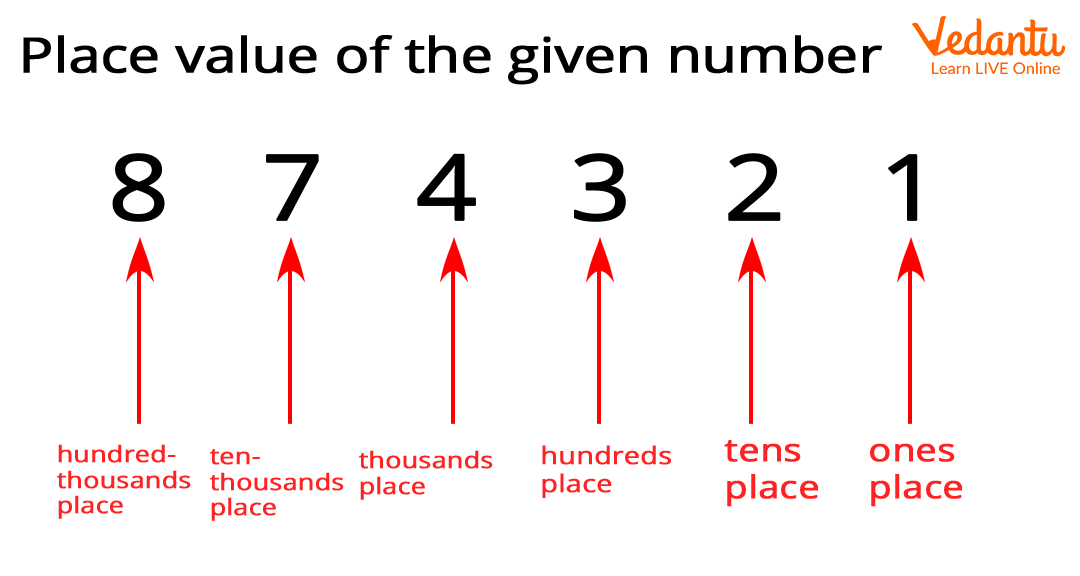
Place values of each digit in the number 874321
Conclusion
Having a strong understanding of place value is a good step because it gives you the key number knowledge you need to solve calculations like addition, subtraction, multiplication, division, and fractions. It would be difficult to write numbers, identify one more or one less, count forwards and backwards, or compare numbers if you are not thorough about place value. Moreover, understanding place value in Maths has a significant impact on how we think about basic concepts such as money. Understanding place value can help you figure out how much something costs when we wish to buy it.
FAQs on Place Value in the Number System Explained Clearly
1. What is place value in the number system?
Place value in the number system is the value of a digit based on its position in a number. In the decimal number system, each place represents a power of 10.
- The rightmost digit is the ones place (10⁰).
- Next is the tens place (10¹).
- Then the hundreds place (10²), and so on.
2. How do you find the place value of a digit in a number?
To find the place value of a digit, multiply the digit by the value of its position. Use these steps:
- Identify the digit.
- Determine its position (ones, tens, hundreds, etc.).
- Multiply: Digit × Place value.
3. What is the difference between place value and face value?
The face value of a digit is the digit itself, while the place value depends on its position in the number.
- Face value: The actual digit (e.g., 7 in 372 is 7).
- Place value: Digit × position value (7 in 372 = 70).
4. What is the place value chart in the decimal number system?
A place value chart shows the positions of digits in the decimal number system based on powers of 10. Common columns include:
- Ones (10⁰)
- Tens (10¹)
- Hundreds (10²)
- Thousands (10³)
- Ten Thousands (10⁴)
5. How do you write a number in expanded form using place value?
Expanded form expresses a number as the sum of each digit multiplied by its place value. Example: Write 6,482 in expanded form.
- 6 × 1000 = 6000
- 4 × 100 = 400
- 8 × 10 = 80
- 2 × 1 = 2
6. Why is place value important in mathematics?
Place value is important because it helps us understand the value of digits and perform arithmetic operations correctly. It is essential for:
- Reading and writing large numbers
- Addition, subtraction, multiplication, and division
- Comparing and ordering numbers
- Understanding decimals
7. What is the place value of digits in decimal numbers?
In decimal numbers, place value extends to the right of the decimal point in powers of 10 less than 1.
- Tenths = 10⁻¹
- Hundredths = 10⁻²
- Thousandths = 10⁻³
8. How do you compare numbers using place value?
To compare numbers using place value, compare digits starting from the highest place value. Follow these steps:
- Compare digits in the largest place (e.g., thousands).
- If equal, move to the next place (hundreds, tens, ones).
- The first unequal digit determines the greater number.
9. What is the place value of zero in a number?
The place value of zero is zero, but it acts as a placeholder to show the position of other digits. Example: In 4,507:
- The 0 is in the tens place.
- Its place value is 0 × 10 = 0.
10. Can you give an example of place value in a large number?
Yes, place value in large numbers follows the same power-of-10 pattern. Example: In 72,45,681 (Indian system):
- 7 is in the ten lakhs place = 70,00,000
- 2 is in the lakhs place = 2,00,000
- 4 is in the ten thousands place = 40,000
- 5 is in the thousands place = 5,000
- 6 is in the hundreds place = 600
- 8 is in the tens place = 80
- 1 is in the ones place = 1
