









How to Solve Mixed Operations Problems Using Order of Operations Steps and Examples
Mixed operations are a set of operations in mathematics that can be defined as two or more operations, performed simultaneously on the same set of numbers. These are important to study in mathematics. Mixed operations are multiple operations involved like addition, subtraction, multiplication and division. Using PEMDAS or BODMAS rules, we demonstrate how to implement mixed operations. This article also helps you in attaining addition, subtraction, multiplication, and division worksheets pdf for free. So, let's begin.
What are Mixed Operations?
Mixed operations are those operations in which more than one operation is done. Suppose there is an expression, 5 + 2 -1. Here we can see that two operations are used. One is addition and the other one is subtraction. So such expressions will come under the mixed operations.
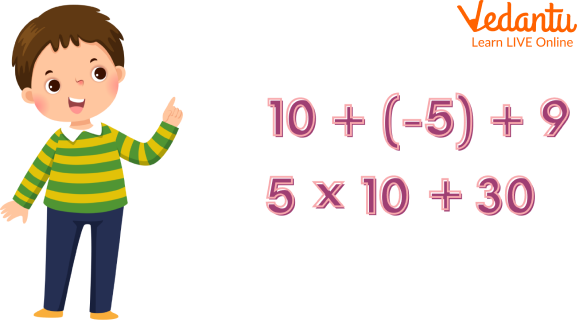
Mixed Operations
Order of Operation
The below-given image shows the order in which the operations are applied to a problem, having more than one operation.
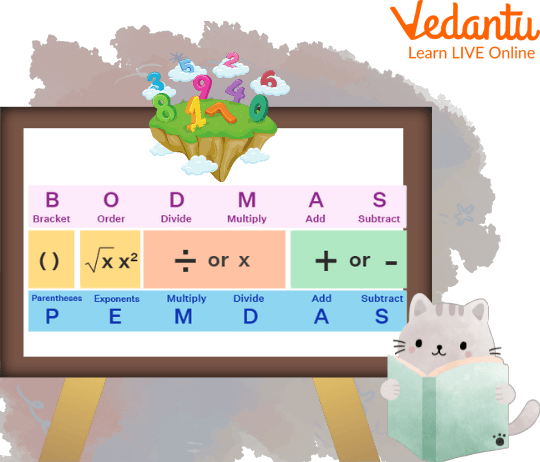
Order of Operations
Mixed Operations Rules
Following are the mixed operation rules:
Operation rule 1: First thing to do while operating the expression is to solve the numbers inside the parenthesis or bracket. We solve the parenthesis inside to out, grouping the operations. Observe the pattern of brackets present in the expression. There is an order to solve brackets, that is $[\{()\}]$. First, we solve the round bracket (), then the curly bracket {} then the box(square) bracket []. The order of operations to be followed inside the brackets.
Operation rule 2: After operating on parenthesis, we look for exponents. If present, solve them.
Operation rule 3: Now, we operate on the four basic operations. In this step, we look for numbers with multiplication and division operations. If present, solve them from left to right.
Operation rule 4: Last operations to be carried out are addition or subtraction and solving them from left to right.
Solved Mixed Addition and Subtraction Word Problems for Grade 2
Below are some addition and subtraction worksheets for grade 2:
Q 1. $4 \times(5+2)$
Ans: $4 \times(7)=28$ (Correct $(\checkmark)$.) This is a correct way to solve the parentheses) Let us look at another approach for the same expression. $4 \times(5+2)=20+2=22$ (Incorrect $(X)$.) This is an incorrect way to solve.
Q 2. $4 \times(-5)^2$
Ans: $4 \times(25)=100$ (Correct $(\checkmark)$.) This is a correct way to solve the exponents)
Another approach for the same expression may be as follows
$4 \times(-5)^2=-20^2=-400$ ((Incorrect $(X)$.) This is an incorrect way to solve the exponent
Q 3. $3+5 \times 2$
Ans: $3+5 \times 2=3+10=13$ (Correct $(\checkmark)$. Correct order.)
Another approach for the same expression may be as follows
$3+5 \times 2=8 \times 2=16$ (Incorrect $(X)$. Incorrect order.)
Practice Problems
Here are some practice problems based on the addition and subtraction worksheets;
Q 1: Find the total of the difference of 230 and 101, with 452.
Ans. 581
Q 2. Find the sum of the difference of 435 and 281, with 412.
Ans. 566
Q 3. Subtract the sum of 79 and 53 from 123.
Ans. 9
Q 4. Multiply the quotient of 16 and 2 by 66.
Ans. 528
Q 5. Divide the multiplication of 6 and 3 by 9.
Ans. 2
Mixed Operations Worksheets
This article provides you with the addition, subtraction, multiplication, and division worksheets pdf to practice more and more to gain proficiency.
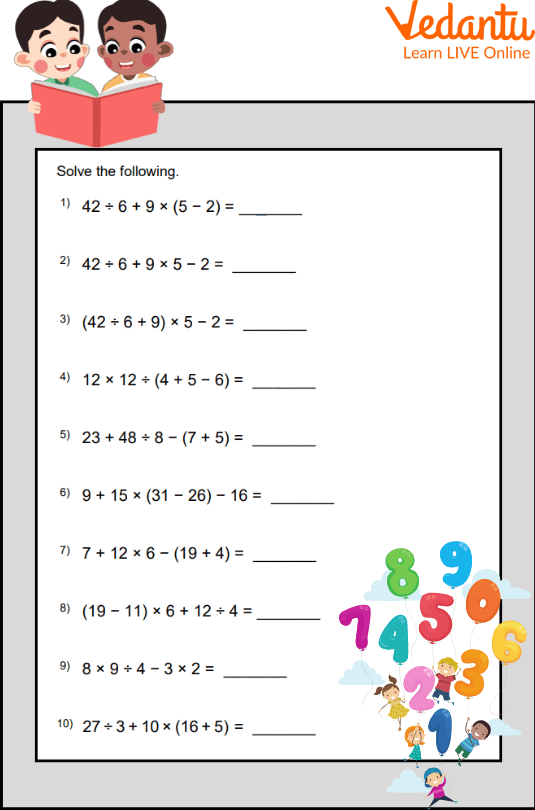
Mixed operations worksheets
Summary
Mixed operation is a mathematical concept that is used in many different fields of mathematics. It is used to describe situations where an operation produces more than one result, and can be viewed as a combination of two or more different operations. This concept can be applied to many fields such as combinatorics, probability and statistics. In this article, we tried to discuss some of these mixed operations in mathematics terms, along with some solved mixed addition and subtraction word problems for grade 2. If you understand the concept, you may find it interesting to solve the given addition and subtraction worksheets, even if you don't like studying mathematics.
FAQs on Mixed Operations Worksheets for Order of Operations Practice
1. What are mixed operations in maths?
Mixed operations are mathematical expressions that contain two or more operations such as addition, subtraction, multiplication, and division in the same problem. These problems require applying the correct order of operations to find the right answer. For example, in 8 + 4 × 3, you multiply first (4 × 3 = 12) and then add (8 + 12 = 20).
2. What is the order of operations in mixed operations worksheets?
The order of operations is the rule that tells you to solve expressions in the sequence PEMDAS: Parentheses, Exponents, Multiplication and Division, Addition and Subtraction. Follow these steps:
- Solve inside parentheses first.
- Simplify exponents.
- Perform multiplication and division from left to right.
- Perform addition and subtraction from left to right.
3. How do you solve mixed operations step by step?
To solve mixed operations, apply the order of operations (PEMDAS) step by step. For example, solve 12 − 3 × 2 + 4:
- Multiply first: 3 × 2 = 6
- Rewrite: 12 − 6 + 4
- Subtract left to right: 12 − 6 = 6
- Add: 6 + 4 = 10
4. Why is the order of operations important in mixed operations?
The order of operations is important because it ensures everyone gets the same correct answer for a mixed operations expression. Without it, expressions like 6 + 2 × 5 could have different answers. Using PEMDAS: 2 × 5 = 10, then 6 + 10 = 16, which is the correct result.
5. Can you give an example of a mixed operations problem with brackets?
A mixed operations problem with brackets requires solving inside the parentheses first. For example, (5 + 3) × 4:
- Solve inside brackets: 5 + 3 = 8
- Multiply: 8 × 4 = 32
6. What is the difference between simple operations and mixed operations?
Simple operations involve only one type of operation, while mixed operations include two or more different operations in one expression. For example:
- Simple: 7 + 5 = 12
- Mixed: 7 + 5 × 2
7. How do you solve mixed operations with division and multiplication?
Solve division and multiplication from left to right as they have equal priority in the order of operations. For example, 24 ÷ 6 × 2:
- Divide first (left to right): 24 ÷ 6 = 4
- Multiply: 4 × 2 = 8
8. What are common mistakes in mixed operations worksheets?
Common mistakes in mixed operations include ignoring the order of operations and solving from left to right without priority rules. Typical errors include:
- Adding before multiplying
- Forgetting to solve parentheses first
- Not working left to right for multiplication and division
9. How do you solve mixed operations with fractions?
To solve mixed operations with fractions, apply the order of operations and follow fraction rules for each step. For example, 1/2 + 3/4 × 2:
- Multiply first: 3/4 × 2 = 3/2
- Add: 1/2 + 3/2 = 4/2
- Simplify: 4/2 = 2
10. How can I practice mixed operations effectively?
You can practice mixed operations effectively by using structured mixed operations worksheets and checking each step using the order of operations. To improve accuracy:
- Solve step by step using PEMDAS
- Rewrite the expression after each step
- Check your final answer carefully
- Practice word problems involving multiple operations
