









What is the Before Number Concept with Number Line Examples
Do you know what comes before 236? We all learned counting in our previous classes. We all have learned the concept of less than, more than, and equals to. In this module, we are going to see the concept of before numbers.
Counting is a series of numbers in order. We use counting in our daily lives. We do addition, subtraction, division, and multiplication in our day-to-day life. The series of numbers have to be kept in mind for various purposes.
Every number has a number before and a number following the same. The number which comes before is the before the number and the number which follows a number is the after number. Before numbers can be easily understood through counting. A number preceding the number is before the number. For example, let's take a series of numbers which is 1,2,3,4,5,6,7,8,9. Now let's say the question is what is the previous number of 3, now if series 2 comes before 3. Hence, the before a number of 3 is 2.
Difference between Before Number and After Number
As the before number is the number that comes before, the after number is the number that comes after the specified number. In the counting series of 1,2,3,4,5,6,7,8,9, if the before a number of 5 is 4 then the after a number of 5 is 6. Another example is the before a number of 8 is 7 and the after a number of 8 is 9.
Before Number through Number Line Representation
Numbers can also be understood through Number Line Representation.
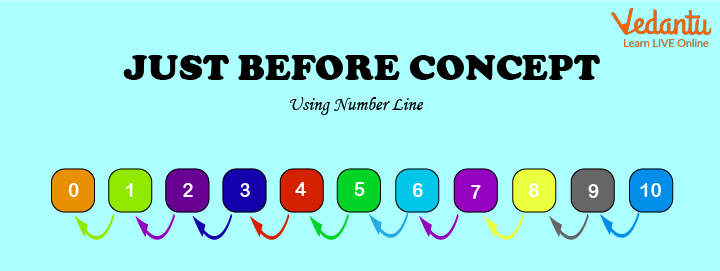
Just Before Concept
The number which comes left to the number is before the number. Let's take an example through this number line representation. As we can clearly see the arrows which are depicting the before numbers. 9 comes before 10, 8 comes before 9, 7 comes before 8, 6 comes before 7, 5 comes before 6, 4 comes before 5, 3 comes before 4, 2 comes before 3, and 1 comes before 2. This table can also be used to understand the concept of after number. 2 comes after 1, 3 comes after 2, 6 comes after 5, etc.
Solved Examples
Q1. What comes before 18?
Ans: Let’s memorise the counting to find the answer to this question. The answer to this would be 17 as 17 comes before 18 in the counting series. In the same way, the answer to what comes after 18 would be 19.
Q2. What comes before 15?
Ans: To solve this question, we have to keep counting in mind. As 14 comes before 15 in the counting. 14 is before a number of 15.
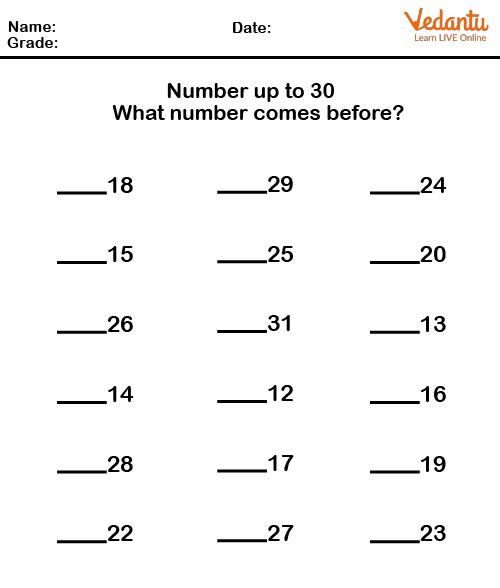
Worksheet for Before Number
This worksheet will help you understand the concept of before numbers in a better way. Children have to solve all the given questions.
Practice on Your Own
Q1. What comes before 675?
Ans: 674 comes before 675.
Q2. What comes before and after 238?
Ans: 237 comes before 238 and 239 comes after 238.
Summary
We all know the concept of counting which is used in addition, subtraction, multiplication, and division. The concept of counting is used to identify before numbers as well. Before number is the number that comes before the specified number. Before numbers are also used in more than and less than concepts of numbers.
FAQs on Understanding the Before Number Concept in Maths
1. What is the before number concept in Maths?
The before number concept is the understanding that one number comes immediately before another number in counting order. It helps children recognize number sequence and develop early number sense.
- If we count: 1, 2, 3, 4, 5
- The number before 5 is 4.
- The number before 3 is 2.
2. How do you find the number that comes before a given number?
To find the number before a given number, subtract 1 from that number. This works because numbers increase by one in a counting sequence.
- Before 10: 10 − 1 = 9
- Before 7: 7 − 1 = 6
- Before 1: 1 − 1 = 0
3. Why is the before number concept important for children?
The before number concept is important because it develops number sense and understanding of number sequence. It prepares children for addition, subtraction, and comparing numbers.
- Improves counting skills
- Builds sequencing ability
- Helps in solving basic subtraction problems
4. What is the number before 1?
The number before 1 is 0 in whole numbers. When counting starts from zero, 0 comes just before 1.
- Counting sequence: 0, 1, 2, 3…
- So, 1 − 1 = 0
5. What is the difference between before number and after number?
The before number is one less than a given number, while the after number is one more than it. Both are based on number sequence.
- Before 8 → 8 − 1 = 7
- After 8 → 8 + 1 = 9
6. Can you give examples of before numbers from 1 to 10?
Examples of before numbers from 1 to 10 show that each number has a value one less than it.
- Before 2 → 1
- Before 3 → 2
- Before 4 → 3
- Before 5 → 4
- Before 10 → 9
7. How do you teach the before number concept to kindergarten students?
You can teach the before number concept using counting activities and number lines. Visual and hands-on methods make learning easier.
- Use a number line and move one step backward.
- Count aloud forward and backward.
- Use objects like blocks and remove one to show subtraction of 1.
8. What is the formula for finding the before number?
The formula for finding the before number is n − 1, where n is the given number. This formula works for whole numbers and integers.
- If n = 15 → 15 − 1 = 14
- If n = 100 → 100 − 1 = 99
9. What are common mistakes students make with before numbers?
A common mistake is adding 1 instead of subtracting 1 when finding the before number. Students may confuse before and after concepts.
- Incorrect: Before 6 = 7
- Correct: 6 − 1 = 5
- Forgetting that before 1 is 0
10. How does the before number concept help in subtraction?
The before number concept helps in subtraction because subtracting 1 gives the number that comes immediately before. It builds the foundation for basic subtraction facts.
- 9 − 1 = 8 (8 is before 9)
- 20 − 1 = 19
