









How to Teach Counting Addition and Place Value Using Cups
What is Cup Maths?
We know that a cup is an item that holds something and that something is a volume. Now, a question arises: what is the use of cups in learning Maths? Well, today we are going to figure this out. Also, you will get to learn basic arithmetic operations on a set of numbers using a cup.
This will be fun for you all as writing numbers on a cup and then performing operations simultaneously will brush your mental calculations and also help you solve a variety of Maths questions that will not only help you at present but also in the future.
Now, let us start with a basic cup Maths example and proceed with certain questions based on it.
Example of a Cup Maths
Take three disposable cups and start writing numbers on one cup. Suppose you wrote 12 one-digit numbers on one cup, now, take the second cup and use all four Mathematical operators like +, -, and x. These four operators were for the first four numbers. Now, repeat the cycle and in this way, this cycle repeats three times to cover all 12 numbers.
Take the third cup and write numbers as per the numbers you took in the first cup and the operators you used on the second cup.
So, let us take the following numbers in the first cup:
2
5
6
8
5
9
8
6
5
7
4
9
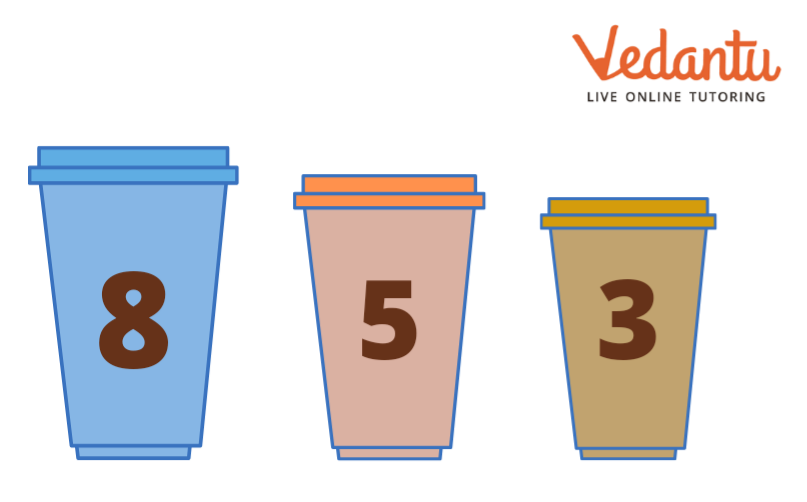
Cup Maths
Now, look at the following table and the corresponding operators that we used in the first and the second cup, respectively.
Here, we are going to take the fourth cup to show the results:
We know that the result will be the same as mentioned in the above table. However, we have to sharpen the mental calculation of a kid, so let us change the order of numbers in the fourth cup, as shown below:
Now, we will give it to the child so that he/she can arrange the numbers by looking at the first, second, and third cup to give the correct result in the fourth cup.
After he/she is done with the arranging part, check the solution. If he/she gets wrong somewhere, guide him/her by taking images of numbers or objects in surroundings or whatever suits you the best.
Hence, we conclude that cup Maths is an interesting and easy activity for kids to adopt the habit of mental calculation at a very young age. Practising this on a daily basis will master him/her and make a pro in Maths, which, in turn, will be helpful in the long run.
FAQs on Learn Maths With Cups Through Practical Activities
1. What does Learn Maths with Cups mean?
Learn Maths with Cups means using cups as hands-on objects to teach basic maths concepts like counting, addition, subtraction, multiplication, and place value. Cups act as simple manipulatives that help learners visualize numbers and quantities.
- Each cup can represent a number.
- Objects (beans, coins, counters) can be placed inside cups.
- Cups can be grouped to show tens, hundreds, or equal groups.
2. How do you teach counting with cups?
You teach counting with cups by placing a specific number of objects into each cup and counting them one by one. This builds one-to-one correspondence and number recognition.
- Label cups with numbers (1, 2, 3, 4...).
- Ask the learner to place the correct number of counters in each cup.
- Count aloud to reinforce number order.
3. How can cups be used to teach addition?
Cups can teach addition by combining objects from two cups to find the total sum. This shows addition as joining groups together.
- Put 3 counters in one cup.
- Put 2 counters in another cup.
- Combine and count all counters.
4. How do you explain subtraction using cups?
Subtraction with cups is shown by removing objects from a cup to find how many are left. This demonstrates subtraction as taking away.
- Place 7 counters in a cup.
- Remove 3 counters.
- Count the remaining counters.
5. Can cups help in teaching multiplication?
Yes, cups help teach multiplication by showing equal groups of objects. Multiplication is repeated addition of equal quantities.
- Place 4 counters in each cup.
- Use 3 cups.
- Count the total number of counters.
6. How can you teach division using cups?
Division with cups is taught by sharing objects equally into groups to find how many go in each cup. This shows division as equal sharing.
- Start with 12 counters.
- Divide them equally into 3 cups.
- Count how many are in each cup.
7. How do cups help in understanding place value?
Cups help explain place value by grouping objects into tens and ones. Each cup can represent a different place value column.
- One cup labeled “Ones”.
- One cup labeled “Tens”.
- 10 ones are exchanged for 1 ten.
8. What age group can use the cup method for learning maths?
The cup method is most effective for children aged 3 to 8 years who are learning early maths skills. It supports preschool and primary learners.
- Counting and number recognition (ages 3–5).
- Basic addition and subtraction (ages 5–7).
- Multiplication and division foundations (ages 6–8).
9. Why is learning maths with cups effective?
Learning maths with cups is effective because it turns abstract numbers into concrete, visual representations. Learners can see and touch quantities.
- Improves number sense.
- Builds strong conceptual understanding.
- Reduces maths anxiety.
10. What are common mistakes when teaching maths with cups?
A common mistake when teaching maths with cups is focusing only on counting without explaining the underlying maths concept. Understanding must go beyond moving objects.
- Not encouraging learners to explain their thinking.
- Skipping number labeling on cups.
- Moving to abstract numbers too quickly.
