









What Is the Meaning of Inverse in Maths with Definition and Examples
Inverse Mathematics
Are you wondering to know the meaning of inverse in Mathematics? Inverse is nothing but the opposite arithmetic operation or reverse the effect of each other. For example, the inverse of addition is subtraction and the inverse of multiplication is division.
The Inverse of Addition is Subtraction
Addition moves Forward whereas Subtraction moves Backward. Let us understand with an example:
30 + 4 = 34 can be reversed by 34 - 4 = 30. (Back to where we started)
The Inverse of Subtraction is Addition
Let us understand inverse of subtraction with an example:
12 - 3 = 9 can be reversed by 9 + 3 = 12 (Back to where we started)
Additive Inverse
Additive inverse is what we add to the given number to get Zero.
Example:
The additive inverse of -3 is 3 because -3 + 3 = 0
Also, the additive inverse of + 8 is - 8 because 8 - 8 = 0
The Inverse of Multiplication is Division
Multiplication can be “undone” by Division. Let us understand with an example:
Example: 6 8 = 48 can be reversed by 488 = 6 (Back to where we started)
The Inverse of Division is Multiplication
Division can be “undone” by Multiplication. Let us understand with an example:
Example: 18 3 = 6 can be reversed by 6 3 = 18 (Back to where we started)
Multiplicative Inverse
Multiplicative inverse is with what we multiply a given number to get the result 1.
In other words, it is simply the reciprocal of a given number. Let us understand with an example:
The multiplicative inverse of 6 is 16, because 6 16 = 1.
But Division With 0 Cannot be Done.
We cannot divide any number by 0.
Example:
6 0 = 0 cannot be reversed by 0 0.
Inverse Function
An inverse function can be “undone” by another function. Let us understand with an example:
Here, the function 3x + 5 is represented in a flow diagram below:
x Multiply by 3 3x Add 5 3x + 5
The inverse function goes the other way:
y - 53 Divided By 3 Y - 5 Subtract 5 y
Therefore, the inverse of 3x+ 5 is y - 53.
Inverse of Function Representation
The inverse is generally represented with a little -1 after the function name as shown below:
f⁻¹ (y)
It can be said as f inverse of y
Hence, the inverse of f(x) = 3x + 5 is written as:
f⁻¹ (y) = y - 53
Important Thing To Note About Inverse of A Function
The most important thing about the inverse of function is that it takes us back where we started.
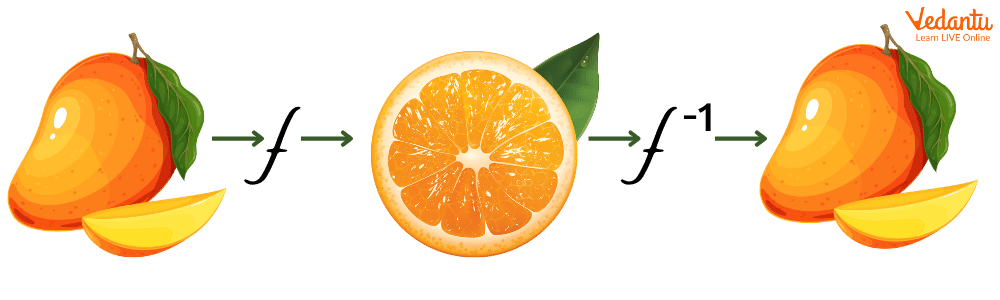
Here, the function f turns the mango into an orange.
Then, the inverse function f⁻¹ turns the orange back into the mango.
Let us understand with an example.
Inverse Function Example
Find the inverse of 5x + 5, when the value of x is 3,
Solution:
Given function: 5x + 5
Substituting the value of x in the above function, we get
53 + 5
15 + 5 = 20
Therefore, 5x + 5 = 20 ( when the value of x is 3).
Now, we will use the inverse on 20 using the formula discussed above .
f⁻¹ (20) = 20 - 55 = 3
And now you can see, we get the 3 back again.
This can be written in one line as:
f⁻¹ (f(20)) = 3
Hence, we can say applying a function f and then its inverse f⁻¹ give us the original value back.
f⁻¹ (f(x)) = x
Conclusion
In short, inverse means opposite in direction or position. The term ‘inverse’ is derived from the Latin word ‘inverses’ which means to turn upside down or inside and outside. In other words, an inverse operation is a mathematical operation that undoes what was performed on the previous operation.
FAQs on Inverse Meaning in Mathematics Explained Clearly
1. What does inverse mean in Maths?
In Maths, inverse means an operation or function that reverses the effect of another operation or function. If one process does something, its inverse undoes it.
- Addition and subtraction are inverses.
- Multiplication and division are inverses.
- A function and its inverse return you to the original value.
2. What is an inverse operation?
An inverse operation is an operation that reverses the effect of another operation. When two operations undo each other, they are called inverses.
- Addition ↔ Subtraction
- Multiplication ↔ Division
- Squaring ↔ Square root (for positive numbers)
3. What is the inverse of a number?
The inverse of a number usually means its multiplicative inverse, which is 1 divided by the number. The formula is 1/a for any non-zero number a.
- The inverse of 5 is 1/5.
- The inverse of 2/3 is 3/2.
4. What is the difference between additive inverse and multiplicative inverse?
The additive inverse gives a sum of 0, while the multiplicative inverse gives a product of 1.
- Additive inverse of a number a is −a.
- Multiplicative inverse of a number a is 1/a (a ≠ 0).
5. What is an inverse function?
An inverse function is a function that reverses the effect of the original function. If f(x) gives y, then its inverse f−1(y) gives back x.
- If f(x) = 2x + 3
- Then f−1(x) = (x − 3)/2
6. How do you find the inverse of a function?
To find the inverse of a function, swap x and y and solve for y. The steps are:
- Write the function as y = f(x).
- Swap x and y.
- Solve for y.
- Replace y with f−1(x).
7. What is the inverse of a matrix?
The inverse of a matrix is a matrix that, when multiplied by the original matrix, gives the identity matrix. For a 2×2 matrix A = [[a, b], [c, d]], the inverse is:
A−1 = (1/(ad − bc)) [[d, −b], [−c, a]]
- The determinant ad − bc must not be zero.
- If ad − bc = 0, the matrix has no inverse.
8. What does inverse proportion mean?
In inverse proportion, when one quantity increases, the other decreases so that their product remains constant. The relationship is written as y = k/x, where k is a constant.
- If x doubles, y halves.
- If x triples, y becomes one-third.
9. Can zero have an inverse?
Zero has an additive inverse but no multiplicative inverse.
- The additive inverse of 0 is 0 because 0 + 0 = 0.
- Zero has no multiplicative inverse because 1/0 is undefined.
10. Why are inverse operations important in solving equations?
Inverse operations are important because they help isolate the variable and solve equations. To solve an equation, you undo operations in reverse order using their inverses.
- For x + 5 = 12, subtract 5.
- x = 7.
