









How To Find X Intercept And Y Intercept Of A Line
What is the Intercept of a Line?
The x-intercept and the y-intercept are the two different types of intercepts. The line's actual point of intersection with the x-axis is known as the x-intercept, while its actual point of intersection with the y-axis is known as the y-intercept. In this article, we will define the intercept, show how to obtain the intercept for a given line, and demonstrate how to graph intercepts.
What is x-Intercept?
The general form of the linear equation is written as \[y = mx + c\], where m and c are constants. The line's crossing point, which is located at the x-axis of the plane, is known as the x-intercept. This indicates that anytime a linear equation crosses the x-axis, its y-coordinate value will always be equal to 0. The y-coordinate is zero for the x-intercept and the x-coordinate is zero for the y-intercept. The term "horizontal intercept" also applies to the x-intercept.
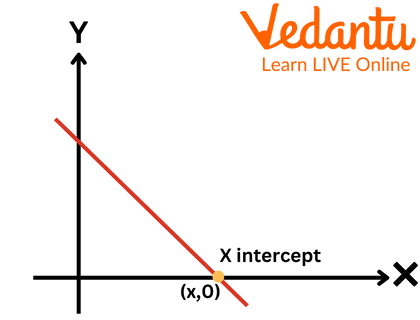
X-Intercept
What is y- Intercept?
The graph's intersection with the y-axis is known as the y-intercept. Finding the intercepts for any function with the formula \[y = f\left( x \right)\] is crucial when graphing the function. An intercept can be one of two different forms for a function. The x-intercept and the y-intercept are what they are. A function's intercept is the location on the axis where the function's graph crosses it.
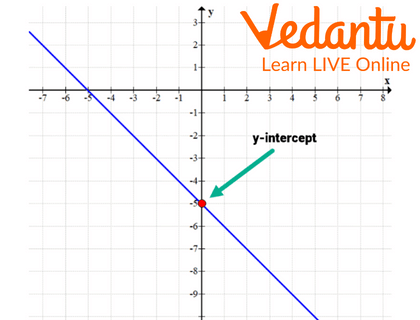
Y-Intercept
Equation of a Line with Intercepts
How to find an intercept of a straight line? Intercepts are subject to various equations and formulas. By solving for x and putting \[y = 0\] in the equation, all of the formulas are obtained.
Following are the steps to determine the y intercept of a function, where\[y = f\left( x \right)\], where \[x = 0\] is simply substituted.
Resolve for y.
Put the y-point intercepts in place (0, y).
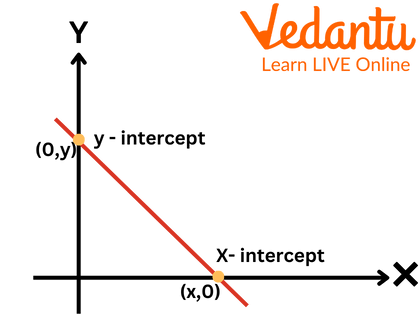
Intercepts
Conclusion
The two different kinds of intercepts are the x-intercept and the y-intercept. The x-intercept of a line is its actual point of intersection with the x-axis, and the y-intercept is its true point of intersection with the y-axis.
Solved Examples
Example 1:Find the value of "a" if the y-intercept of a function \[y = a(x - 1)\left( {x - 2} \right)\left( {x - 3} \right)\] is \[\left( {0,12} \right)\] .
Ans: The given function's equation is:
\[y = a(x - 1)\left( {x - 2} \right)\left( {x - 3} \right)\]
By adding \[x = 0\] to the y-intercept formula, it can be calculated.
\[y = a \left( {0 - 1} \right]\left[ {0 - 2} \right]\left[ {0 - 3} \right]\] \[ = - 6a\]
The y-intercept is therefore \[\left( {0, - 6a} \right)\]
However, the issue claims that the provided function's y-intercept is \[\left( {0,12} \right)\]. Thus,
\[ - 6a = 12\]
Using -6 to divide both sides,
\[a = - 2\]
Example 2: Find the x and y intercept in the given graph.
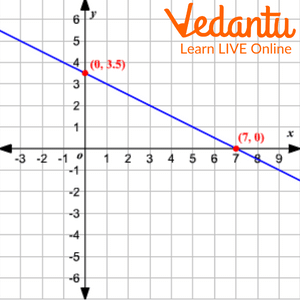
Ans: The x-intercept is 7 and y – intercept is 3.5 in the given graph.
Example 3: Find the x-intercept of \[y = 4x - 8\].
Ans: For finding the x – intercept we must put y coordinate as 0.
Thus, putting\[y = 0\] ,we will get:
\[\begin{array}{l}0 = 4x - 8\\8 = 4x\\x = 2\end{array}\]
Therefore, x coordinate is 2.
FAQs on Intercepts Of A Line Explained With Graphs and Equations
1. What are the intercepts of a line?
The intercepts of a line are the points where the line crosses the x-axis and y-axis. These are called the x-intercept and y-intercept respectively.
- The x-intercept is found where y = 0.
- The y-intercept is found where x = 0.
- Intercepts are written as coordinate points like (a, 0) or (0, b).
2. How do you find the x-intercept of a line?
The x-intercept of a line is found by setting y = 0 in the equation and solving for x.
- Example: For the line 2x + 3y = 6
- Set y = 0 → 2x = 6
- Solve → x = 3
- The x-intercept is (3, 0)
3. How do you find the y-intercept of a line?
The y-intercept of a line is found by setting x = 0 in the equation and solving for y.
- Example: For 2x + 3y = 6
- Set x = 0 → 3y = 6
- Solve → y = 2
- The y-intercept is (0, 2)
4. What is the intercept form of a line?
The intercept form of a line is written as x/a + y/b = 1, where a and b are the intercepts.
- a is the x-intercept.
- b is the y-intercept.
- The line crosses the axes at (a, 0) and (0, b).
5. How do you convert a linear equation into intercept form?
To convert a linear equation into intercept form, rewrite it so the right side equals 1.
- Example: Given 2x + 3y = 6
- Divide both sides by 6 → (2x/6) + (3y/6) = 1
- Simplify → x/3 + y/2 = 1
6. What is the difference between slope-intercept form and intercept form?
The slope-intercept form is written as y = mx + c, while the intercept form is written as x/a + y/b = 1.
- In slope-intercept form, m is slope and c is y-intercept.
- In intercept form, a and b are the x and y intercepts.
- Slope-intercept form emphasizes steepness, while intercept form emphasizes axis crossings.
7. Can a line have only one intercept?
Yes, a line can have only one intercept if it is parallel to one of the coordinate axes.
- A horizontal line like y = 4 has a y-intercept but no x-intercept.
- A vertical line like x = 2 has an x-intercept but no y-intercept.
8. What happens to the intercepts if a line passes through the origin?
If a line passes through the origin, both intercepts are at the point (0, 0).
- This means both x-intercept and y-intercept are zero.
- Example: y = 2x passes through the origin.
9. How do you graph a line using its intercepts?
To graph a line using intercepts, plot the x-intercept and y-intercept and draw a straight line through them.
- Step 1: Find x-intercept (set y = 0).
- Step 2: Find y-intercept (set x = 0).
- Step 3: Plot both points on the coordinate plane.
- Step 4: Draw a straight line joining them.
10. What is a worked example of finding intercepts of a line?
To find the intercepts of 3x − 2y = 6, set one variable to zero at a time.
- For x-intercept: set y = 0 → 3x = 6 → x = 2 → (2, 0)
- For y-intercept: set x = 0 → −2y = 6 → y = −3 → (0, −3)
