









Length Of Rectangle Formula Using Area And Perimeter With Examples
A rectangle could even be a closed 2-D shape, having four sides, four corners, and 4 proper angles [90°]. The rectangles are equal and parallel. Since a rectangle is a 2-D shape, it's characterized by two dimensions, length, and width. Length is the longer aspect of the rectangle and width is that of the shorter side. Examples of Rectangle:
Parks and Agriculture lands
Canvas
Tiles
Tables, etc.
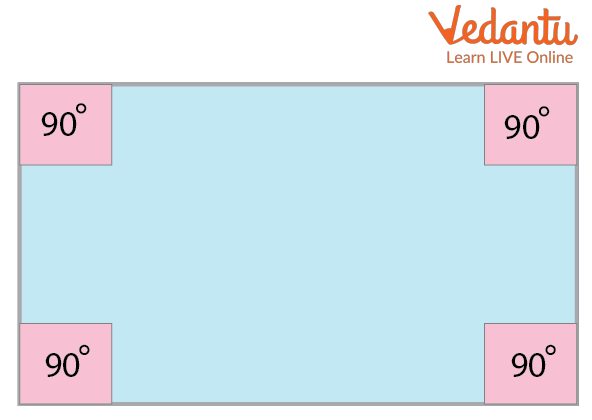
Rectangle
Length and Breadth of Rectangle:
We know that a rectangle is a Polygon shape in which the opposite sides are parallel and equal to each other and all four angles are right angles.
The longer side of the rectangle is known as the length of the rectangle.
The shorter side of the rectangle is known as the breadth of the rectangle. Breadth is additionally referred to as the width of a rectangle.
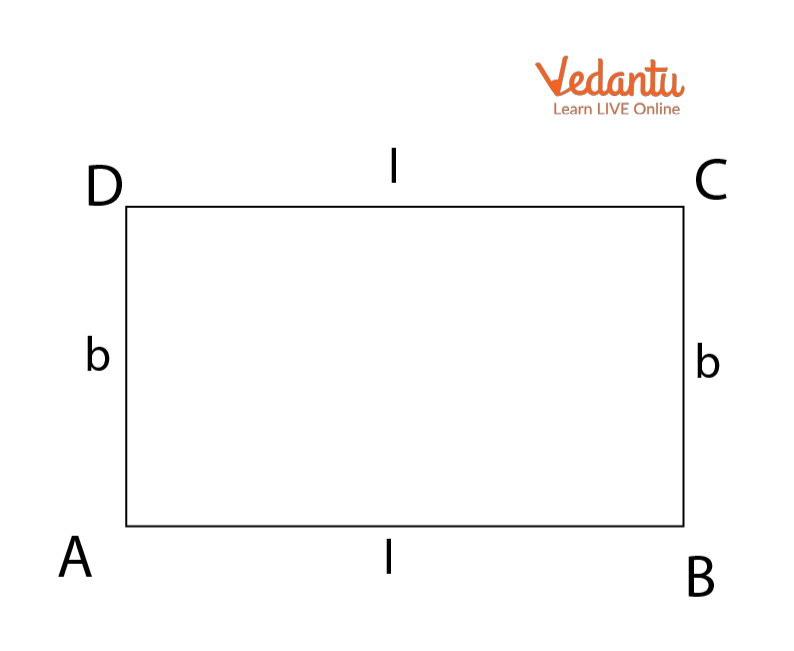
Breadth of the Rectangle
What are Length and Breadth:
Length - The definition of length is the measurement or extent of anything from beginning to conclusion. To put it another way, it is the greater of the higher two or three dimensions of a geometric form or object. A rectangle, for instance, has length and breadth as its dimensions. Additionally, the length might be a quantity in the International System of Quantities with the dimension distance.
Breadth - A similar word to width is breadth. A thing's breadth is the distance between its facets and features. Often, this is a noun. When a verbal desire is categorical regarding an object's size, the term is employed. For instance, when someone asks about the width of something, they are actually referring to the measurement. Additionally, it can be utilized to capture a range or variation of something that cannot be quantified. This might be a special talent or area of knowledge that a person possesses.
Length of Rectangle Formula:
If we've area of a rectangle is A; the breadth of a rectangle is B and the length of the rectangle is going to be L; so
Length formula:
\[{\rm{L = }}\dfrac{{\rm{A}}}{{\rm{B}}}\]
Length \[ = \] Area \[ \div \] Breadth
If we've perimeter of a rectangle is P, the breadth of the rectangle be B, and the length of the rectangle will be L; so
Length formula:
\[{\rm{L}} = \dfrac{{\rm{P}}}{2} - {\rm{B}}\]
Length = Perimeter ÷2 – Breadth
Breath of Rectangle Formula:
If we've area of a rectangle is A; the length of the rectangle be L and the breadth of the rectangle is going to be B; so
\[{\rm{B = }}\dfrac{{\rm{A}}}{{\rm{L}}}\]
Breadth \[ = \] Area \[ \div \] Length
If we've Perimeter of the rectangle is P; the length of the rectangle is L and the breadth of the rectangle is going to be B; so
\[{\rm{B}} = \dfrac{{\rm{P}}}{2} - {\rm{L}}\]
[Breadth = Perimeter ÷2 – Length]
How to Find Length and Breadth:
Find length and breadth when the area is given
Let’s discuss how to discover size or breadth when the vicinity of a rectangle is given.
Once we would like to locate the size of a rectangle we want to divide the place via breadth.
Length of a rectangle = Area ÷ breadth
l A b
Similarly, once we would like to discover the breadth of a rectangle we want to divide the region by way of length.
The breadth of a rectangle = Area ÷ length
b A l
Find length and breadth when the perimeter is given:
Let’s discuss the thanks to finding length or breadth when the perimeter of the Rectangle is given,
When we'd wish to find the length of a rectangle we need to subtract the breadth from the perimeter by 2
Length Perimeter 2breadth
Similarly, then we'd wish to find the breadth of the rectangle. We need to subtract land from the perimeter divided by two.
Breadth Perimeter 2length
Solved Examples
1. Find the length of the opposite side of the rectangle, the given area, and one of its sides. Rectangle area \[ = \]1575 sq m side 45m
Solution: Area of the rectangle=length× breadth\[ = \]1575sq.m
One side\[ = \]45m
1575\[ = \]length\[ \times \]45.
length \[ = \frac{{1575}}{{45}} = 35\]m
The length of his visit is 35m.
2. Find the breadth of the rectangle whose perimeter is 360 cm and whose breadth is 80 cm.
Solution: Perimeter of Rectangle=360cm
Breadth \[ = \] 80cm
Length \[ = \] Perimeter/2-breadth
\[ = \]\[\frac{{360}}{2} - 80\]
\[ = 180 - 80\]
\[ = 100\]cm
Lengths are 100cm.
3. Find the length of a rectangle whose perimeter is 20 cm and breadth is 1 cm.
Solution: Perimeter of Rectangle \[ = \]20cm
Breadth \[ = \]1cm
Length\[ = \]?
Length \[ = \]perimeter/2\[ - \]breadth
\[ = \frac{{20}}{2} - 1\]
\[ = 10 - 1\]
\[ = \]9cm.
The length goes to be 9cm.
Summary
The rectangle is a quadrilateral that has 4 sides and 4 angles. The longer side of the rectangle is known as size and the Shorter side of the rectangle is referred to as Breadth. A rectangle is four-sided and all the internal angles are equal to 90 degrees. The length of the opposite sides of the rectangle is always equal to each other. If all the sides are equal then it is square.
FAQs on How To Calculate The Length Of A Rectangle
1. What is the formula to find the length of a rectangle?
The formula to find the length of a rectangle is Length = Area ÷ Width.
- If the area and width (breadth) are given, divide the area by the width.
- Formula: L = A ÷ W
- Example: If area = 48 cm² and width = 6 cm, then L = 48 ÷ 6 = 8 cm.
2. How do you find the length of a rectangle if the perimeter is given?
You can find the length of a rectangle using the formula L = (P ÷ 2) − W.
- Perimeter formula: P = 2(L + W)
- Step 1: Divide perimeter by 2.
- Step 2: Subtract the width.
- Example: If P = 30 cm and W = 5 cm, then L = (30 ÷ 2) − 5 = 15 − 5 = 10 cm.
3. How do you calculate the length of a rectangle from its area and width?
To calculate the length of a rectangle, divide the given area by the width.
- Formula: L = A ÷ W
- Example: If area = 72 m² and width = 9 m, then L = 72 ÷ 9 = 8 m.
4. Can you find the length of a rectangle without the width?
No, you cannot find the exact length of a rectangle without knowing at least one more measurement such as width, area, or perimeter.
- You need at least two related values (like area and width).
- With only one measurement, the length cannot be uniquely determined.
5. What is the relationship between length, width, and area of a rectangle?
The relationship is given by the formula Area = Length × Width.
- A = L × W
- Length and width are the two dimensions of a rectangle.
- If you know any two values, you can find the third.
6. How do you find the length of a rectangle step by step?
To find the length of a rectangle, use the formula L = A ÷ W or L = (P ÷ 2) − W depending on the given values.
- Step 1: Identify what is given (area or perimeter).
- Step 2: Choose the correct formula.
- Step 3: Substitute the known values.
- Step 4: Solve and write the answer with units.
7. What is an example of finding the length of a rectangle?
An example of finding the length of a rectangle is when the area is 60 cm² and the width is 5 cm.
- Use the formula: L = A ÷ W
- L = 60 ÷ 5
- L = 12 cm
8. How do you find the length of a rectangle if the diagonal and width are given?
You can find the length of a rectangle using the Pythagorean theorem: L = √(D² − W²).
- Diagonal formula: D² = L² + W²
- Rearranged: L = √(D² − W²)
- Example: If D = 13 cm and W = 5 cm, then L = √(169 − 25) = √144 = 12 cm.
9. Is the length always longer than the width in a rectangle?
No, the length is not always longer than the width, but it is usually defined as the longer side by convention.
- In geometry, length is often the longer dimension.
- If both sides are equal, the shape becomes a square.
10. What units are used to measure the length of a rectangle?
The length of a rectangle is measured in units of length such as meters, centimeters, inches, or feet.
- Common metric units: mm, cm, m, km
- Common imperial units: inches, feet, yards
- The unit must match the width when calculating area.
