









What Is Average In Maths For Kids With Formula And Examples
Let us assume that you go to the market along with two of your friends to purchase a gift item for your science teacher. Suddenly, you find a weighing machine in the shop and each of you decides to see your weight, so your weight comes out to be 4 kg, your friend F1 has 6 kg, and another friend F2 has 5 kg. Then the average of your weight would be the sum of your weights divided by 3 (your 2 friends and you).
Is there any other way to show the average?
To know the concept of average and its types more deeply let us read this article.
Types of Averages
The three types of averages are as follows:
Mean: It is obtained by adding all the numbers and dividing the sum by the total numbers in the given set.
Median: It is the middle number from the given set of numbers.
Mode: It is the most common result.
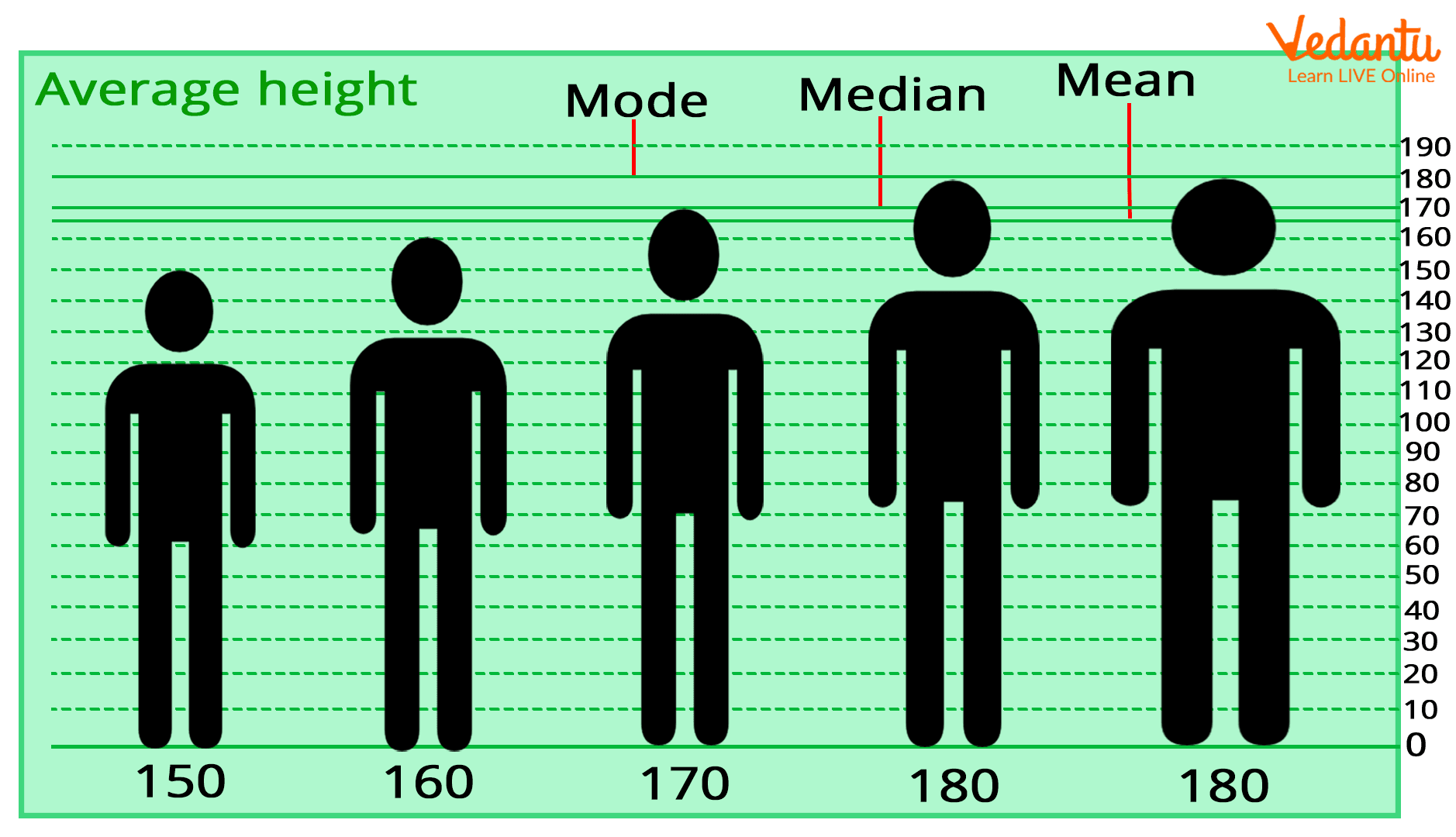
Moving forward, we will provide an explanation of all these types.
Explanation of Average
From the above text, we noticed the following three values of weight:
Your weight - 4
Friend F1 - 6
F2 - 5
Now, let us sum up these values: 4 + 6 + 5 = 15
Number of people = 3
The average weight of three kids will be calculated as:
\[Average=\frac{Sum\, of\, weight\, of\, three\, people}{Number\, of\, people}=\frac{15}{3}=5\]
Here, you can notice the following things:
Just add 4 and 6 = 4 + 6 = 10
Now, divide it by two people = \[\frac{10}{2}= 5\]
Again, you get ‘5’ here, which means your friend’s weight is the average of you and your friend F1’s weight. Also, you can say that F2 is the mean weight of you and your friend.
Hence, you and your friend’s F1 weight is close to or approximately F2’s weight.
Besides this, we call the middle value ‘5’ of the given set of three numbers the median of the set.
How to Find Averages in Simple Terms?
The average of a set of numbers is simply the sum of the observations upon the total number of values in the set. For example, suppose we want to determine the median of 4, 2, 10, 8 and 6. Now let us arrange these values:
2
4
6
8
10
Simply, find the sum of the numbers: 2 + 4 + 6 + 8 + 10 = 30 and divide by 5 to get average \[\left (\frac{30}{5}\right )= 6\]. Here, you can notice that 6 is in the middle and the average that we got here is also 6, which means 6 is the median of the above observation.
Now, let’s discuss about the mode. The mode is the most common result. For example, Class A students have roll numbers in the following order:
Rohit - 10
Sonali - 15
Rishabh - 20
Sohan - 25
Now, adding these numbers- 10 + 15 + 20 + 25 = 60
Now, dividing the sum by 4:
\[\frac{120}{8} = 15\]
Let us take another class. Class B has students’ roll numbers in the following order:
Roma - 6
Shreya - 9
Nitya - 15
Suhani - 20
Rohan - 25
Ruhan - 15
Rina - 15
Reena - 15
Summing up the observations - 6 + 9 + 15 + 20 + 25 + 15 + 15 + 15 = 120
Dividing the sum by 8, we get \[\frac{120}{8} = 15\]
Now, comparing the average of the roll numbers of Class A and B, we see that Class B has students with 15 marks, which is the repetitive data and in such a case when the particular data is the most frequent in a set of observations, we call it the mode of the observation. Here, 15 is the mode of the observation of Class B.
So, this was all about the average, median and mode. Here, we did two examples by summing up the observations and then dividing them. Also, we compared the two cases to understand the concept of mode. This is how we can understand the average types with real-life examples.
FAQs on Concept Of Average And Its Types For Kids
1. What is average in Maths for kids?
The average is a number that shows the typical or central value of a group of numbers. It tells us what value each number would have if they were all equal.
- It is most commonly calculated as the mean.
- Average helps compare scores, heights, marks, or quantities easily.
- Example: The average of 2, 4, and 6 is 4.
2. How do you calculate the average of numbers?
To calculate the average (mean), add all the numbers and divide by the total number of values.
- Formula: Average = (Sum of all values) ÷ (Number of values)
- Step 1: Add the numbers.
- Step 2: Count how many numbers there are.
- Step 3: Divide the sum by the count.
- Example: 5, 10, 15 → Sum = 30, Count = 3 → Average = 10.
3. What is the formula for average?
The formula for average is Average = (Sum of observations) ÷ (Total number of observations).
- This formula is used to find the arithmetic mean.
- It works for marks, money, distance, and many real-life problems.
- Example: If the sum is 50 and there are 5 numbers, the average is 10.
4. What are the types of average?
The three main types of average are Mean, Median, and Mode.
- Mean: Sum of numbers divided by total numbers.
- Median: Middle value when numbers are arranged in order.
- Mode: Number that appears most often.
5. What is the difference between mean, median, and mode?
The difference is that mean is the average by calculation, median is the middle value, and mode is the most frequent value.
- Mean uses addition and division.
- Median depends on position after arranging numbers.
- Mode depends on frequency.
- Example: In 2, 3, 3, 5, 8 → Mean = 4.2, Median = 3, Mode = 3.
6. How do you find the average of marks?
To find the average marks, add all subject marks and divide by the number of subjects.
- Example: Marks = 80, 90, 70, 60
- Step 1: Add → 80 + 90 + 70 + 60 = 300
- Step 2: Divide by 4
- Average marks = 75
7. Why is average important in real life?
The average is important because it helps summarize large amounts of data into one simple number.
- Used to calculate average marks in school.
- Used to find average speed or income.
- Helps compare performance easily.
8. Can you give a simple example of average for kids?
A simple example of average is sharing items equally among friends.
- Suppose 3 kids have 6, 9, and 12 candies.
- Step 1: Add → 6 + 9 + 12 = 27
- Step 2: Divide by 3
- Average candies = 9
9. What is median in average?
The median is the middle number in a list arranged in ascending or descending order.
- Step 1: Arrange numbers in order.
- Step 2: Find the middle value.
- If there are two middle numbers, take their average.
- Example: 2, 4, 6, 8 → Median = (4 + 6) ÷ 2 = 5.
10. What is mode in average?
The mode is the number that appears most frequently in a data set.
- It shows the most common value.
- A set can have one mode, more than one mode, or no mode.
- Example: In 1, 2, 2, 3, 4 → Mode = 2.
