









Properties Formulas and Examples of Three Dimensional Figures
You must have seen the ball at home with which you play during your free time. Ever wondered what shape it is? And what is it called? 3D shapes are solids or materials with three dimensions (length, width, and height), unlike two-dimensional objects with only two dimensions (length and width).
Three-dimensional figures include a cube, a pyramid, and a sphere. This article will discuss three-dimensional shapes, comparing and contrasting three-dimensional figures, the difference between two-dimensional and three-dimensional for kids, examples of 2d and 3d figures, and comparing 3d shapes worksheets.
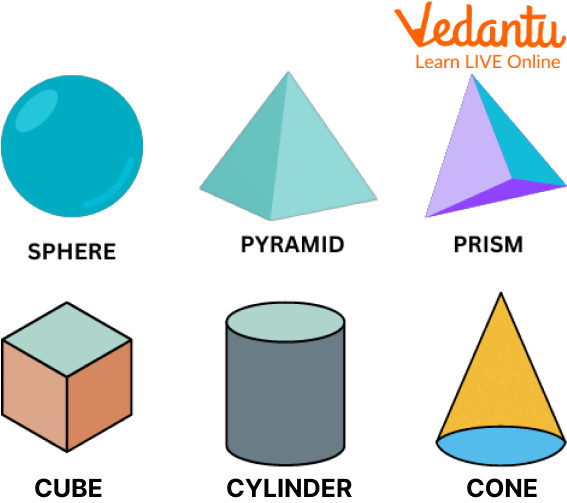
Different 3-dimensional Figures
What are 2d and 3d Shapes?
3D shapes are solids with three dimensions: length, width (width), and height. The term 3D shapes refer to three-dimensional objects. A cube, for example, has all of its faces in the shape of a square.
Two-dimensional shapes have a length and a breadth. They have a surface area but no volume.
Triangles, squares, and rectangles are examples of 2D shapes.
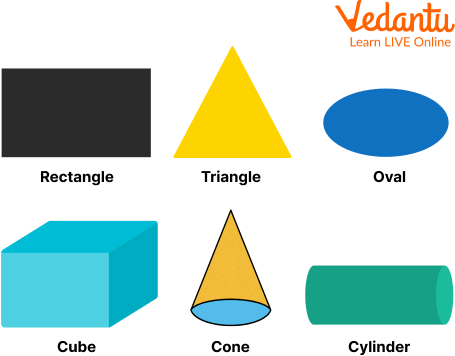
Examples of 2d and 3d Shapes
There are various types of 2 dimensional and 3-dimensional shapes used in Mathematics. The pictures of a few of these figures are given below, along with their respective names.
Difference Between Two-dimensional and Three-dimensional Figures
Knowing the difference between 2d and 3d shapes for kids can be quite easy once you know a few facts. Take a look at the differences between these two:
Comparing 3d Shapes Worksheet: Solved Examples
Q1. Identify the 2D shapes from the following.
Circle, rectangular box, Rubik's cube, hexagon
Ans: Among the given shapes, a circle and a hexagon are 2D shapes because they do not have any thickness or depth. A rectangular box and a Rubik's cube are 3D shapes because they have 3 dimensions (length, width, and height).
Q2. 3D shapes have only length and width. Is this statement correct?
Ans: No, 3d shapes also have the dimension height along with length and width.
Q3. Solve the riddle.
(a) I only have 3 sides and 3 corners. Who am I?
Ans: I am a triangle.
(b) I have no sides and I am round. Who am I?
Ans: I am a circle.
Practice Questions
Q1. Identify the solid shapes by choosing their names from the word box:
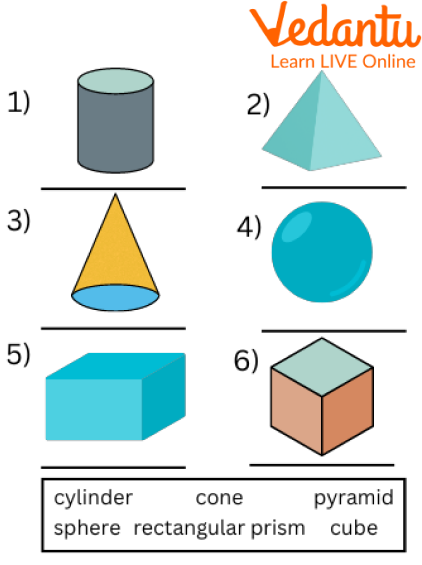
Solid Shapes
Ans: 1. Cylinder
2. Pyramid
3. Cone
4. Sphere
5. Rectangular Prism
6. Cube
Q2. A circle has ___ sides and ____ corners.’
Ans: A circle has 0 sides and 0 corners.
Q3. I am a solid shape. I have one curved surface and no edges. Who am I?
Ans: Sphere
Summary
A 2D shape is a flat shape that has only two dimensions – length and width, with no thickness or depth. That is the reason why it is called a two-dimensional shape. Later on, we came to know about the 3D shape. Compared to these, a 3D (three-dimensional) shape has three dimensions – length, width, and height. Then we saw the immediate difference between these two shapes. After that, we saw some solved examples and practice problems. After going through this article, do try at a practice problem.
FAQs on Comparing and Contrasting Three Dimensional Figures in Geometry
1. What are three dimensional figures in Maths?
Three dimensional figures are solid shapes that have length, width, and height. Unlike 2D shapes, 3D figures occupy space and have volume.
- Examples include cube, cuboid, sphere, cone, cylinder, and pyramid.
- They have faces (flat surfaces), edges (line segments), and vertices (corner points), except curved solids like spheres.
- They are also called solid figures or 3D shapes in geometry.
2. What is the difference between 2D and 3D shapes?
The main difference is that 2D shapes have only length and width, while 3D shapes have length, width, and height.
- 2D shapes (like squares and circles) are flat and have area only.
- 3D figures (like cubes and spheres) occupy space and have both surface area and volume.
- 3D shapes can be physically held, while 2D shapes cannot.
3. How do you compare and contrast three dimensional figures?
To compare and contrast three dimensional figures, examine their faces, edges, vertices, surface area, and volume formulas.
- Count the number of faces, edges, and vertices.
- Identify whether faces are flat or curved.
- Compare formulas, such as Volume of cube = a³ and Volume of cylinder = πr²h.
- Note similarities (e.g., both cube and cuboid have 6 faces) and differences (e.g., cube has all equal edges).
4. What is the difference between a cube and a cuboid?
A cube is a special type of cuboid where all sides are equal in length.
- Cube: 6 equal square faces, 12 equal edges, 8 vertices.
- Cuboid: 6 rectangular faces, opposite faces equal, edges may differ in length.
- Volume of cube = a³; Volume of cuboid = l × w × h.
5. What is the difference between a cone and a cylinder?
The key difference is that a cone has one circular base and one vertex, while a cylinder has two parallel circular bases and no vertex.
- Volume of cone = (1/3)πr²h.
- Volume of cylinder = πr²h.
- A cone has a curved surface ending at a point; a cylinder has a curved surface joining two bases.
6. How many faces, edges, and vertices does a rectangular prism have?
A rectangular prism (cuboid) has 6 faces, 12 edges, and 8 vertices.
- All faces are rectangles.
- Opposite faces are equal and parallel.
- It follows Euler’s formula: F + V − E = 2, since 6 + 8 − 12 = 2.
7. What is the formula for the volume of common 3D shapes?
The volume formulas for common three dimensional figures are based on their base area and height.
- Cube: a³
- Cuboid: l × w × h
- Cylinder: πr²h
- Cone: (1/3)πr²h
- Sphere: (4/3)πr³
8. How do you find the surface area of a cube?
The surface area of a cube is 6a², where a is the length of one edge.
- A cube has 6 equal square faces.
- Area of one face = a².
- Total surface area = 6 × a².
9. What is the difference between a pyramid and a prism?
A prism has two parallel congruent bases, while a pyramid has one base and a single vertex.
- Prism: lateral faces are rectangles; volume = Base area × height.
- Pyramid: triangular faces meet at a vertex; volume = (1/3) × Base area × height.
- Prisms have uniform cross-sections; pyramids taper to a point.
10. How is a sphere different from other three dimensional figures?
A sphere is different because it has no faces, no edges, and no vertices.
- It is perfectly round in shape.
- Surface area of sphere = 4πr².
- Volume of sphere = (4/3)πr³.
- Every point on the surface is equidistant from the center.
