









How to Add Numbers Using Expanded Form with Step by Step Examples
Ever wondered how a huge number can be broken down into small parts? This concept in mathematics is called the Expanded form. If you are unaware of this, you don’t need to worry. Because in this article, we will discuss everything about the expanded form and how we can add using expanded form. We will learn how to express the digits using addition in expanded form and expanded form sums from scratch, along with solved examples. Moreover, we will focus on how to add using the expanded form.
What is an Expanded Form?
Expanded form is a way to write a number by adding the value of its digits. Use a place value chart to get a clear idea about the value of a number's digits.
In an expanded form, a number is broken according to its place value and expanded to show the value of each digit. When we add using the expanded form, it makes it easy to understand, and by solving expanded form sums, we can develop a better understanding of it. For example, 943 can be written in expanded form, as given below.
The expanded form of 943 is given by 9 hundred 4 tens 3 ones.
expanded form: 900 + 40 + 3.

An Example of an Expanded Form
Place Value
Each number has a place value. The value of that digit is determined according to its position in the number. As we move from left to right, the value of a digit in a number increases. The place value of the digits on the left is lesser than those on the right.
By using the position of the number, the value for each number is computed. On starting from right to left, we can understand the notations used in the place value using an example.
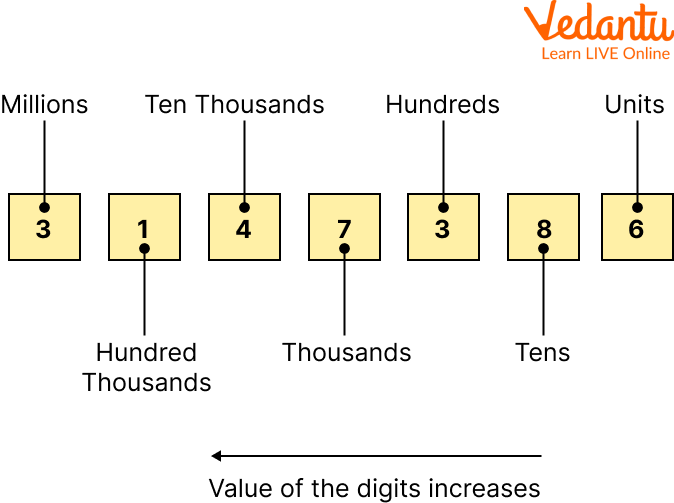
Place Value of a Number
Thus, the expanded form of the number 254 is 200 + 50 + 4.
How to Find an Expanded Form?
Steps to write a number in the expanded form are given below.
Ones: $1 \times 4=4$
Tens: $7 \times 10=70$
Hundred: $3 \times 100=300$
Thousand: $8 \times 1000=8000$
$8000+300+70+4=8374$
Write the number in its most basic form.
Use the place value table to determine its place values.
Let the place value of the number be Multiplied by the number.
The number is multiplied by the number’s place value.
Display it as a digit place value.
Each digit should be represented as the product of the digit and its place value.
Expanded Form with Decimals
The extended form of a number with a decimal point or fraction is written with a base 10 denominator represented by a power of 10. For example, the number 3.482 in the expanded form is written as:
3.482 = 3 + 0.4 + 0.08 + 0.002.
How to Write in Expanded Form?
Suppose we want to expand 1.234. At first, we have one place, i.e. 1. Then, we have the first decimal place, the tenths. We take 2 and multiply it by a fraction $\dfrac{1}{10}$
$1+\left(2 \times \dfrac{1}{10}\right)$
Then, we have the hundredth place. Now move to a higher multiple of 10 for the denominator. In simple words, add another 0.
$1+\left(2 \times \dfrac{1}{10}\right)+\left(3 \times \dfrac{1}{100}\right)$
Finally, we have the thousandth place. Add another 0 in the denominator.
$1+\left(2 \times \dfrac{1}{10}\right)+\left(3 \times \dfrac{1}{100}\right)+\left(4 \times \dfrac{1}{1000}\right)$
Hence, the expanded form of $1.234$ is $1+0.2+0.03+0.004$.
Addition in Expanded Form
With the help of an example, we will learn about addition in expanded form.
1. Add 32 and 25
32= 30 + 2 (An expanded form of the number)
25= 20 + 5
Now, 32+25=30+2+20+5
= 50 + 7
= 57
The numbers are written in expanded form as 32 = 30 + 2 and 25 = 20 + 5.
Now digits of one’s place are added, i.e., 2 + 5 = 7.
Again numbers of ten’s place are added, i.e., 30 + 20 = 50
Total sum = 50 + 7 = 57
Thus the required total sum is 57.
Solved Expanded Form Sums
1. Add 361 and 527 by arranging the numbers in expanded form.
361 = 300 + 60 +1
527 = 500 + 20 +7
Sum = 800 + 80 + 8
= 888
Thus the required sum is 888.
2. Add using the expanded form: 231, 402, and 355
Adding ones = 1 + 2 + 5 = 8
Adding tens = 3 + 0 + 5 = 8
Adding hundred = 2 + 4 + 3 = 9
Therefore, the addition sum is 988.
Practice Questions
1. 31 + 42 =
Ans. 73
Q2. 43 + 44 =
Ans. 87
Q3. 23 + 25 =
Ans. 48
Summary
In this article, we learned that the expanded form is nothing more than a technique for rewriting a number by including the values of the digits. With the help of some solved expanded form sums, we tried to understand how numbers are arranged in the expanded form before adding.
By solving more and more expanded form sums, students can learn about expanded forms. We have also got some useful information about the expanded form. We have also learned about place value, its expanded form, how it is found, and the steps for addition in expanded form.
FAQs on Add Using Expanded Form in Maths
1. What does add using expanded form mean?
Adding using expanded form means breaking numbers into their place values (hundreds, tens, ones) and then adding each place separately.
In expanded form, a number is written as the sum of its digits by place value.
Example:
34 = 30 + 4
52 = 50 + 2
Add separately:
- 30 + 50 = 80
- 4 + 2 = 6
2. How do you add numbers using expanded form step by step?
To add using expanded form, split each number into place values and add corresponding places together.
Steps:
- Write each number in expanded form.
- Add the hundreds, tens, and ones separately.
- Combine the sums to get the final answer.
Example:
47 + 35 = (40 + 7) + (30 + 5)
- 40 + 30 = 70
- 7 + 5 = 12
3. Can you give an example of addition using expanded form?
Yes, addition using expanded form separates numbers by place value before adding.
Example:
123 + 245
Expanded form:
- 123 = 100 + 20 + 3
- 245 = 200 + 40 + 5
- 100 + 200 = 300
- 20 + 40 = 60
- 3 + 5 = 8
4. Why is expanded form useful for addition?
Expanded form is useful for addition because it clearly shows the place value of each digit, making calculations easier to understand.
It helps students:
- Understand hundreds, tens, and ones.
- Avoid place value mistakes.
- Prepare for standard column addition.
5. How do you add three-digit numbers using expanded form?
To add three-digit numbers using expanded form, add hundreds, tens, and ones separately.
Example:
356 + 412
Expanded form:
- 356 = 300 + 50 + 6
- 412 = 400 + 10 + 2
- 300 + 400 = 700
- 50 + 10 = 60
- 6 + 2 = 8
6. What is the difference between expanded form addition and column addition?
Expanded form addition breaks numbers into place values, while column addition stacks numbers vertically by place value.
Expanded form:
- Separates hundreds, tens, ones first.
- Focuses on place value understanding.
- Aligns digits in columns.
- Often includes regrouping (carrying).
7. How do you regroup when adding using expanded form?
Regrouping in expanded form happens when a place value sum is 10 or more and must be converted to the next place value.
Example:
48 + 27
Expanded:
- 40 + 8
- 20 + 7
- 8 + 7 = 15 (10 + 5)
- 40 + 20 + 10 = 70
- Remaining ones = 5
8. How do you add decimals using expanded form?
To add decimals using expanded form, separate whole numbers and decimal place values before adding.
Example:
3.4 + 2.35
Expanded:
- 3.4 = 3 + 0.4
- 2.35 = 2 + 0.3 + 0.05
- 3 + 2 = 5
- 0.4 + 0.3 = 0.7
- 0.7 + 0.05 = 0.75
9. What are common mistakes when adding using expanded form?
Common mistakes in expanded form addition include mixing place values or forgetting to regroup.
Typical errors:
- Adding tens to ones incorrectly.
- Forgetting to combine all partial sums.
- Ignoring regrouping when sums exceed 9.
10. When should students use expanded form to add numbers?
Students should use expanded form when learning place value or when they need a clearer understanding of addition.
It is especially helpful for:
- Early elementary math learners.
- Adding large numbers step by step.
- Building strong number sense before column addition.
