









How to Solve 3 Digit Subtraction Missing Number Problems Step by Step
Finding the missing numbers in a sequence or a series is a fun activity for the students to identify the patterns and memorise multiplication tables, numbers, fundamental mathematical operations, or even counting. Since subtraction is done by taking away or removing things. It is a way to reduce numbers, operands, or objects. In this article, we will learn missing number subtraction and see how we can do the subtraction when some digits are missing.
What is Subtraction?
We use subtraction in our everyday life in different situations, like if we buy a toy and it costs 70 rupees, and we give the shopkeeper a 100 rupee note, then to know how much money the shopkeeper will return us, we need to learn the subtraction.
So we can say that it's the operation of removing the objects from the collection.
The subtraction formula is stated as Minuend - Subtrahend = Difference. Here, minuend is the number from which the other number is subtracted, and subtrahend is the number that is subtracted from the minuend. The symbol (-) indicates the subtraction operation, and the difference indicates the result. The example given below shows the subtraction formula.
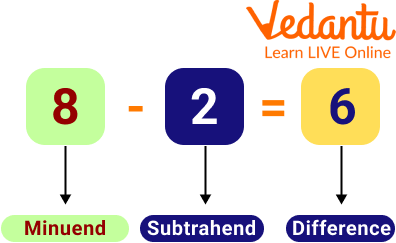
Subtraction parts
What is Missing Number Subtraction?
Missing numbers in subtraction are those that have been missed in a particular subtraction. We can find those missing numbers by identifying the pattern. Whenever there are blanks in a series of numbers, a few numbers have been missed, and we need to observe the pattern and fill in the blanks with suitable numbers. We can find missing numbers to memorise counting and multiplication tables and learn arithmetic operations.
How to Solve Missing Digit Subtraction?
It's very interesting to learn about missing number subtraction.
In missing number subtraction probably, we will be provided with 3 cases which will be very easy to solve, and they will be solved in the same way whether its column based or given in single digits. So now let's learn about each case one by one in detail.
Case 1: In the first case, we can see that if the missing number is immediately after the equals sign, we need to subtract the second number from the first.
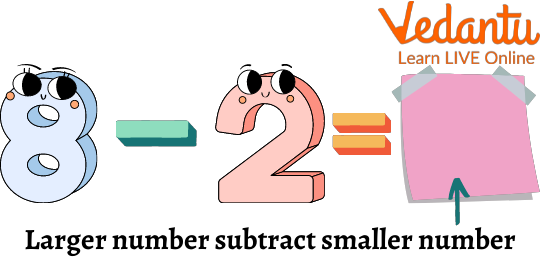
Missing Digit Subtraction
We need to find a number that is equal to 8 minus 2. When the number 2 is subtracted from 8.
So, we have 8 - 2 = 6.
Case 2: In the second case, we can see that if the missing number is being subtracted from the larger number, we need to subtract the given answer from the larger number.
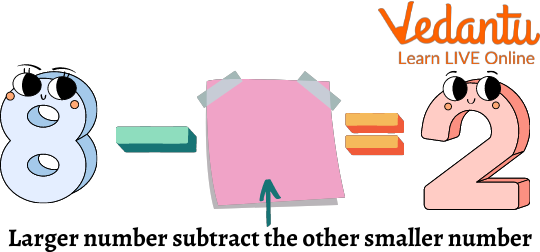
Missing Digit Subtraction
We need to find a number which when subtracted from 8, gives the difference equal to 2. So, 8 - 6 = 2
Case 3: If the missing number is immediately before the subtraction sign, we need to add the two numbers together.

Missing digit subtraction
Therefore, as per the above image, we have
_____ - 6 = 2
So, on adding 6 + 2, we get 8. And if 6 is subtracted from 8, we get 2.
Hence, the missing number is 8 here.
Important Points to Keep in Mind While Doing Subtraction
If 1 is subtracted from a number, then it gives the predecessor of the number as the difference.
The number from which the other number is to be subtracted is called the minuend, The number subtracted is called the subtrahend, and the answer we get is called the difference.
If the subtrahend is missing, then the difference is subtracted from the minuend.
If we want to find the missing minuend, the difference is added to the subtrahend.
Difference + subtrahend = minuend
Solved Examples
(i) 9 – _ = 4
Ans. The number, which is taken away from 9, so that it leaves 4 as the difference, is 5.
Therefore, the missing digit should be written as 9 – 5 = 4
(ii)? – 2 = 5
Ans. Finding the number that must be subtracted by 2 to leave the number 5.
The answer is 7.
Therefore, the missing number should be 7 – 2 = 5.
(iii) 6 - _ = 5
Ans. Finding out the number which is taken away from 6 so that it leaves 5
The answer is 1.
Therefore, the solution should be written as 6 – 1 = 5.
Practice Questions
Q 1. __ - 6 = 6 (Ans: 12)
Q 2. 8 - __= 2 (Ans: 6)
Q 3. 17 - 8 =__ (Ans: 9)
Q 4. 23 - 5 =__ (Ans: 18)
Q 5. __ - 13 = 3 (Ans: 16)
Summary
So in this article, we learned about so many interesting things which were related to subtraction, like what subtraction and missing number subtraction is, how to use them in our everyday life, what are the various forms of missing digit subtraction, how to solve them and also learned that what are the important points to keep in mind while doing subtraction. We read about it and solved some examples to clear all your doubts about the concepts.
FAQs on 3 Digit Subtraction with Missing Numbers
1. What is 3 digit subtraction with missing numbers?
3 digit subtraction with missing numbers is a subtraction problem where one digit or number is unknown and must be found using place value and subtraction rules. In these problems, either the minuend, subtrahend, or a digit within them is replaced with a blank. To solve:
- Use place value (hundreds, tens, ones).
- Subtract column by column from right to left.
- Use the given digits and the final difference to determine the missing number.
2. How do you solve a 3 digit subtraction problem with a missing digit?
To solve a 3 digit subtraction problem with a missing digit, subtract column by column and use logic to determine the unknown value. Follow these steps:
- Start from the ones place and move left.
- Borrow if needed.
- Use the known digits and final answer to calculate the missing digit.
3. What is the rule for 3 digit subtraction with borrowing?
The rule for 3 digit subtraction with borrowing is to regroup 1 from the next higher place value when the top digit is smaller than the bottom digit. Steps include:
- If the ones digit is smaller, borrow 1 ten.
- If the tens digit becomes smaller, borrow 1 hundred.
- Continue subtracting from right to left.
4. How do you find a missing minuend in 3 digit subtraction?
To find a missing minuend, add the subtrahend and the difference together. The formula is Minuend = Difference + Subtrahend. Example: ? − 245 = 123. So, 123 + 245 = 368. The missing minuend is 368. This uses the inverse relationship between addition and subtraction.
5. How do you find a missing subtrahend in 3 digit subtraction?
To find a missing subtrahend, subtract the difference from the minuend. The formula is Subtrahend = Minuend − Difference. Example: 789 − ? = 456. So, 789 − 456 = 333. The missing subtrahend is 333. This method applies the inverse operation of subtraction.
6. Can you give an example of a 3 digit subtraction missing number problem?
Yes, an example of a 3 digit subtraction missing number problem is 5?8 − 214 = 344. Solve step by step:
- Ones: 8 − 4 = 4.
- Tens: ? − 1 = 4, so ? = 5.
- Hundreds: 5 − 2 = 3.
7. Why is place value important in 3 digit subtraction with missing numbers?
Place value is important because subtraction works separately in the hundreds, tens, and ones columns. Understanding place value helps you:
- Subtract correctly in each column.
- Borrow accurately when needed.
- Identify which digit is missing.
8. What are common mistakes in 3 digit subtraction with missing digits?
Common mistakes include incorrect borrowing, ignoring place value, and not checking the final answer. Students often:
- Forget to reduce the digit after borrowing.
- Subtract the smaller number from the larger regardless of position.
- Fail to verify using addition.
9. How do you check your answer in a 3 digit subtraction missing number problem?
You check your answer by using the inverse operation, which is addition. Add the difference and the subtrahend to see if you get the minuend. Example: 654 − 321 = 333. Check: 333 + 321 = 654. If the sum matches the original minuend, the solution is correct.
10. What is the difference between 3 digit subtraction with and without borrowing?
The difference is that borrowing is needed only when the top digit is smaller than the bottom digit in a column. In subtraction without borrowing, each top digit is greater than or equal to the bottom digit. In subtraction with borrowing, you regroup from the next higher place value. Example:
- 532 − 211 (no borrowing)
- 402 − 178 (borrowing required)
