




Which one of these is a monomer of Bakelite?
A. Vinyl acetate
B. Tetrafluoroethylene
C. Formaldehyde
D. Propylene
Answer
 Verified
284.1k+ views
Hint: Polymers are made up of smaller units that are known as monomers. They bind to other monomers to form a repeating chain of molecules known as polymers. Similarly bakelite is a polymer which is made up of a monomer that has a pungent and suffocating odor.
Complete step by step answer:
- A monomer is a molecule that forms the basic unit of polymers. A monomer is a simple molecule that has two or more binding sites.
- The binding sites are used to form covalent linkages with other monomer molecules to form the macromolecule. This process is known as polymerization.
- All simple molecules do not behave as monomers, but only those molecules which have two or more building sites can act as a monomer.
- For example, ammonia, water, ethanol, etc are not monomers, but alkenes, vinyl chloride, adipic acid, phenol, formaldehyde, etc are monomers.
- Bakelite is a polymer that is made up of two monomers: phenol and formaldehyde. This is a thermosetting polymer.
- Bakelite is the common name for the polymer that is made from the polymerization of phenol and formaldehyde. Formaldehyde has a very pungent and a suffocating odor.
- In this, phenol is reacted with formaldehyde. The controlled reaction in the presence of acidic or basic medium results in the formation of ortho and para hydroxymethyl phenols and their derivatives.
- The process involved is shown below.
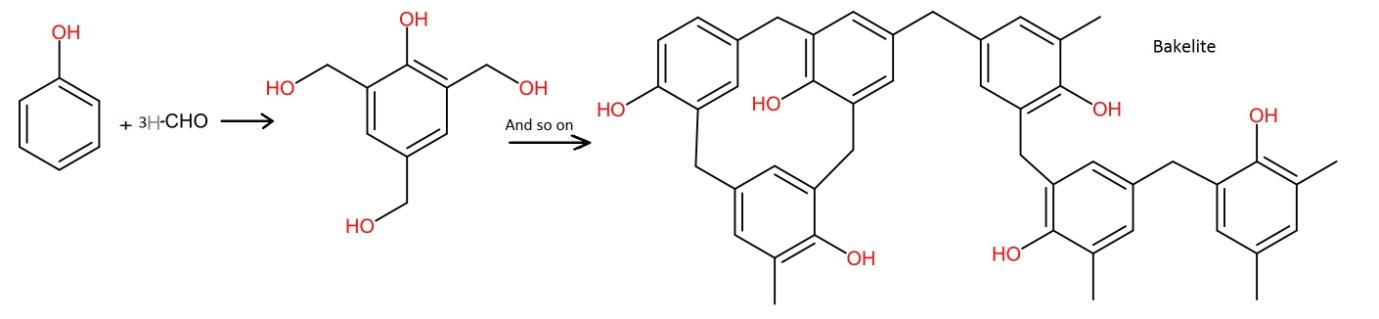
Therefore, formaldehyde and phenol are the monomers of Bakelite. Hence, the correct answer is option (C).
Note: Students tend to confuse between formaldehyde and acetaldehyde. Make sure you do not confuse between the two. Formaldehyde is $HCHO$ and acetaldehyde is $C{H}_{3}CHO$.
Complete step by step answer:
- A monomer is a molecule that forms the basic unit of polymers. A monomer is a simple molecule that has two or more binding sites.
- The binding sites are used to form covalent linkages with other monomer molecules to form the macromolecule. This process is known as polymerization.
- All simple molecules do not behave as monomers, but only those molecules which have two or more building sites can act as a monomer.
- For example, ammonia, water, ethanol, etc are not monomers, but alkenes, vinyl chloride, adipic acid, phenol, formaldehyde, etc are monomers.
- Bakelite is a polymer that is made up of two monomers: phenol and formaldehyde. This is a thermosetting polymer.
- Bakelite is the common name for the polymer that is made from the polymerization of phenol and formaldehyde. Formaldehyde has a very pungent and a suffocating odor.
- In this, phenol is reacted with formaldehyde. The controlled reaction in the presence of acidic or basic medium results in the formation of ortho and para hydroxymethyl phenols and their derivatives.
- The process involved is shown below.
Therefore, formaldehyde and phenol are the monomers of Bakelite. Hence, the correct answer is option (C).
Note: Students tend to confuse between formaldehyde and acetaldehyde. Make sure you do not confuse between the two. Formaldehyde is $HCHO$ and acetaldehyde is $C{H}_{3}CHO$.
Recently Updated Pages
JEE Main Mock Test 2025-26: Principles Related To Practical

JEE Main 2025 Organic Compounds Containing Oxygen Mock Test
JEE Main 2025-26 Organic Compounds Containing Oxygen Mock Test
JEE Main 2025-26 Mock Test: Purification & Characterisation of Organic Compounds
JEE Main 2025-26 Mock Test: Principles Related To Practical
JEE Main Mock Test 2025-26: Free Practice & Solutions
Trending doubts
Understanding Atomic Structure for Beginners
Electron Gain Enthalpy and Electron Affinity Explained
Understanding Electromagnetic Waves and Their Importance
Understanding Instantaneous Velocity
Understanding Collisions: Types and Examples for Students
JEE Main 2025-26 Mock Test Preparation: Classification of Elements and Periodicity in Properties
Other Pages
JEE Advanced 2026 Notification Out with Exam Date, Registration (Extended), Syllabus and More
CBSE Notes Class 12 Chemistry Chapter 9 - Amines - 2026-27
Degree of Dissociation: Meaning, Formula, Calculation & Uses
NCERT Solutions For Class 12 Chemistry In Hindi Chapter 10 Haloalkanes And Haloarenes - 2026-27
Understanding How a Current Loop Acts as a Magnetic Dipole
NCERT Solutions For Class 12 Chemistry In Hindi Chapter 3 Electrochemistry Hindi Medium - 2026-27