




The biodegradable polymer nylon-$2$ -nylon-$6$ is formed by condensation of glycine and______.
A. acrylonitrile
B. amino caproic acid
C. alanine
D. adipic acid
Answer
 Verified
249.6k+ views
Hint: Biodegradable polymers are polymers which can be degraded or broken down by other living organisms like bacteria so that the polymer does not cause any serious effect on the environment.
Step by Step Explanation: Nylon-$2$ -nylon-$6$ is a biodegradable polymer. It is a polyamide and is obtained by condensation of monomers glycine $\left( {{{\text{H}}_2}{\text{N - C}}{{\text{H}}_2}{\text{ - COOH}}} \right)$ and amino caproic acid $\left[ {{{\text{H}}_2}{\text{N}}{{\left( {{\text{C}}{{\text{H}}_2}} \right)}_5}{\text{COOH}}} \right]$ . When n numbers of glycine are condensed with n numbers of amino caproic acid, Nylon-$2$ -nylon-$6$ is obtained with the loss of water molecules. The reaction is as follows:
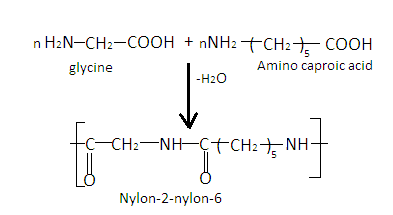
Nylon-$2$ -nylon-$6$ is an alternating polyamide copolymer as it is prepared from two monomers. It is used in-
- Synthesis of artificial fibers.
- As a thread in the bristles of a toothbrush.
- In making strings of musical instruments.
- As matrix material.
- In car components next to the engine due to heat resistance property.
Hence the correct answer is B.
Additional Information: Besides Nylon-$2$ -nylon-$6$, dextran and PHBV which are both polyesters are also bio-degradable polymers which can be degraded by bacteria in the environment. The characteristics of biodegradable polymers are-
1. They are inert and non-toxic
2. They have bio-compatibility.
3. They have permeability.
4. They have tensile strength and mechanical strength.
5. They have controlled the rate of degradation as they can be easily degraded within a suitable time –period.
Note: Biodegradable polymers have many uses in medical field-
1. They are used as orthopedic devices
2. They are used as implants and sutures.
3. They are also used as rug-release matrices.
Step by Step Explanation: Nylon-$2$ -nylon-$6$ is a biodegradable polymer. It is a polyamide and is obtained by condensation of monomers glycine $\left( {{{\text{H}}_2}{\text{N - C}}{{\text{H}}_2}{\text{ - COOH}}} \right)$ and amino caproic acid $\left[ {{{\text{H}}_2}{\text{N}}{{\left( {{\text{C}}{{\text{H}}_2}} \right)}_5}{\text{COOH}}} \right]$ . When n numbers of glycine are condensed with n numbers of amino caproic acid, Nylon-$2$ -nylon-$6$ is obtained with the loss of water molecules. The reaction is as follows:
Nylon-$2$ -nylon-$6$ is an alternating polyamide copolymer as it is prepared from two monomers. It is used in-
- Synthesis of artificial fibers.
- As a thread in the bristles of a toothbrush.
- In making strings of musical instruments.
- As matrix material.
- In car components next to the engine due to heat resistance property.
Hence the correct answer is B.
Additional Information: Besides Nylon-$2$ -nylon-$6$, dextran and PHBV which are both polyesters are also bio-degradable polymers which can be degraded by bacteria in the environment. The characteristics of biodegradable polymers are-
1. They are inert and non-toxic
2. They have bio-compatibility.
3. They have permeability.
4. They have tensile strength and mechanical strength.
5. They have controlled the rate of degradation as they can be easily degraded within a suitable time –period.
Note: Biodegradable polymers have many uses in medical field-
1. They are used as orthopedic devices
2. They are used as implants and sutures.
3. They are also used as rug-release matrices.
Recently Updated Pages
JEE Isolation, Preparation and Properties of Non-metals Important Concepts and Tips for Exam Preparation

Isoelectronic Definition in Chemistry: Meaning, Examples & Trends
Ionisation Energy and Ionisation Potential Explained
Iodoform Reactions - Important Concepts and Tips for JEE
Introduction to Dimensions: Understanding the Basics
Instantaneous Velocity Explained: Formula, Examples & Graphs
Trending doubts
JEE Main 2026: Exam Dates, Session 2 Updates, City Slip, Admit Card & Latest News
Hybridisation in Chemistry – Concept, Types & Applications
JEE Main 2026 Application Login: Direct Link, Registration, Form Fill, and Steps
Understanding the Electric Field of a Uniformly Charged Ring
Derivation of Equation of Trajectory Explained for Students
JEE Main Marking Scheme 2026- Paper-Wise Marks Distribution and Negative Marking Details
Other Pages
CBSE Class 12 Chemistry Question Paper 2026 PDF Download (All Sets) with Answer Key
NCERT Solutions For Class 12 Chemistry Chapter 10 Biomolecules - 2025-26
JEE Advanced Marks vs Ranks 2025: Understanding Category-wise Qualifying Marks and Previous Year Cut-offs
NCERT Solutions For Class 12 Chemistry Chapter 2 Electrochemistry - 2025-26
NCERT Solutions For Class 12 Chemistry Chapter 1 Solutions - 2025-26
NCERT Solutions For Class 12 Chemistry Chapter 3 Chemical Kinetics - 2025-26