






How a Common Civil Law System Promotes Equality and National Integration in India
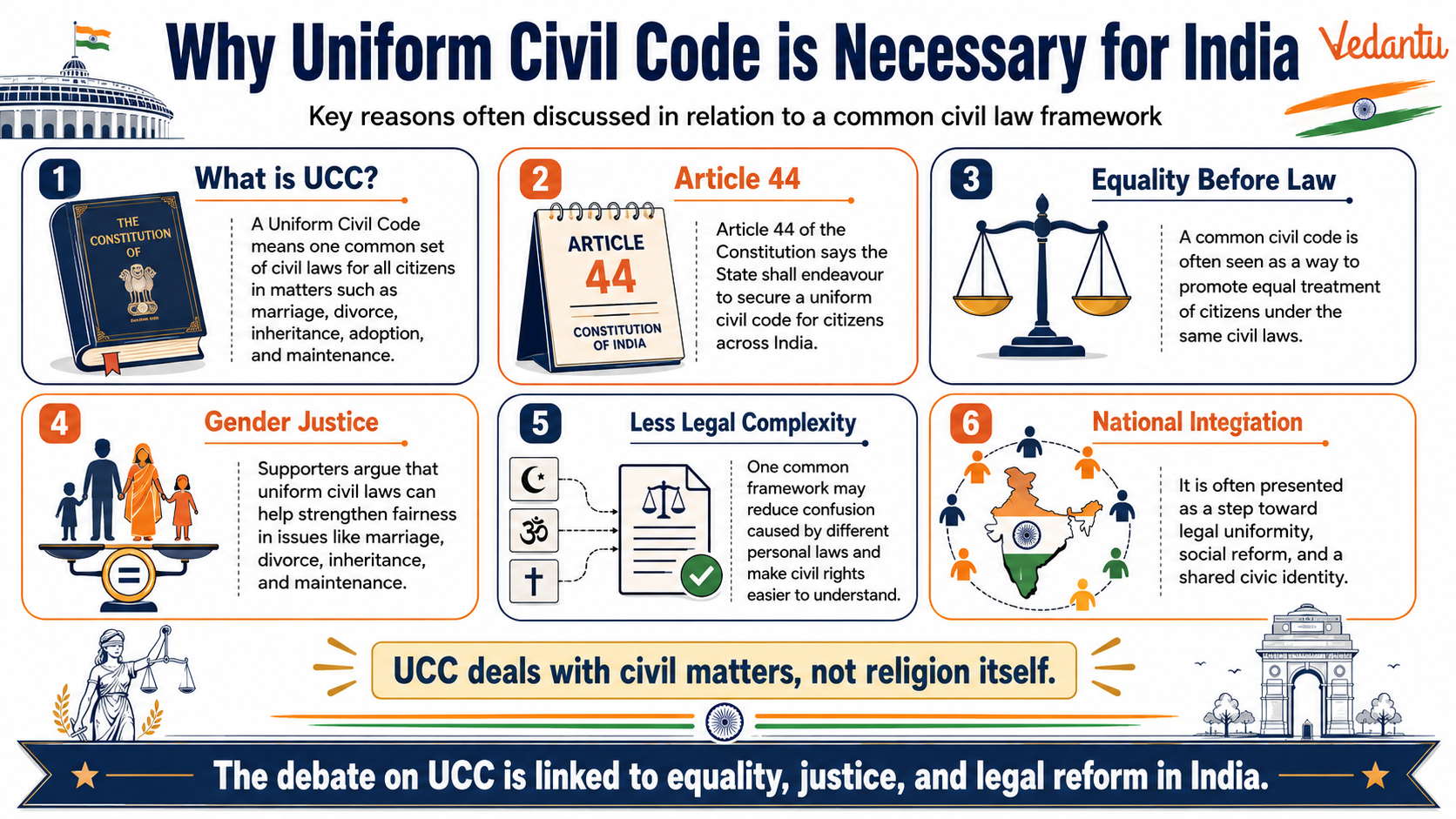
The Uniform Civil Code (UCC) refers to the proposal of having a single set of civil laws governing personal matters such as marriage, divorce, inheritance, adoption, and maintenance for all citizens of India, irrespective of religion. At present, different religious communities in India follow their own personal laws based on customs and scriptures. The demand for a Uniform Civil Code arises from the need to promote equality, national unity, and gender justice. The issue is closely linked with Article 44 of the Indian Constitution, which directs the State to endeavor to secure a uniform civil code for its citizens. Understanding why the Uniform Civil Code is necessary is important for students, competitive exam aspirants, and general readers interested in Indian polity and constitutional debates.
What Is Uniform Civil Code?
The Uniform Civil Code is a common set of secular civil laws that would apply equally to all Indian citizens in matters of personal law. It does not deal with criminal laws, which are already uniform across the country, but focuses on civil matters that are currently governed by religion-based personal laws.
Areas Covered Under UCC
- Marriage and divorce
- Adoption and guardianship
- Inheritance and succession
- Maintenance and alimony
- Property rights
Constitutional Basis of Uniform Civil Code
The concept of the Uniform Civil Code is mentioned in Part IV of the Indian Constitution under the Directive Principles of State Policy.
Article 44 of the Indian Constitution
Article 44 states that the State shall endeavor to secure for the citizens a uniform civil code throughout the territory of India. Although Directive Principles are not enforceable by courts, they are fundamental in the governance of the country and guide lawmakers in framing policies.
Relation with Fundamental Rights
The debate around UCC often involves balancing Article 14 which guarantees equality before law, Article 15 which prohibits discrimination, and Article 25 which ensures freedom of religion. The need for UCC arises from ensuring that equality and justice are not compromised in the name of religious practices.
Why Uniform Civil Code Is Necessary For India
1. Ensures Equality Before Law
Different personal laws create unequal legal standards for citizens based on religion. A Uniform Civil Code would provide equal rights and responsibilities to all citizens, thereby strengthening the principle of equality enshrined in the Constitution.
2. Promotes Gender Justice
Many personal laws have provisions that discriminate against women in matters of inheritance, divorce, and maintenance. A uniform code would eliminate gender bias and empower women by ensuring equal rights.
3. Strengthens National Integration
A common civil law for all citizens can promote a sense of unity and reduce divisions based on religion. It reinforces the idea that all citizens are equal members of one nation.
4. Simplifies Legal System
Multiple personal laws create complexity and confusion in legal proceedings. A Uniform Civil Code would simplify the legal framework and make justice delivery more efficient.
5. Reduces Vote Bank Politics
Personal laws have sometimes been used for political gains. A uniform law can reduce the misuse of religion for electoral benefits and promote secular governance.
6. Aligns with Modern Democratic Values
Modern democratic societies emphasize individual rights over community-based privileges. A Uniform Civil Code supports progressive reforms and aligns India with global standards of human rights.
Comparison Between Present Personal Laws and Uniform Civil Code
| Aspect | Present System | Under Uniform Civil Code |
|---|---|---|
| Applicability | Based on religion | Same for all citizens |
| Gender Rights | Varies across religions | Equal rights for men and women |
| Legal Complexity | Multiple personal laws | Single unified law |
The table highlights how a Uniform Civil Code can remove disparities and create a simplified and equitable legal framework for all citizens.
Arguments Against Uniform Civil Code
While many support the idea of UCC, there are concerns that need careful consideration.
- Fear of interference with religious freedom under Article 25
- Concern about loss of cultural identity and traditions
- Challenges in drafting a law acceptable to all communities
- Possibility of social unrest if implemented without consensus
Way Forward for Implementing Uniform Civil Code
The implementation of UCC requires a balanced and inclusive approach to ensure that it promotes unity without hurting cultural diversity.
- Wide consultation with religious leaders and communities
- Gradual reforms in personal laws to ensure gender equality
- Creating awareness among citizens about constitutional values
- Ensuring that the code protects both equality and cultural diversity
Conclusion
The Uniform Civil Code is considered necessary for India to uphold the constitutional principles of equality, secularism, and justice. It aims to provide equal rights to all citizens, especially women, and to promote national integration by removing legal distinctions based on religion. However, its implementation requires sensitivity, dialogue, and consensus-building to ensure that it strengthens democracy without undermining cultural diversity. A carefully drafted and inclusive Uniform Civil Code can help India move toward a more just and unified society.
FAQs on Uniform Civil Code in India: Need and Importance for a United Nation
1. What is the Uniform Civil Code (UCC) in India?
The Uniform Civil Code (UCC) refers to a single set of civil laws that apply equally to all citizens of India regardless of religion.
• It governs marriage, divorce, inheritance, adoption, and succession.
• Mentioned under Article 44 of the Directive Principles of State Policy in the Indian Constitution.
• Aims to replace religion-based personal laws with a common civil law.
In simple terms, UCC promotes one nation, one civil law for personal matters.
2. Why is Uniform Civil Code considered necessary for India?
The Uniform Civil Code is considered necessary to promote equality, national unity, and gender justice.
• Ensures equal rights for men and women across religions.
• Reduces discrimination in personal laws.
• Strengthens national integration and secularism.
• Simplifies complex religious personal laws.
Thus, UCC supports the constitutional values of equality, justice, and secularism.
3. What are the main objectives of the Uniform Civil Code?
The main objective of the Uniform Civil Code is to establish legal uniformity in personal matters.
• Promote gender equality and women empowerment.
• Ensure equal protection of laws under Article 14.
• Strengthen national unity and integrity.
• Remove outdated religious practices conflicting with fundamental rights.
Overall, UCC aims to create a fair and modern civil system in India.
4. What does Article 44 of the Indian Constitution say about UCC?
Article 44 states that the State shall endeavor to secure a Uniform Civil Code for citizens throughout India.
• It is part of the Directive Principles of State Policy (DPSP).
• Not legally enforceable but acts as a guideline.
• Reflects the vision of the Constitution makers.
Thus, Article 44 encourages the government to implement UCC in the future.
5. How will the Uniform Civil Code promote gender equality?
The Uniform Civil Code promotes gender equality by eliminating discriminatory religious personal laws.
• Provides equal rights in marriage and divorce.
• Ensures fair inheritance and property rights for women.
• Prevents practices like arbitrary divorce and unequal succession.
By applying the same civil laws to all, UCC strengthens women’s rights and social justice.
6. Which Indian state has implemented the Uniform Civil Code?
Currently, Goa is the only Indian state that follows a form of Uniform Civil Code.
• Based on the Portuguese Civil Code, 1867.
• Common civil laws apply to all communities in Goa.
• Regulates marriage, divorce, and inheritance uniformly.
Goa is often cited as a practical example of UCC in India.
7. What are the challenges in implementing Uniform Civil Code in India?
Implementing the Uniform Civil Code faces legal, social, and political challenges.
• Religious diversity and cultural sensitivity.
• Opposition from minority communities.
• Fear of interference with freedom of religion (Article 25).
• Political debates and lack of consensus.
Hence, careful dialogue and inclusive reforms are required for UCC implementation.
8. How is Uniform Civil Code different from personal laws?
The Uniform Civil Code differs from personal laws by applying equally to all citizens.
• Personal laws are religion-based (Hindu, Muslim, Christian, Parsi laws).
• UCC proposes a common civil law for everyone.
• Promotes uniformity instead of separate legal systems.
Thus, UCC replaces multiple religious laws with a single secular framework.
9. What are the benefits of Uniform Civil Code for national integration?
The Uniform Civil Code strengthens national integration by promoting legal unity.
• Encourages a sense of equal citizenship.
• Reduces communal divisions based on personal laws.
• Reinforces the idea of ‘Unity in Diversity’.
By ensuring common civil rights, UCC supports a more cohesive Indian society.
10. Is Uniform Civil Code against secularism?
No, the Uniform Civil Code is not against secularism; rather, it supports true secular principles.
• Secularism means equal treatment of all religions.
• UCC ensures laws are not based on religion.
• Protects fundamental rights over religious customs.
Therefore, UCC aligns with the constitutional vision of a secular and democratic India.
