






Why Are These Nations Among the Poorest Countries in the World?
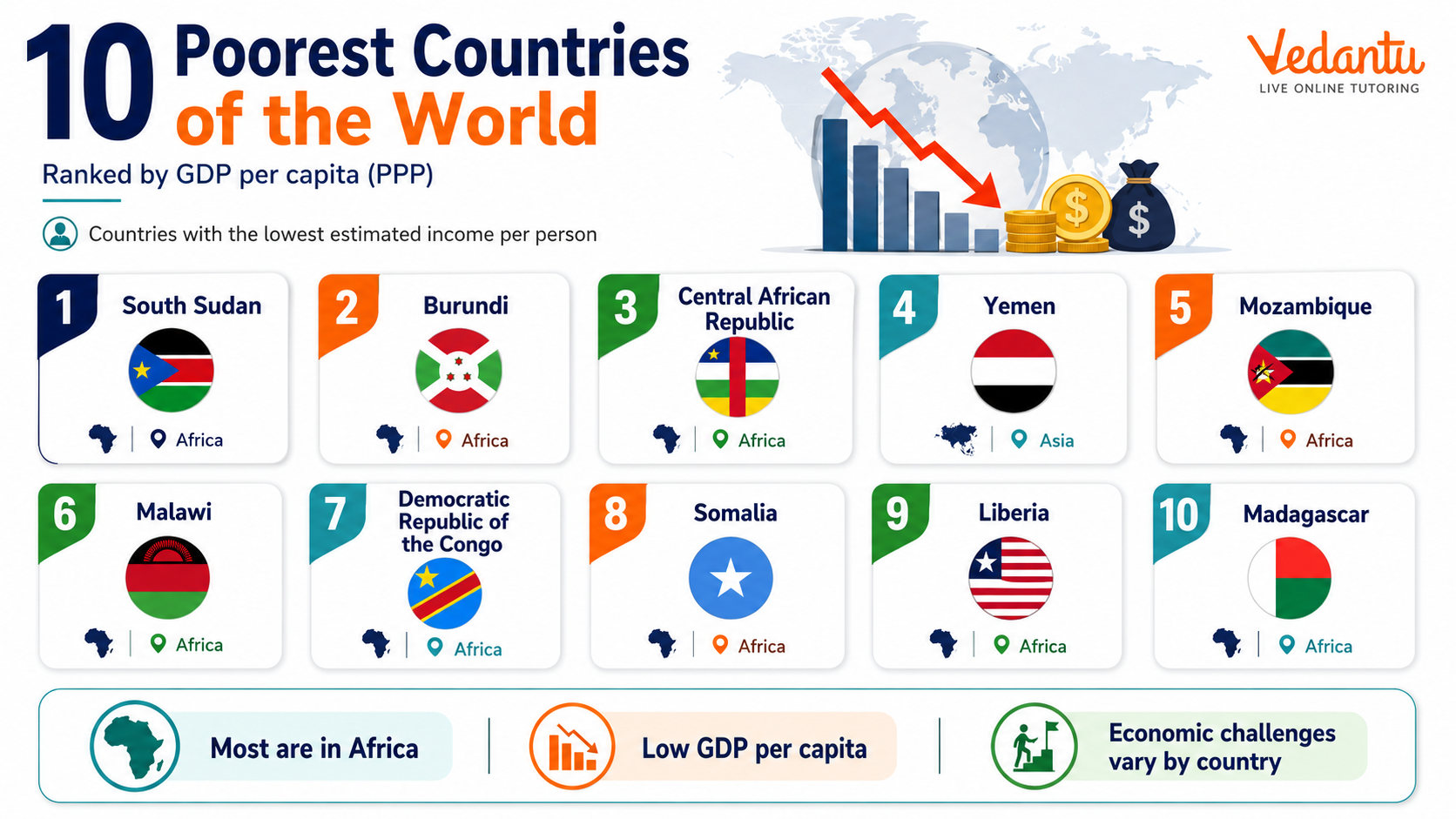
The poorest countries in the world are generally identified based on their Gross Domestic Product - GDP per capita. GDP per capita measures the average income earned per person in a country in a year. Nations with extremely low GDP per capita often face serious challenges such as poverty, unemployment, poor healthcare systems, limited education facilities, political instability, and weak infrastructure. Understanding which are the 10 poorest countries of the world is important for General Knowledge, competitive exams, and global awareness. This topic highlights global economic inequality and the developmental challenges faced by low-income nations.
What Is Meant By The Poorest Countries?
The poorest countries are those with the lowest GDP per capita according to international organizations such as the International Monetary Fund - IMF and the World Bank. These countries are often categorized as Low Income Countries or Least Developed Countries - LDCs. Their economies are usually dependent on agriculture, mining, or foreign aid.
Key Characteristics Of Poor Countries
- Very low GDP per capita
- High levels of poverty and unemployment
- Poor healthcare and education systems
- Political instability or conflict
- Heavy dependence on agriculture or natural resources
Top 10 Poorest Countries In The World By GDP Per Capita
| Rank | Country | Approx GDP Per Capita In USD |
|---|---|---|
| 1 | Burundi | 300 |
| 2 | South Sudan | 350 |
| 3 | Malawi | 450 |
| 4 | Central African Republic | 500 |
| 5 | Mozambique | 550 |
| 6 | Somalia | 600 |
| 7 | Democratic Republic Of The Congo | 650 |
| 8 | Liberia | 700 |
| 9 | Niger | 750 |
| 10 | Madagascar | 800 |
Note that GDP per capita figures are approximate and may vary slightly depending on the source and year of estimation. These countries are mainly located in Sub Saharan Africa, which remains the poorest region in the world in terms of average income levels.
Reasons Behind Extreme Poverty
Several factors contribute to the low income levels of these countries. Poverty is usually the result of multiple interconnected problems rather than a single cause.
- Civil wars and internal conflicts that destroy infrastructure
- Corruption and weak governance
- Lack of industrial development
- Rapid population growth
- Limited access to global markets
- Climate change and natural disasters
Impact Of Poverty On People
Extreme poverty affects every aspect of life in these countries. Citizens often struggle to meet basic needs such as food, clean water, shelter, education, and healthcare. Malnutrition, high infant mortality rates, and low literacy rates are common issues.
- High child mortality rates
- Low life expectancy
- Limited job opportunities
- Poor sanitation and housing conditions
Efforts To Reduce Poverty
International organizations such as the United Nations, World Bank, and IMF are working to reduce global poverty. Sustainable Development Goals - SDGs focus on eliminating extreme poverty and improving living standards worldwide.
- Providing financial aid and debt relief
- Promoting education and skill development
- Improving healthcare systems
- Encouraging political stability and good governance
Conclusion
The 10 poorest countries of the world face severe economic and social challenges due to low GDP per capita, political instability, and weak infrastructure. Most of these nations are located in Africa and struggle with poverty, conflict, and underdevelopment. Understanding these countries helps students build strong General Knowledge and develop awareness about global economic inequality. This topic is important for competitive exams and helps in understanding international development issues in a clear and meaningful way.
FAQs on Which Are The 10 Poorest Countries Of The World? Explained for Students
1. Which are the 10 poorest countries in the world?
The 10 poorest countries in the world are ranked mainly by GDP per capita (PPP), reflecting low income levels and economic hardship.
Commonly listed countries include:
• Burundi
• South Sudan
• Malawi
• Central African Republic (CAR)
• Mozambique
• Somalia
• Democratic Republic of the Congo (DRC)
• Niger
• Liberia
• Madagascar
These nations face challenges like poverty, low economic growth, unemployment, hunger, and political instability.
2. How are the poorest countries in the world ranked?
The poorest countries are ranked primarily based on GDP per capita (Purchasing Power Parity - PPP), which measures average income per person.
Key ranking factors include:
• Gross Domestic Product (GDP) per capita
• Human Development Index (HDI)
• Poverty rate
• Literacy and life expectancy
• Access to healthcare and education
Organizations like the World Bank and International Monetary Fund (IMF) publish these global economic rankings.
3. Why are most of the world’s poorest countries located in Africa?
Most of the world’s poorest countries are in Sub-Saharan Africa due to historical and structural challenges.
Main reasons include:
• Colonial exploitation and weak economic foundations
• Political instability and civil wars
• Corruption and poor governance
• Limited industrialization
• Climate change and drought
These factors result in low GDP growth, high unemployment, and widespread poverty.
4. Which is the poorest country in the world currently?
Currently, Burundi is often ranked as the poorest country in the world based on GDP per capita.
Key facts about Burundi:
• Located in East Africa
• Economy depends heavily on agriculture
• Faces political instability and food insecurity
• Low Human Development Index (HDI)
Its per capita income remains among the lowest globally.
5. What are the main causes of poverty in the poorest countries?
The main causes of poverty in the poorest countries include economic, social, and political factors.
Major causes are:
• Lack of education and skills
• Political instability and corruption
• Unemployment and low wages
• Poor healthcare systems
• Natural disasters and climate change
These issues limit economic development, foreign investment, and sustainable growth.
6. How does poverty affect people in the poorest countries?
Poverty severely impacts living conditions, health, and education in the poorest countries.
Common effects include:
• Malnutrition and hunger
• High child mortality rates
• Limited access to clean water
• Poor sanitation facilities
• Low school enrollment
This creates a cycle of extreme poverty, inequality, and slow economic progress.
7. Are the poorest countries improving economically?
Some of the poorest countries are showing gradual economic improvement, but progress is slow and uneven.
Positive signs include:
• Foreign aid and international support
• Infrastructure development
• Agricultural reforms
• Growth in small industries
However, challenges like conflict, debt, and climate risks still hinder sustainable development.
8. What is the difference between poor countries and developing countries?
Poor countries have extremely low income levels, while developing countries are progressing but not yet fully industrialized.
Key differences:
• Poor countries: Very low GDP per capita, high poverty rates
• Developing countries: Growing economy, improving infrastructure
• Developed countries: High income and strong industrial base
Thus, all poor countries are developing, but not all developing countries are among the world’s poorest nations.
9. How does the Human Development Index (HDI) relate to the poorest countries?
The Human Development Index (HDI) measures overall development based on income, education, and life expectancy.
In the poorest countries:
• Life expectancy is low
• Literacy rates are limited
• Per capita income is minimal
Countries like Niger, Chad, and Central African Republic consistently rank low on the HDI, indicating severe development challenges.
10. Can international organizations help the poorest countries?
Yes, international organizations play a key role in supporting the poorest countries through aid and development programs.
Major contributors include:
• United Nations (UN)
• World Bank
• International Monetary Fund (IMF)
• World Food Programme (WFP)
They provide financial assistance, food security programs, healthcare support, and infrastructure funding to reduce global poverty and promote sustainable development.
