






What Rights Did Article 35A Provide to the Residents of Jammu and Kashmir?
Article 35A was a special constitutional provision that granted special rights and privileges to the permanent residents of Jammu and Kashmir. It was added to the Constitution of India in 1954 through a Presidential Order under Article 370. The main objective of Article 35A was to empower the Jammu and Kashmir state legislature to define who would be considered a permanent resident of the state and to provide them with exclusive rights and benefits. This topic is important for General Knowledge, competitive exams, and understanding Indian polity and constitutional developments.
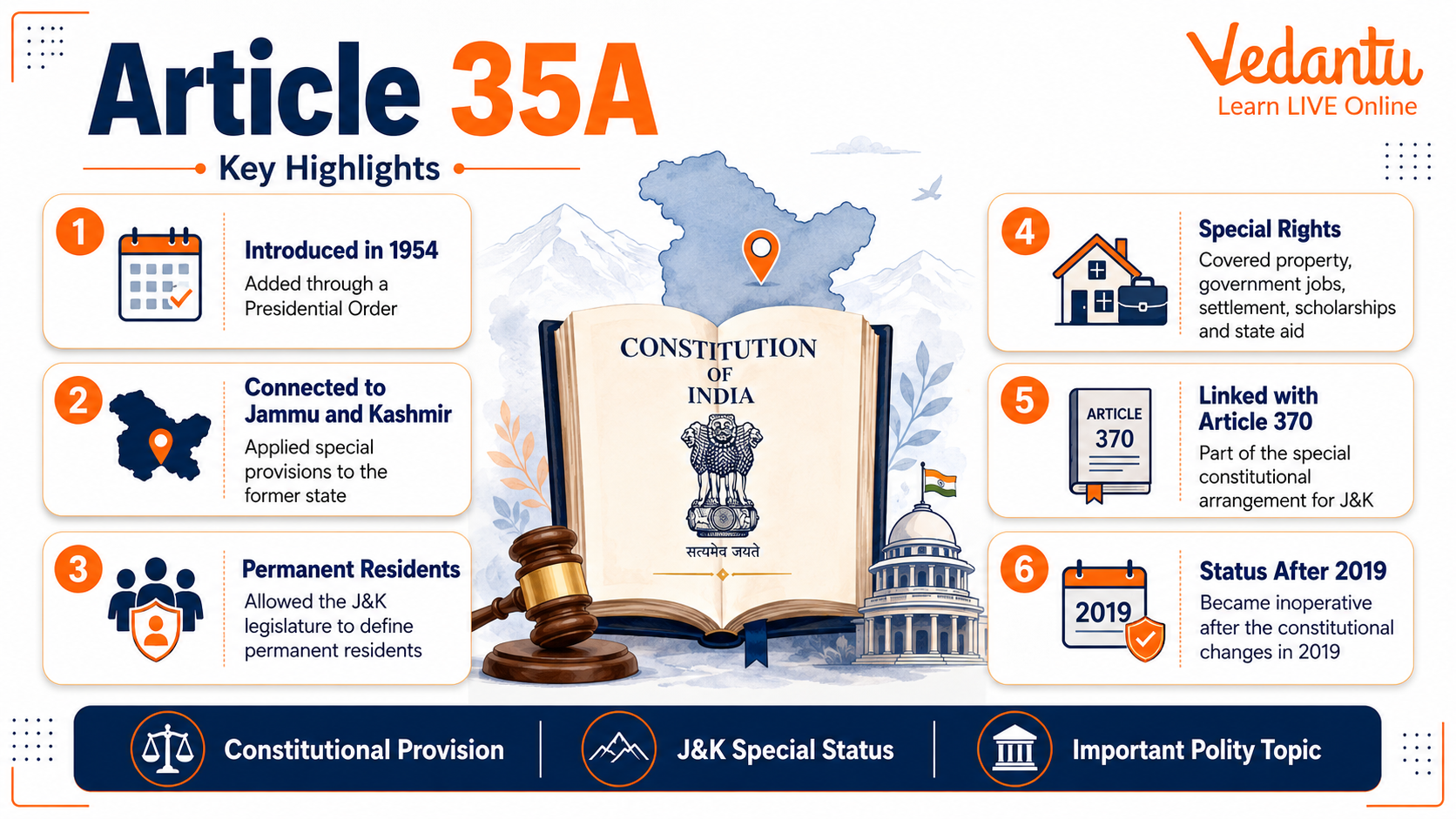
What Is Article 35A?
Article 35A was a provision in the Indian Constitution that gave the Jammu and Kashmir legislature the authority to define permanent residents of the state and grant them special rights. It was introduced through the Constitution Application to Jammu and Kashmir Order, 1954, issued by the President of India under Article 370.
Unlike most constitutional provisions, Article 35A was not added through a constitutional amendment under Article 368. Instead, it was incorporated through a Presidential Order, which later became a subject of legal and political debate.
Historical Background of Article 35A
To understand Article 35A, it is important to know the historical context of Jammu and Kashmir’s accession to India.
- In 1947, after independence, Jammu and Kashmir signed the Instrument of Accession to join India.
- Article 370 was introduced to grant special autonomous status to the state.
- In 1954, the President of India issued an order that added Article 35A to the Constitution.
- This provision allowed the state to continue its own laws regarding permanent residents and their rights.
What Rights Did Article 35A Provide?
Article 35A empowered the Jammu and Kashmir legislature to define permanent residents and grant them special rights and privileges. These rights were not available to citizens from other Indian states.
1. Right to Own Property
Only permanent residents of Jammu and Kashmir were allowed to purchase and own immovable property in the state. Citizens from other states could not buy land or property there.
2. Government Employment
Permanent residents had exclusive rights to apply for government jobs in the state administration.
3. Scholarships and Educational Benefits
State government scholarships and other educational benefits were reserved for permanent residents.
4. Settlement Rights
Only permanent residents had the right to settle permanently in Jammu and Kashmir.
Key Features of Article 35A
| Feature | Description | Impact |
|---|---|---|
| Special Status | Applied only to Jammu and Kashmir | Gave autonomy in defining permanent residents |
| Exclusive Rights | Property, jobs, scholarships reserved | Restricted rights of non-residents |
| Legal Protection | Laws could not be challenged for violating Fundamental Rights | Strengthened state authority |
The table above summarizes the core aspects of Article 35A. It shows how the provision created a legal framework that protected special rights for permanent residents while limiting the applicability of certain Fundamental Rights to non-residents in the state.
Controversies and Legal Debates
Article 35A was controversial for several reasons. Critics argued that it discriminated against other Indian citizens by restricting property ownership and employment opportunities. Some also questioned its constitutional validity because it was added through a Presidential Order rather than a formal constitutional amendment.
- It was challenged in the Supreme Court on grounds of equality and fundamental rights.
- There were debates about gender discrimination, especially regarding women who married outside the state.
- Supporters believed it protected the cultural identity and demographic composition of the region.
Abrogation of Article 35A
On 5 August 2019, the Government of India revoked Article 370 and, as a result, Article 35A also ceased to operate. The state of Jammu and Kashmir was reorganized into two Union Territories - Jammu and Kashmir, and Ladakh.
With the abrogation, special privileges related to permanent residency ended, and all Indian citizens gained equal rights to buy property, seek employment, and settle in the region, subject to applicable laws.
Importance of Article 35A for Exams
Article 35A is an important topic in Indian Polity and General Knowledge. It is frequently asked in:
- UPSC Civil Services Examination
- State Public Service Commission exams
- SSC and Banking exams
- Other competitive and GK-based tests
Key Points to Remember
- Article 35A was added in 1954 through a Presidential Order.
- It empowered Jammu and Kashmir to define permanent residents.
- It granted exclusive rights related to property, jobs, and settlement.
- It ceased to exist after the abrogation of Article 370 in 2019.
Conclusion
Article 35A was a significant constitutional provision that shaped the legal and political landscape of Jammu and Kashmir for decades. It provided special rights to permanent residents and reflected the unique constitutional relationship between the state and the Union of India. However, its abrogation in 2019 marked a major shift in Indian constitutional history. Understanding Article 35A helps students grasp important aspects of Indian polity, federalism, and constitutional amendments, making it a vital topic for General Knowledge and competitive examinations.
FAQs on Article 35A: Meaning, Background and Special Rights for Jammu and Kashmir
1. What is Article 35A of the Indian Constitution?
Article 35A was a special constitutional provision that empowered the Jammu and Kashmir Legislature to define permanent residents and grant them exclusive rights.
• Introduced through the Constitution (Application to Jammu and Kashmir) Order, 1954
• Derived from Article 370 of the Indian Constitution
• Allowed J&K to have special laws regarding citizenship and property
• Became inoperative after the abrogation of Article 370 on 5 August 2019
This topic is important for GK, UPSC, SSC, and competitive exams under Indian Polity and Constitutional Amendments.
2. When was Article 35A added to the Constitution?
Article 35A was added in 1954 through a Presidential Order issued by the President of India.
• Officially inserted via the Constitution (Application to Jammu and Kashmir) Order, 1954
• Issued under the powers of Article 370
• Not added through a constitutional amendment under Article 368
• Applied only to the State of Jammu and Kashmir
This makes it a frequently asked question in Indian Constitution and polity exams.
3. What rights did Article 35A provide to Jammu and Kashmir?
Article 35A granted special rights and privileges exclusively to the permanent residents of Jammu and Kashmir.
• Right to own immovable property in J&K
• Eligibility for state government jobs
• Access to scholarships and educational benefits
• Right to settle permanently in the state
Non-permanent residents were restricted from these benefits, making it a key feature of J&K’s special status.
4. Who were considered permanent residents under Article 35A?
Permanent residents were individuals recognized by the Jammu and Kashmir Legislature under state laws.
• Residents living in J&K before 14 May 1954
• Those who lawfully acquired immovable property in the state
• Individuals granted permanent resident certificates by the state government
• Their descendants were also eligible
This definition played a crucial role in property rights and employment eligibility in Jammu and Kashmir.
5. Why was Article 35A controversial?
Article 35A was controversial because it was seen as discriminatory and not passed through Parliament.
• Critics argued it violated Right to Equality (Article 14)
• Women marrying non-permanent residents faced legal issues
• It restricted property and job rights for other Indian citizens
• Added via Presidential Order, not a constitutional amendment
The debate around Article 35A was central to discussions on federalism, equality, and national integration.
6. What is the relationship between Article 35A and Article 370?
Article 35A was a product of Article 370, which granted special autonomy to Jammu and Kashmir.
• Article 370 allowed special constitutional provisions for J&K
• Article 35A was introduced using powers under Article 370
• Both provisions granted special status to the state
• Both became inoperative on 5 August 2019
Understanding their connection is important for Indian Polity and constitutional law studies.
7. When was Article 35A removed or revoked?
Article 35A became inoperative on 5 August 2019 along with the abrogation of Article 370.
• Government of India issued a Presidential Order
• Jammu and Kashmir Reorganisation Act, 2019 was passed
• J&K was reorganized into two Union Territories — Jammu & Kashmir and Ladakh
• Special rights of permanent residents were abolished
This development is highly important for current affairs and competitive exams.
8. How did Article 35A affect property rights in Jammu and Kashmir?
Article 35A restricted property ownership in J&K to permanent residents only.
• Non-residents could not buy or own land in the state
• Property inheritance was limited to permanent residents
• Protected local demographic structure
• After 2019, property laws were amended to allow broader ownership
This provision significantly impacted land laws and investment in Jammu and Kashmir.
9. Did Article 35A affect women’s rights in Jammu and Kashmir?
Article 35A created legal debates regarding women’s property and residency rights.
• Women marrying non-permanent residents risked losing certain privileges (earlier interpretations)
• Children of such marriages faced residency complications
• Later court rulings clarified some protections
• The issue was often cited in equality and gender rights discussions
This aspect is important in topics related to constitutional law and gender justice.
10. Why is Article 35A important for competitive exams and GK?
Article 35A is important because it relates to Indian Constitution, federalism, and current affairs.
• Frequently asked in UPSC, SSC, Banking, CDS, NDA exams
• Linked with Article 370, J&K Reorganisation Act 2019
• Important for understanding special status and constitutional provisions
• Relevant for debates on equality, autonomy, and national integration
Students preparing for General Knowledge and Indian Polity must clearly understand Article 35A and its implications.
