






How Tube Wells and Traditional Wells Supply Water for Irrigation
Well and Tube Well Irrigation is an important method of artificial irrigation under the subject of Geography and General Knowledge. It involves drawing underground water through wells or tube wells for agricultural purposes. This method is widely used in regions where surface water sources such as rivers and canals are limited. In countries like India, well and tube well irrigation play a crucial role in increasing agricultural productivity, ensuring water availability during dry seasons, and supporting food security. Understanding this topic is essential for school exams, competitive exams, and general awareness.
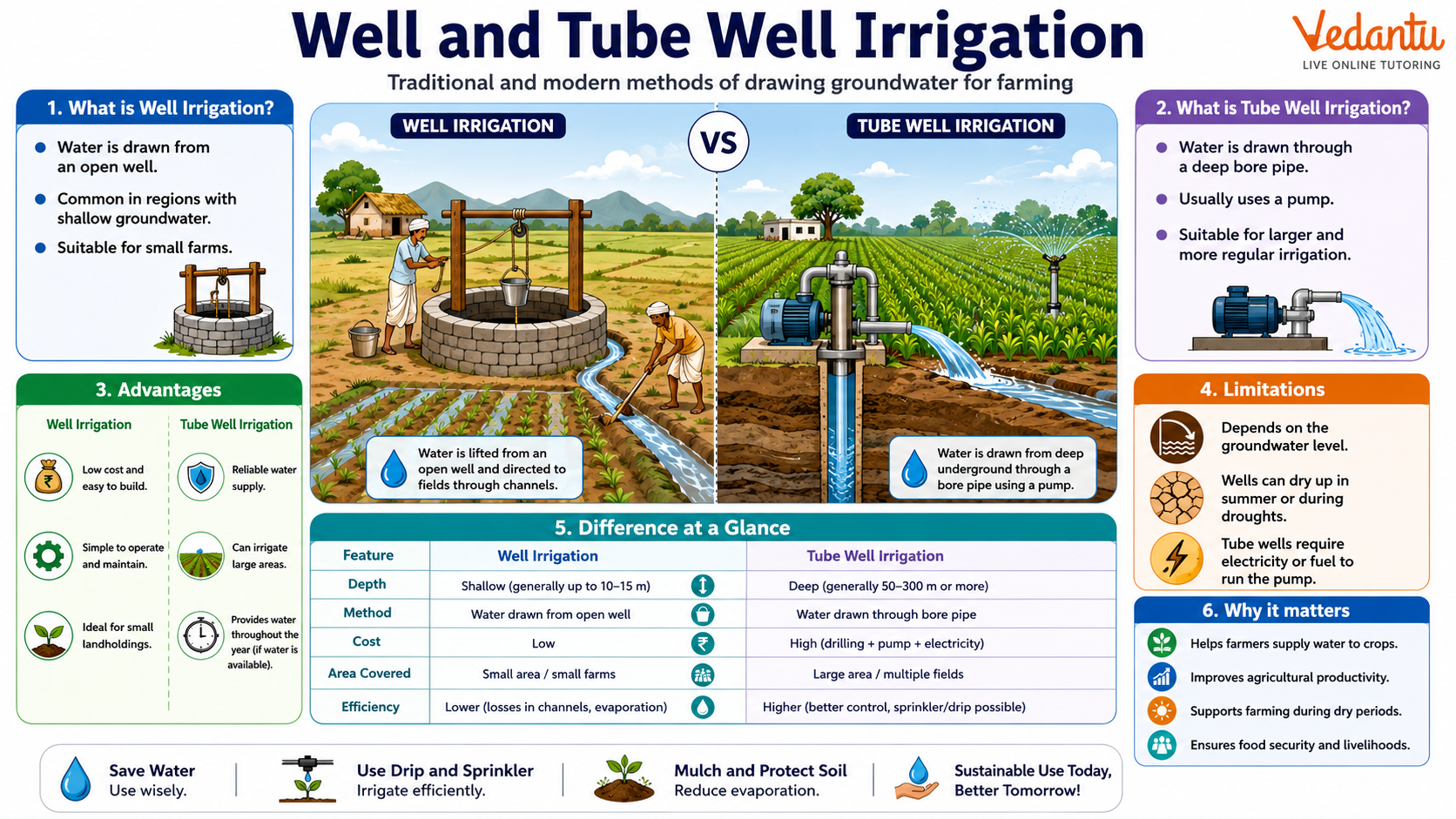
Meaning of Well Irrigation
Well irrigation is one of the oldest methods of irrigation. In this system, water is drawn from shallow wells dug into the ground to access groundwater. The water is lifted using traditional methods such as buckets, pulleys, Persian wheels, or modern electric pumps.
Features of Well Irrigation
- Wells are usually shallow and dug manually.
- Suitable for regions with a high water table.
- Water lifting can be manual or mechanical.
- Common in alluvial plains and rural areas.
Meaning of Tube Well Irrigation
Tube well irrigation is a modern method of extracting groundwater. A deep bore is drilled into the ground and fitted with a tube and pump to draw water. Tube wells are deeper than ordinary wells and can extract water from greater depths using electric or diesel pumps.
Features of Tube Well Irrigation
- Water is drawn from deep underground layers.
- Requires electricity or diesel to operate pumps.
- Provides a continuous and reliable water supply.
- More efficient compared to traditional wells.
Difference Between Well and Tube Well Irrigation
| Basis of Difference | Well Irrigation | Tube Well Irrigation |
|---|---|---|
| Depth | Shallow | Deep |
| Technology Used | Traditional methods | Modern pumps and bore system |
| Water Output | Limited | Large and continuous supply |
The table above clearly shows that tube wells are more advanced and efficient compared to traditional wells. However, both methods are important depending on the availability of groundwater and economic conditions of farmers.
Advantages of Well and Tube Well Irrigation
Advantages of Well Irrigation
- Low construction cost.
- Simple technology and easy maintenance.
- Independent water source for small farmers.
- Suitable for small agricultural fields.
Advantages of Tube Well Irrigation
- High water discharge capacity.
- Ensures irrigation during dry seasons.
- Suitable for large farms.
- Improves agricultural productivity.
Disadvantages of Well and Tube Well Irrigation
Disadvantages of Well Irrigation
- Limited water supply.
- Depends heavily on the level of groundwater.
- Not suitable for large scale farming.
Disadvantages of Tube Well Irrigation
- High installation cost.
- Requires electricity or fuel.
- Overuse may lead to depletion of groundwater.
Conditions Suitable for Well and Tube Well Irrigation
Certain geographical and environmental conditions favor the use of wells and tube wells for irrigation. These conditions determine the success and sustainability of groundwater irrigation methods.
- High and stable groundwater table.
- Soft and porous soil such as alluvial soil.
- Availability of electricity or diesel for pumps in case of tube wells.
- Moderate rainfall regions.
Importance in Agriculture
Well and tube well irrigation have significantly contributed to agricultural development. They provide farmers with control over water supply, reduce dependence on monsoon rainfall, and enable multiple cropping. In regions like the Indo Gangetic plains, tube wells are a major source of irrigation. These methods also support the cultivation of water intensive crops such as wheat, rice, and sugarcane.
Conclusion
Well and Tube Well Irrigation are essential groundwater based irrigation methods that support farming activities across many parts of the world. While traditional wells are cost effective and suitable for small farmers, tube wells offer higher efficiency and greater water supply. Both systems have advantages and limitations, and their sustainable use is necessary to prevent groundwater depletion. For students and competitive exam aspirants, understanding their features, differences, advantages, and disadvantages is important for scoring well in Geography and General Knowledge sections.
FAQs on Well and Tube-Well Irrigation: Meaning, Process and Importance
1. What is well and tube well irrigation?
Well and tube well irrigation is a method of supplying water to crops by drawing groundwater from wells or deep tube wells.
• Well irrigation uses shallow wells dug manually to access groundwater.
• Tube well irrigation uses deep boreholes with pumps to lift water.
• It is common in regions with high groundwater availability.
• Also known as groundwater irrigation, it supports farming in areas with low rainfall.
2. What is the difference between well irrigation and tube well irrigation?
The main difference lies in depth, technology, and water output.
• Well irrigation: Shallow depth, traditional methods, lower water supply.
• Tube well irrigation: Deep boring, electric/diesel pumps, higher water discharge.
• Tube wells are more efficient and suitable for large-scale farming.
• Wells are common in villages with manual or animal-powered systems.
3. What are the advantages of tube well irrigation?
Tube well irrigation provides a reliable and controlled water supply for agriculture.
• Ensures water availability even during dry seasons.
• Covers large agricultural areas efficiently.
• Reduces dependence on monsoon rainfall.
• Helps increase crop yield and productivity.
• Common in states like Punjab, Haryana, and Uttar Pradesh.
4. What are the disadvantages of well and tube well irrigation?
Despite benefits, well and tube well irrigation have environmental and economic drawbacks.
• Overuse may cause groundwater depletion.
• High installation and electricity costs for tube wells.
• Not suitable in areas with low water table.
• Risk of soil salinity due to excessive irrigation.
• May lead to falling groundwater levels over time.
5. In which regions is well and tube well irrigation most common?
Well and tube well irrigation is common in regions with soft soil and abundant groundwater.
• Northern Plains of India (Punjab, Haryana, Uttar Pradesh, Bihar).
• Areas with alluvial soil.
• Regions with moderate to high water table levels.
• Less common in rocky or desert regions with scarce groundwater.
6. How does a tube well work?
A tube well works by drilling a deep borehole and using a pump to extract groundwater.
• A narrow steel pipe is inserted deep into the ground.
• An electric or diesel pump lifts water to the surface.
• Water is distributed to fields through channels or pipes.
• It is a key method of modern irrigation systems.
7. Why is groundwater important for irrigation?
Groundwater is important because it provides a steady and dependable source of irrigation water.
• Available even during drought conditions.
• Less affected by seasonal rainfall changes.
• Supports multiple cropping throughout the year.
• Essential for food security and agricultural sustainability.
8. What factors affect the success of well irrigation?
The success of well irrigation depends on natural and economic factors.
• Level of the water table.
• Type of soil (alluvial soil is ideal).
• Amount of annual rainfall.
• Availability of electricity or pumping equipment.
• Proper groundwater management practices.
9. How does tube well irrigation help in increasing agricultural production?
Tube well irrigation boosts agricultural production by ensuring timely water supply.
• Enables multiple cropping seasons.
• Supports high-yield variety (HYV) seeds.
• Reduces crop failure due to irregular rainfall.
• Promotes Green Revolution farming techniques.
10. What are the environmental impacts of excessive tube well irrigation?
Excessive tube well irrigation can harm the environment by lowering groundwater levels.
• Causes groundwater depletion.
• Leads to drying of nearby wells.
• Increases risk of land subsidence.
• May result in soil salinity and reduced soil fertility.
• Requires sustainable water resource management.
