






Key Features of Union–State Relations: Legislative, Administrative and Financial Powers
Union State Relations refer to the constitutional distribution of powers and responsibilities between the Union Government and the State Governments in India. As India follows a federal system with a strong unitary bias, the Constitution clearly defines legislative, administrative, and financial relations between the two levels of government. These provisions ensure coordination, cooperation, and smooth functioning of governance across the country while maintaining national unity and integrity. Understanding Union State Relations is essential for students, competitive exam aspirants, and anyone interested in Indian Polity.
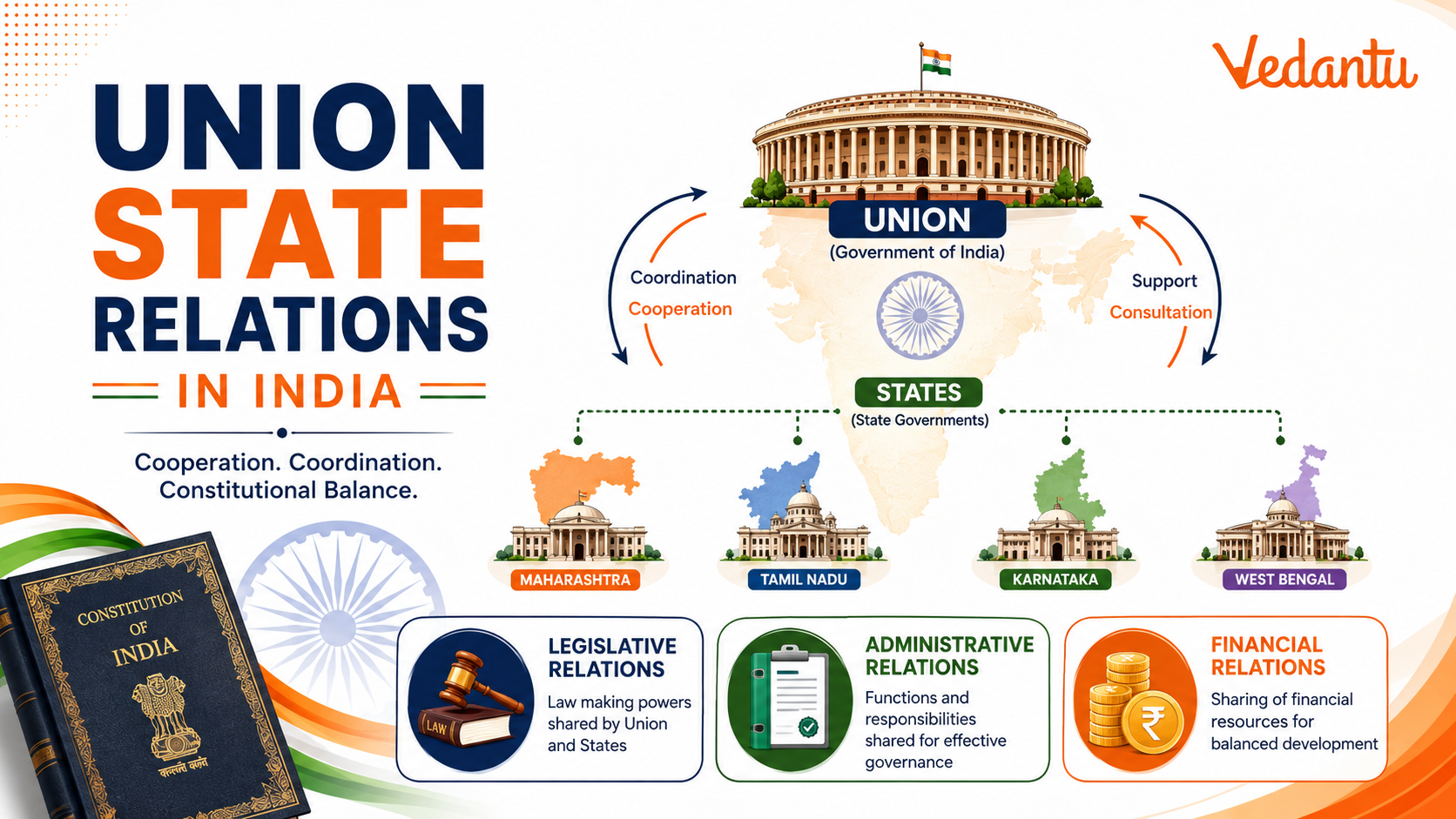
Constitutional Basis of Union State Relations
The Constitution of India lays down detailed provisions regarding Union State Relations primarily in Part XI and Part XII. These provisions are divided into three broad categories: Legislative Relations, Administrative Relations, and Financial Relations. The Seventh Schedule plays a crucial role in defining the legislative powers of the Union and the States.
- Part XI - Articles 245 to 263 deal with Legislative and Administrative Relations.
- Part XII - Articles 268 to 293 deal with Financial Relations.
- Seventh Schedule - Contains Union List, State List, and Concurrent List.
Legislative Relations
Legislative relations define the law-making powers of the Union and State Legislatures. Article 246 distributes subjects between the Union and the States through three lists mentioned in the Seventh Schedule.
Distribution of Legislative Subjects
| List | Authority | Examples of Subjects |
|---|---|---|
| Union List | Parliament | Defence, Foreign Affairs, Banking |
| State List | State Legislature | Police, Public Order, Agriculture |
| Concurrent List | Both Parliament and State Legislature | Education, Forests, Marriage |
In case of conflict between Union and State laws on subjects in the Concurrent List, the Union law prevails. Residuary powers, which are subjects not mentioned in any list, rest with Parliament.
Special Circumstances When Parliament Can Legislate on State Subjects
- During National Emergency under Article 352.
- When Rajya Sabha passes a resolution by two-thirds majority under Article 249.
- When two or more states request Parliament to legislate under Article 252.
- To implement international agreements under Article 253.
Administrative Relations
Administrative relations deal with the distribution of executive powers between the Union and the States. While States have autonomy in their administrative matters, the Union can issue directions to ensure compliance with constitutional provisions.
Key Features of Administrative Relations
- Executive power of the Union extends to matters on which Parliament can legislate.
- States must ensure compliance with Union laws.
- The President can establish Inter State Council under Article 263.
- All India Services like IAS and IPS strengthen coordination between Union and States.
If a State fails to comply with Union directions, it may lead to the imposition of President's Rule under Article 356.
Financial Relations
Financial relations determine the distribution of revenue between the Union and the States. The Constitution provides for a systematic allocation of taxation powers to maintain fiscal balance.
Distribution of Financial Powers
| Type of Tax | Levied By | Collected By |
|---|---|---|
| Customs Duty | Union | Union |
| State GST | State | State |
The Finance Commission, constituted under Article 280, recommends the distribution of tax revenues between the Union and the States. Grants in aid are provided under Article 275 to support states in need.
Role of Finance Commission
- Recommends sharing of central taxes with states.
- Suggests principles for grants in aid.
- Promotes fiscal stability and balance.
Importance of Union State Relations
Union State Relations are vital for maintaining the federal structure of India. They ensure balance between unity and regional autonomy. Proper coordination helps in effective policy implementation, national development, disaster management, and maintaining law and order across the country.
- Promotes cooperative federalism.
- Ensures equitable distribution of resources.
- Strengthens national integration.
- Provides mechanisms to resolve conflicts.
Challenges in Union State Relations
Despite constitutional clarity, tensions sometimes arise between the Union and States due to political differences, fiscal disputes, and administrative control. Issues related to Governor's role, use of Article 356, and distribution of GST revenues often become areas of debate.
Conclusion
Union State Relations form the backbone of India's federal system. Through legislative, administrative, and financial provisions, the Constitution ensures a balanced distribution of powers while maintaining national unity. A clear understanding of these relations is crucial for competitive examinations and for comprehending how governance functions in India. By promoting cooperative federalism and resolving conflicts through constitutional mechanisms, Union State Relations help sustain democratic governance in the country.
FAQs on Union–State Relations in India: Structure, Powers and Key Issues
1. What are Union-State Relations in the Indian Constitution?
Union-State Relations refer to the distribution of powers and responsibilities between the Central Government and State Governments under the Indian Constitution. These relations are mainly covered in Part XI (Articles 245–263) and include:
• Legislative Relations – Division of law-making powers
• Administrative Relations – Coordination in executive functions
• Financial Relations – Distribution of revenue and taxes
This framework ensures a federal system with a strong centre, often searched as federal structure of India or centre-state relations.
2. How are legislative powers divided between the Union and States?
Legislative powers are divided through the Seventh Schedule of the Constitution into three lists. These include:
• Union List (100 subjects) – Defence, Foreign Affairs, Banking
• State List (61 subjects) – Police, Public Health, Agriculture
• Concurrent List (52 subjects) – Education, Forests, Marriage
In case of conflict, Union law prevails over State law under Article 254. This division defines the law-making powers in India.
3. What happens if there is a conflict between Union and State laws?
In case of conflict, Union law overrides State law on subjects in the Concurrent List. According to Article 254:
• Central law prevails over State law
• State law can operate only with Presidential assent
• During emergencies, Parliament can legislate on State List matters
This principle strengthens the central authority in India's quasi-federal system.
4. What are Administrative Relations between the Centre and States?
Administrative relations ensure coordination between the Union and States in governance. Key provisions include:
• Article 256 – States must comply with Union laws
• Article 257 – Union can give directions to States
• All India Services (IAS, IPS) – Joint administrative control
• Inter-State Council (Article 263) – Coordination mechanism
These provisions maintain administrative unity and cooperative federalism.
5. What are Financial Relations between the Union and States?
Financial relations deal with revenue sharing and tax distribution between Centre and States. Important features include:
• Division of taxation powers (Articles 268–281)
• Finance Commission (Article 280) recommends tax sharing
• GST Council ensures cooperative tax structure
• Grants-in-aid under Article 275
This system promotes fiscal federalism and balanced economic development.
6. What is the role of the Finance Commission in Union-State Relations?
The Finance Commission is a constitutional body that recommends the distribution of financial resources between Centre and States. Its key functions are:
• Recommending tax devolution formula
• Suggesting grants-in-aid
• Promoting fiscal discipline
Established under Article 280, it strengthens financial federalism and revenue sharing in India.
7. How does emergency affect Union-State Relations?
During an Emergency, the balance of power shifts towards the Centre. Under:
• National Emergency (Article 352) – Parliament can legislate on State List
• President’s Rule (Article 356) – State government is suspended
• Financial Emergency (Article 360) – Centre controls state finances
These provisions temporarily convert India into a more unitary system.
8. What is the Inter-State Council?
The Inter-State Council is a constitutional body established under Article 263 to promote coordination between Centre and States. Its functions include:
• Discussing inter-state disputes
• Investigating common interests
• Recommending better policy coordination
It plays a vital role in cooperative federalism and centre-state dialogue.
9. Why is India called a quasi-federal state?
India is called a quasi-federal state because it combines federal and unitary features. Key reasons include:
• Strong Union List dominance
• Single Constitution and single citizenship
• Emergency provisions strengthening Centre
• Power of Parliament to alter state boundaries
This blend of federal structure with central supremacy defines Indian federalism.
10. What is the importance of Union-State Relations for competitive exams?
Union-State Relations are crucial for exams like UPSC, SSC, State PSC, and other competitive exams. Important focus areas include:
• Articles 245–263 and Seventh Schedule
• Legislative, administrative, and financial relations
• Emergency provisions and Article 356
• Finance Commission and GST Council
Understanding centre-state relations helps in polity, governance, and constitutional law questions.
