






Why Table-Top Airports Are Challenging and How They Ensure Safety
Tabletop Airports are unique types of airports built on elevated plateaus or hilltops with steep drops at one or both ends of the runway. These airports are commonly found in hilly or mountainous regions where flat land is limited. Due to their geographical location, tabletop airports require special design, skilled pilots, and strict safety measures. They are important from a General Knowledge perspective, especially for competitive exams, aviation studies, and geography-related topics.
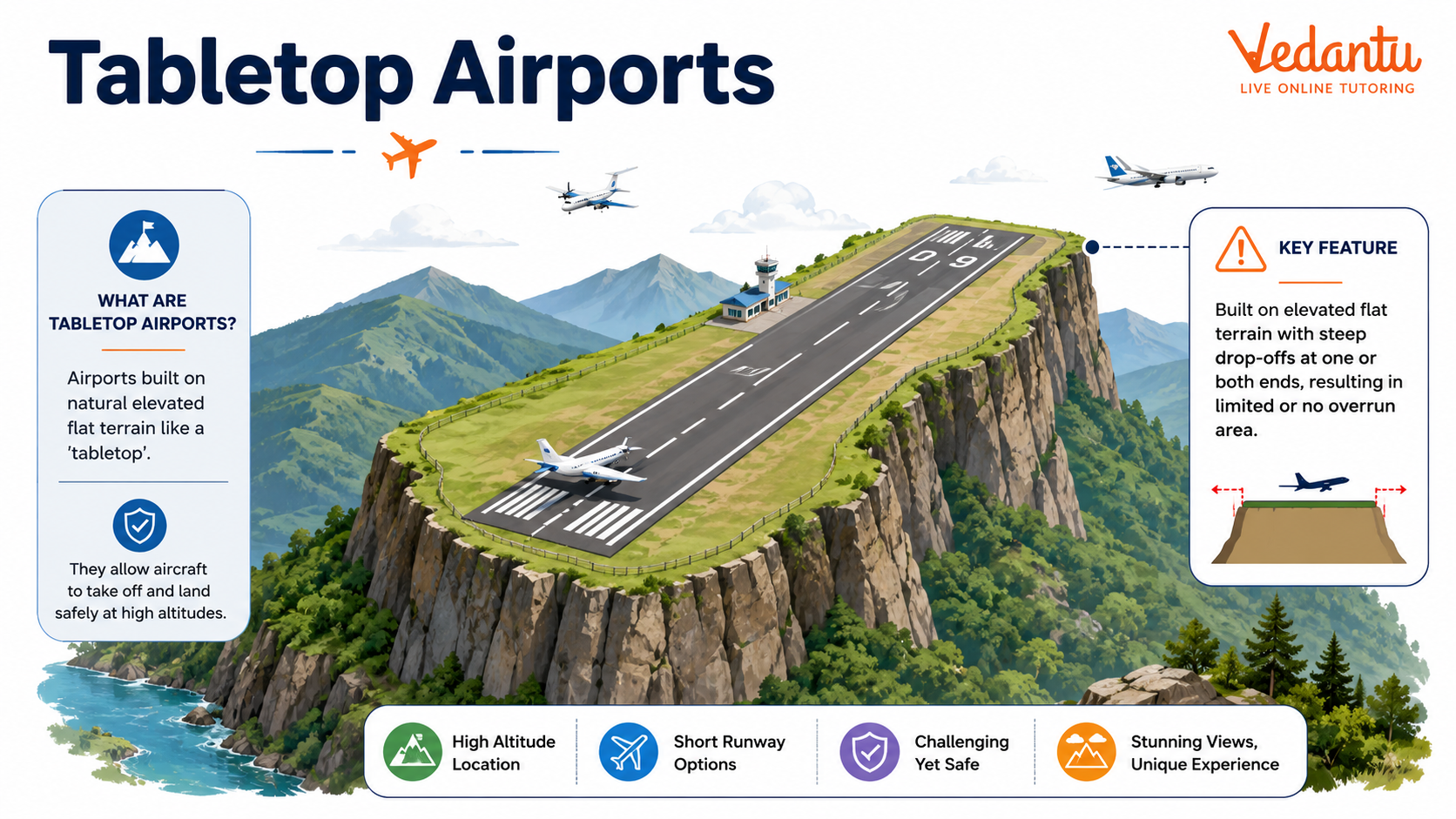
What are Tabletop Airports?
A tabletop airport is an airport located on top of a plateau or hill, where the runway is built by cutting and leveling the top surface. The runway usually ends abruptly with deep valleys or steep slopes on either side. This creates a visual effect of a table, which is why they are called tabletop airports.
These airports are mainly constructed in regions where flat land is unavailable due to mountainous terrain. They require precise landing and take-off operations because there is little room for error.
Key Features of Tabletop Airports
- Located on elevated plateaus or hilltops
- Runways have steep drops at one or both ends
- Limited runway overrun area
- Require special pilot training and expertise
- Often surrounded by valleys, rivers, or forests
- Higher risk during bad weather conditions
Why are Tabletop Airports Challenging?
Landing and take-off at tabletop airports are considered challenging due to geographical constraints. Pilots must follow precise approach paths and maintain accurate speed control.
Major Challenges
- Shorter runway safety margins
- Strong crosswinds in hilly regions
- Poor visibility due to fog or heavy rain
- Limited scope for go-around maneuvers
- High dependency on pilot skill and advanced navigation systems
Major Tabletop Airports in India
| Airport Name | Location | State |
|---|---|---|
| Kozhikode International Airport | Karipur | Kerala |
| Mangalore International Airport | Mangalore | Karnataka |
| Lengpui Airport | Aizawl | Mizoram |
These airports are well-known examples of tabletop airports in India. They frequently appear in current affairs and competitive examinations due to safety discussions and aviation developments.
Safety Measures at Tabletop Airports
Due to increased risk factors, special safety systems are implemented at tabletop airports to reduce accidents and improve operational security.
- Runway End Safety Area - RESA construction
- Advanced Instrument Landing Systems - ILS
- Strict weather monitoring systems
- Special pilot certification and simulator training
- Improved drainage systems to avoid waterlogging
Difference Between Regular and Tabletop Airports
| Feature | Regular Airport | Tabletop Airport |
|---|---|---|
| Location | Flat land | Hilltop or plateau |
| Runway Ends | Extended safety areas | Steep drop-offs |
| Landing Difficulty | Moderate | High |
The primary difference lies in terrain and runway safety margins. Tabletop airports demand greater precision and advanced aviation support systems.
Importance in General Knowledge and Competitive Exams
Tabletop airports are frequently asked in competitive exams such as UPSC, SSC, State PSC, Railways, Banking exams, and other government recruitment tests. Questions may relate to their definition, examples, safety concerns, or recent news events.
- Static GK related to Indian geography
- Current affairs related to aviation safety
- Infrastructure development in hilly regions
Quick Revision Points
- Built on elevated plateaus or hilltops
- Steep valleys at runway ends
- High landing and take-off precision required
- Examples in India - Kozhikode, Mangalore, Lengpui
- Important topic in static GK and current affairs
Conclusion
Tabletop airports represent a remarkable blend of engineering skill and aviation expertise. Built in challenging terrains, they serve as crucial connectivity hubs for remote and hilly regions. However, their unique structure makes them operationally demanding and safety-sensitive. Understanding tabletop airports is essential for students preparing for competitive examinations as well as anyone interested in aviation and geography. Proper awareness of their features, examples, and challenges helps in building strong General Knowledge foundations.
FAQs on Tabletop Airports and How Hilltop Runways Work
1. What is a tabletop airport?
A tabletop airport is an airport built on top of a hill or plateau with steep drops at one or both ends of the runway.
• The runway is located on an elevated terrain resembling a table surface.
• It usually has deep valleys or cliffs at the ends.
• Requires highly skilled pilots for landing and takeoff.
• Common in hilly regions where flat land is limited.
This term is often searched under hilltop airports, elevated runway airports, and dangerous airports in the world.
2. Why are tabletop airports considered risky?
Tabletop airports are considered risky because of their limited runway length and steep drop-offs.
• No room for error during landing overruns.
• Challenging during bad weather conditions like rain or fog.
• Strong crosswinds can affect aircraft stability.
• Requires precise pilot training and navigation systems.
They are often discussed under aviation safety, runway safety area, and aircraft landing challenges.
3. Which are the famous tabletop airports in India?
India has several well-known tabletop airports located in hilly regions.
• Calicut International Airport (Kozhikode), Kerala
• Mangalore International Airport, Karnataka
• Lengpui Airport, Mizoram
These airports are frequently mentioned in GK questions, UPSC exams, and topics related to Indian aviation infrastructure.
4. What are the key features of a tabletop runway?
A tabletop runway has distinct geographical and structural characteristics.
• Built on a plateau or hilltop.
• One or both runway ends end in a steep valley.
• Limited runway safety area (RSA).
• Advanced landing systems for safe operations.
These features are commonly searched as airport runway types, aviation geography, and types of airports.
5. How do pilots safely land at tabletop airports?
Pilots follow strict aviation procedures and specialized training to land safely at tabletop airports.
• Use of Instrument Landing System (ILS).
• Accurate speed and descent control.
• Special simulator training for short runway landings.
• Continuous coordination with Air Traffic Control (ATC).
This topic relates to pilot training, aviation safety standards, and DGCA regulations.
6. What is the difference between a tabletop airport and a normal airport?
The main difference lies in the airport’s geographical location and runway structure.
• Tabletop airports are built on elevated plateaus with steep edges.
• Normal airports are constructed on flat terrain with extended safety areas.
• Tabletop airports have higher operational risks.
• Normal airports provide longer overrun areas for safety.
This comparison is often searched under types of airports in India and aviation infrastructure differences.
7. Which is the most dangerous tabletop airport in the world?
One of the most dangerous tabletop airports globally is Paro International Airport in Bhutan.
• Surrounded by high mountains.
• Requires specially trained pilots.
• Limited number of certified operators.
• Challenging weather and visibility conditions.
It is frequently listed among world’s most dangerous airports and challenging airport landings.
8. Why are tabletop airports built despite safety challenges?
Tabletop airports are built due to geographical constraints and connectivity needs.
• Lack of flat land in hilly or mountainous regions.
• Need to improve regional connectivity.
• Boost tourism and economic development.
• Strategic and defense importance in some areas.
This is related to regional airport development, UDAN scheme, and transport infrastructure planning.
9. What safety measures are taken at tabletop airports?
Strict safety measures are implemented to minimize risks at tabletop airports.
• Installation of Runway End Safety Areas (RESA).
• Advanced radar and navigation systems.
• Regular runway inspections.
• Restrictions during adverse weather.
These measures are part of international aviation standards set by ICAO and national authorities like DGCA.
10. Are tabletop airports important for competitive exams?
Yes, tabletop airports are important for competitive exams due to their geographical and aviation significance.
• Frequently asked in UPSC, SSC, NDA, and State PSC exams.
• Relevant under Indian geography and current affairs.
• Often linked to aviation accidents and infrastructure topics.
• Important for general knowledge and interviews.
They are commonly searched as GK questions on airports and important airports in India.
