






How Brahmo Samaj Led by Ram Mohan Roy Changed Indian Society
Ram Mohan Roy Brahmo refers to the reformist ideas and religious movement associated with Raja Ram Mohan Roy, the founder of the Brahmo Sabha in 1828, which later became the Brahmo Samaj. He was one of the most influential social and religious reformers of modern India and is often called the Father of the Indian Renaissance. Through the Brahmo movement, he aimed to reform Hindu society by promoting monotheism, opposing social evils, and encouraging rational thinking. His contributions laid the foundation for social reform movements in 19th century India and played a key role in shaping modern Indian thought.
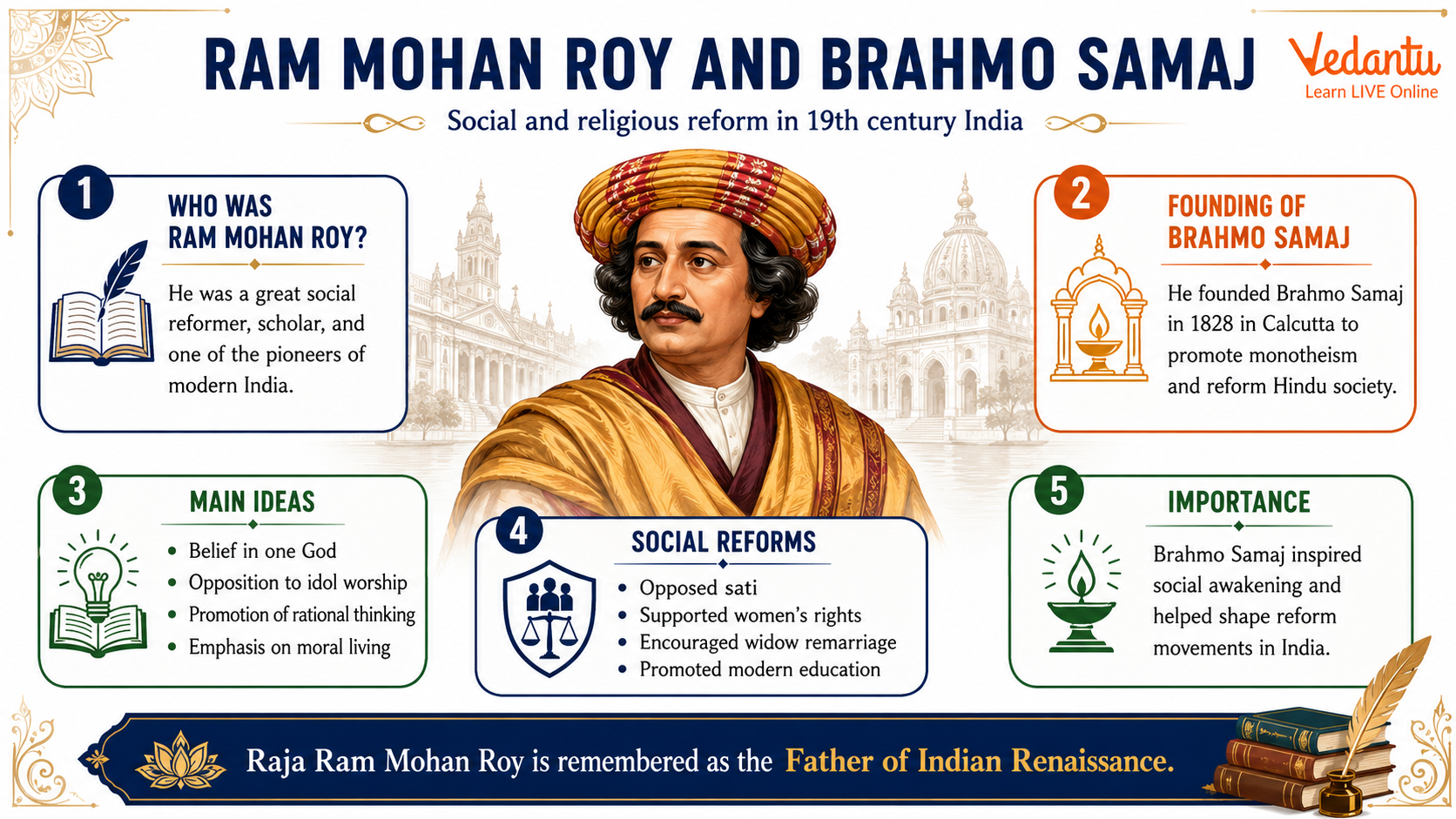
Who Was Raja Ram Mohan Roy?
Raja Ram Mohan Roy was born in 1772 in Radhanagar, Bengal. He was a scholar who had deep knowledge of Sanskrit, Persian, Arabic, and English. He studied various religious texts including the Vedas, Upanishads, Quran, and Bible. His exposure to different philosophies influenced his belief in monotheism and rationalism. He worked for social, educational, and religious reforms during British rule in India.
- Born - 1772, Radhanagar, Bengal
- Founded Brahmo Sabha in 1828
- Advocated abolition of Sati
- Supported women education and rights
- Died - 1833 in Bristol, England
Formation of Brahmo Samaj
In 1828, Raja Ram Mohan Roy established the Brahmo Sabha in Calcutta, which later came to be known as the Brahmo Samaj. The main objective of the organization was to purify Hinduism and promote the worship of one God without idol worship. It opposed ritualism, caste discrimination, and social evils that had become part of society.
Main Objectives of Brahmo Samaj
- Promotion of monotheism - belief in one God
- Opposition to idol worship and superstitions
- Abolition of social evils like Sati
- Encouragement of women education
- Promotion of rational thinking and modern education
Social Reforms Led by Ram Mohan Roy
Raja Ram Mohan Roy actively worked to reform Indian society. He believed that social progress was necessary for national development. His reform efforts were supported by logical arguments and appeals to both Indian scriptures and British authorities.
Abolition of Sati
One of his greatest achievements was his campaign against the Sati system, in which widows were forced to immolate themselves on their husband's funeral pyre. Due to his persistent efforts and support from Governor General Lord William Bentinck, Sati was officially abolished in 1829.
Promotion of Women Rights
- Supported widow remarriage
- Advocated property rights for women
- Encouraged female education
Educational Reforms
He promoted modern scientific education instead of traditional learning alone. He supported English education and helped in establishing institutions that combined Western and Indian knowledge systems.
Philosophy and Religious Views
Raja Ram Mohan Roy believed in the unity of God and rejected idol worship. He emphasized the teachings of the Upanishads and supported a rational and ethical approach to religion. He believed that religion should promote moral values and social harmony rather than blind faith.
- Belief in one formless God
- Opposition to caste discrimination
- Encouragement of interfaith dialogue
- Emphasis on reason and morality
Key Facts About Ram Mohan Roy and Brahmo Samaj
| Aspect | Details | Year |
|---|---|---|
| Birth | Radhanagar, Bengal | 1772 |
| Founded Brahmo Sabha | Calcutta | 1828 |
| Abolition of Sati | Supported by Lord William Bentinck | 1829 |
| Death | Bristol, England | 1833 |
The table above summarizes the important milestones in the life of Raja Ram Mohan Roy and the early development of the Brahmo movement.
Impact of Brahmo Samaj
The Brahmo Samaj had a lasting impact on Indian society. It inspired future reformers such as Debendranath Tagore and Keshab Chandra Sen. The movement encouraged critical thinking, social reform, and religious tolerance. It also contributed to the growth of nationalism by promoting self respect and modernization.
- Strengthened social reform movements in India
- Promoted women empowerment
- Encouraged modern education
- Laid foundation for Indian Renaissance
Conclusion
Ram Mohan Roy and the Brahmo Samaj played a crucial role in transforming Indian society during the 19th century. By promoting monotheism, rationalism, and social reforms, he challenged orthodox practices and worked towards a more progressive society. His efforts in abolishing Sati, supporting women rights, and encouraging modern education make him one of the greatest reformers in Indian history. The legacy of the Brahmo Samaj continues to be remembered as a turning point in India's social and religious reform movement.
FAQs on Ram Mohan Roy and Brahmo Samaj: Life, Ideas, and Reforms
1. Who was Ram Mohan Roy?
Raja Ram Mohan Roy was a prominent Indian social reformer and the founder of the Brahmo Samaj who played a key role in the Indian Renaissance.
• Born in 1772 in Bengal, he is known as the Father of Modern India.
• He worked for social, religious, and educational reforms.
• He opposed practices like Sati, child marriage, and caste discrimination.
• He promoted modern education and women’s rights.
• Frequently asked in GK and competitive exams under topics like Indian Reform Movements and Bengal Renaissance.
2. What is Brahmo Samaj?
Brahmo Samaj was a religious reform movement founded by Raja Ram Mohan Roy in 1828 to promote monotheism and social reform.
• It believed in one God and rejected idol worship.
• Opposed caste system and social evils.
• Encouraged women’s education and widow remarriage.
• Played a major role in the Indian social and religious reform movement.
• Often searched as: founder of Brahmo Samaj, aims of Brahmo Samaj, and Brahmo Samaj movement.
3. Why is Ram Mohan Roy called the Father of Modern India?
Ram Mohan Roy is called the Father of Modern India because he introduced progressive reforms that modernized Indian society.
• Led the campaign against the Sati system.
• Promoted Western education and scientific learning.
• Supported freedom of press and rational thinking.
• Encouraged social equality and women’s empowerment.
• Related search terms include Indian Renaissance leader and social reformers of India.
4. What was the role of Ram Mohan Roy in abolishing Sati?
Raja Ram Mohan Roy played a crucial role in the abolition of the Sati system in 1829.
• He strongly criticized Sati through writings and petitions.
• Influenced Lord William Bentinck to pass the law banning Sati.
• Used religious texts to prove Sati was not compulsory in Hinduism.
• The practice was officially banned under the Bengal Sati Regulation Act, 1829.
• Important for exams under social reform movements in India.
5. What were the main aims of Brahmo Samaj?
The main aim of Brahmo Samaj was to reform Hindu society and promote monotheism.
• Belief in one formless God.
• Rejection of idol worship and superstitions.
• Opposition to caste discrimination.
• Promotion of women’s rights and education.
• Encouragement of rationalism and ethical living.
• Common GK query: objectives of Brahmo Samaj.
6. When and where was Brahmo Samaj founded?
Brahmo Samaj was founded in 1828 in Calcutta (Kolkata) by Raja Ram Mohan Roy.
• Established during the Bengal Renaissance period.
• Initially called the Brahma Sabha.
• Later developed under leaders like Debendranath Tagore.
• Frequently asked in exams: Year of Brahmo Samaj foundation.
7. What were the contributions of Ram Mohan Roy in education?
Raja Ram Mohan Roy promoted modern and scientific education in India.
• Supported teaching of English and Western sciences.
• Helped establish Hindu College (1817) in Calcutta.
• Advocated for rational and practical learning.
• Opposed traditional education based only on religious texts.
• Important under topics like education reforms in British India.
8. What were the social reforms introduced by Ram Mohan Roy?
Ram Mohan Roy introduced major social reforms to improve Indian society.
• Abolition of Sati.
• Support for widow remarriage.
• Opposition to child marriage.
• Campaign against caste inequality.
• Promotion of women’s property rights.
• Related searches: social reformers of 19th century India.
9. How did Brahmo Samaj influence Indian society?
Brahmo Samaj influenced Indian society by promoting reform, rationalism, and equality.
• Inspired future reform movements like Prarthana Samaj.
• Spread awareness against social evils.
• Encouraged inter-caste marriages.
• Strengthened the foundation of modern Indian nationalism.
• Frequently asked in GK under impact of Brahmo Samaj.
10. When did Raja Ram Mohan Roy die?
Raja Ram Mohan Roy died in 1833 in Bristol, England, where he had gone as an ambassador of the Mughal Emperor.
• Died on 27 September 1833.
• He was representing Emperor Akbar II.
• Remembered as a pioneer of Indian social and religious reform.
• Important factual question for GK and competitive exams.
