






Key Differences Between NRC and CAA and Why They Matter for Citizens
The National Register of Citizens (NRC) and the Citizenship Amendment Act (CAA) are two major topics in Indian polity that have generated widespread discussion and debate. Both are related to the concept of citizenship in India, which determines who is recognized as a legal citizen of the country. Understanding NRC and CAA is important for students, competitive exam aspirants, and general readers as they are closely linked to constitutional provisions, fundamental rights, and the political and social framework of India.
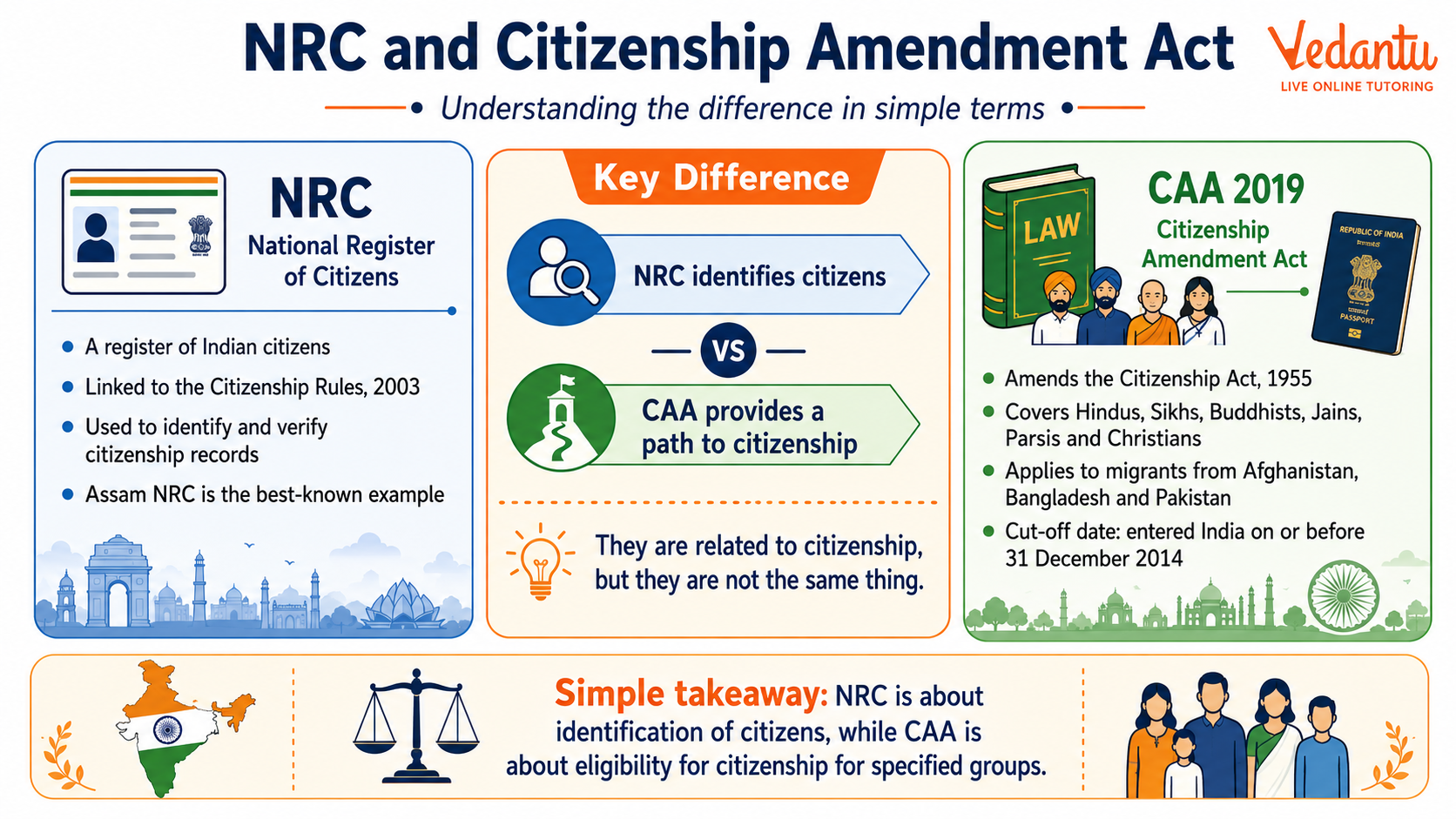
What is NRC - National Register of Citizens?
The National Register of Citizens (NRC) is an official record of legal Indian citizens. Its main purpose is to identify genuine citizens and detect illegal immigrants living in the country. The NRC was first prepared in 1951 after the Census of India. In recent years, the NRC update process was carried out in Assam following the Supreme Court's directions.
Objectives of NRC
- To identify illegal immigrants residing in India.
- To create an authentic database of Indian citizens.
- To safeguard the demographic and cultural identity of specific regions.
- To strengthen national security and border management.
NRC in Assam
The NRC update in Assam was based on the Assam Accord of 1985. According to the Accord, people who entered Assam after March 24, 1971, were considered illegal immigrants. The final NRC list in Assam was published in August 2019.
- Applicants had to provide documentary proof of citizenship.
- Documents included birth certificates, land records, and electoral rolls.
- People excluded from the list could appeal in Foreigners Tribunals.
What is CAA - Citizenship Amendment Act, 2019?
The Citizenship Amendment Act (CAA), 2019 amended the Citizenship Act of 1955. It provides a fast-track route to Indian citizenship for certain persecuted minorities from neighboring countries. The Act applies to Hindus, Sikhs, Buddhists, Jains, Parsis, and Christians who migrated from Pakistan, Bangladesh, and Afghanistan before December 31, 2014.
Key Features of CAA
- Reduces the required period of residence in India for citizenship from 11 years to 5 years for eligible groups.
- Applies only to migrants from Pakistan, Bangladesh, and Afghanistan.
- Covers six religious communities specified in the Act.
- Does not apply to tribal areas of Assam, Meghalaya, Mizoram, and Tripura as included in the Sixth Schedule of the Constitution.
Difference Between NRC and CAA
| Basis | NRC | CAA |
|---|---|---|
| Nature | Register of Indian citizens | Amendment to Citizenship Act 1955 |
| Purpose | Identify illegal immigrants | Grant citizenship to specific migrants |
| Coverage | Implemented in Assam | Applies across India with exceptions |
While NRC focuses on identifying legal citizens and excluding illegal immigrants, CAA provides a path to citizenship for certain persecuted minorities from neighboring countries. The two are different in nature and objective but both deal with the issue of citizenship.
Constitutional and Legal Provisions
Citizenship in India is governed by Articles 5 to 11 of the Indian Constitution and the Citizenship Act, 1955. Parliament has the power to regulate citizenship through legislation. The CAA was passed by Parliament in December 2019 and received Presidential assent. The NRC process in Assam was supervised by the Supreme Court.
Relevant Constitutional Articles
- Article 5 - Citizenship at the commencement of the Constitution.
- Article 6 - Rights of citizenship of certain persons who migrated from Pakistan.
- Article 11 - Parliament's power to regulate citizenship by law.
Controversies and Public Debate
Both NRC and CAA led to widespread public debate across India. Supporters argue that these measures protect national security and provide relief to persecuted minorities. Critics express concerns regarding exclusion, documentation challenges, and issues related to equality and secularism. The Supreme Court is examining petitions related to the constitutional validity of CAA.
Importance for Competitive Exams
NRC and CAA are important topics in Indian Polity for exams such as UPSC, SSC, State PSC, and other government examinations. Questions may be asked about constitutional provisions, features of CAA, differences between NRC and CAA, and related current affairs.
- Understand Articles 5 to 11 of the Constitution.
- Learn the key provisions of the Citizenship Act, 1955.
- Know the Assam Accord and its significance.
- Prepare differences between NRC and CAA in tabular form.
Conclusion
The NRC and CAA are significant components of India's citizenship framework. While NRC aims to identify genuine citizens, CAA provides citizenship to specific groups of migrants facing religious persecution. A clear understanding of their objectives, provisions, and differences helps in analyzing their impact on Indian society and governance. For students and aspirants, mastering this topic strengthens their knowledge of Indian polity and constitutional law.
FAQs on NRC and Citizenship Amendment Act: Meaning, Purpose and Impact in India
1. What is NRC in India?
The National Register of Citizens (NRC) is an official record of legal Indian citizens prepared to identify illegal immigrants.
• First prepared in 1951 after the Census.
• Updated in Assam (2019) under Supreme Court supervision.
• Aims to detect undocumented migrants, especially from Bangladesh.
• Often discussed in relation to citizenship verification, Assam Accord (1985), and illegal immigration issues.
2. What is CAA 2019?
The Citizenship Amendment Act (CAA), 2019 amends the Citizenship Act of 1955 to provide fast-track citizenship to certain persecuted minorities.
• Applies to Hindus, Sikhs, Buddhists, Jains, Parsis, and Christians.
• Covers migrants from Pakistan, Bangladesh, and Afghanistan.
• Reduces residency requirement from 11 years to 5 years.
• Frequently searched with terms like citizenship law, religious persecution, and CAA rules.
3. What is the difference between NRC and CAA?
The key difference is that NRC identifies citizens, while CAA grants citizenship to specific groups.
• NRC: A citizenship verification process.
• CAA: A law offering citizenship to certain migrants.
• NRC may apply to all residents; CAA applies only to specific minorities from three countries.
• Common comparisons include NRC vs CAA, citizenship debate, and constitutional validity.
4. Why was NRC updated in Assam?
The Assam NRC update was conducted to identify illegal immigrants as per the Assam Accord of 1985.
• Cut-off date: 24 March 1971.
• Linked to concerns over demographic changes.
• Supervised by the Supreme Court of India.
• Connected to topics like Assam agitation and migration from Bangladesh.
5. Who is eligible under the CAA?
Under CAA 2019, certain non-Muslim minorities from three neighboring countries are eligible for Indian citizenship.
• Countries: Pakistan, Bangladesh, Afghanistan.
• Religions: Hindu, Sikh, Buddhist, Jain, Parsi, Christian.
• Must have entered India before 31 December 2014.
• Often searched as CAA eligibility criteria and citizenship amendment rules.
6. Is NRC applicable across India?
Currently, NRC has been implemented only in Assam, not nationwide.
• The central government has discussed a possible nationwide NRC.
• No official nationwide implementation has occurred yet.
• Related queries include nationwide NRC debate and citizenship documentation requirements.
7. Why is CAA controversial?
The CAA controversy arises due to concerns about religious discrimination and constitutional validity.
• Critics argue it excludes Muslims.
• Supporters say it protects persecuted minorities.
• Led to nationwide protests in 2019–2020.
• Linked to debates on Article 14 (Right to Equality) and secularism.
8. What documents are required for NRC?
For NRC verification, applicants must prove citizenship before the cut-off date.
• Legacy documents (pre-1971 records in Assam).
• Electoral rolls and land records.
• Birth certificates and government-issued IDs.
• Commonly searched as NRC documents list and citizenship proof documents.
9. Does CAA affect existing Indian citizens?
The CAA does not affect existing Indian citizens as it only grants citizenship to eligible migrants.
• It does not cancel or revoke citizenship.
• Applies only to specific foreign nationals.
• Frequently asked in relation to citizenship rights and constitutional safeguards.
10. What is the constitutional basis of CAA and NRC?
Both CAA and NRC are based on provisions under the Indian Constitution and the Citizenship Act, 1955.
• Parliament has power under Article 11 to regulate citizenship.
• NRC relates to citizenship determination procedures.
• Debates involve Article 14 (equality) and fundamental rights.
• Commonly discussed in UPSC, polity exams, and constitutional law topics.
