






Geography of the Northern Mountain Region: Ranges, Climate, and Life
The Northern Mountains are the most prominent and extensive mountain system of India. They form the natural boundary of the country in the north and play a crucial role in shaping the climate, rivers, biodiversity, and economy of the Indian subcontinent. Also known as the Himalayan Mountain System, these mountains are young fold mountains formed due to tectonic movements. For students of geography and competitive exams, understanding the Northern Mountains is essential because of their physical features, divisions, passes, rivers, and strategic importance.
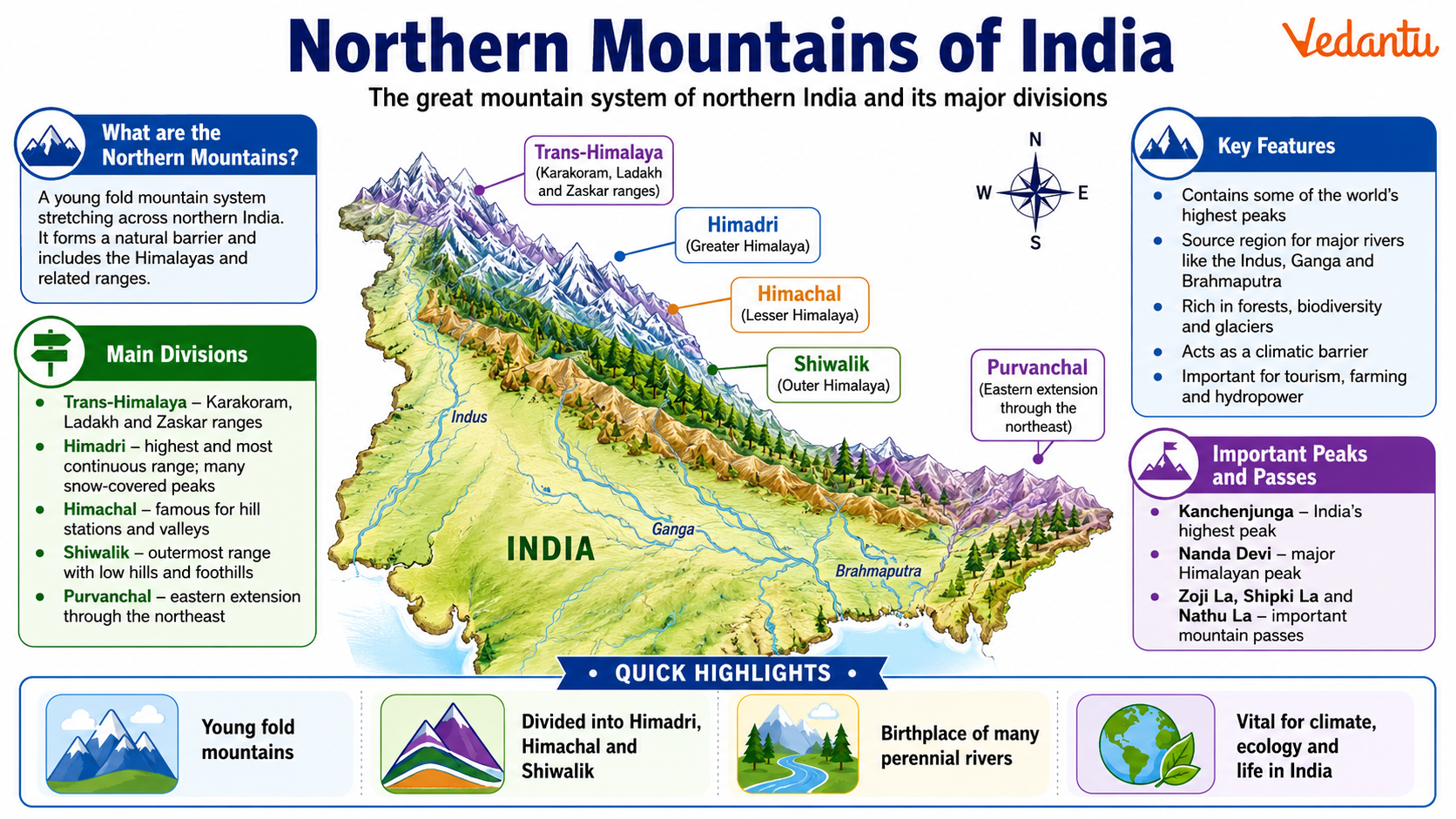
Formation of the Northern Mountains
The Northern Mountains were formed due to the collision of the Indian Plate with the Eurasian Plate around 50 million years ago. This tectonic collision led to the folding of sedimentary rocks, giving rise to the Himalayan mountain system. Since they are geologically young, these mountains are still rising and are prone to earthquakes and landslides.
- Formed by plate tectonic movements
- Classified as young fold mountains
- Geologically active and unstable
- Contain some of the highest peaks in the world
Major Divisions of the Northern Mountains
The Northern Mountains are divided into three parallel ranges from north to south. Each range has distinct physical and climatic characteristics.
1. Himadri - The Greater Himalayas
The Himadri is the northernmost and highest range. It contains the world's highest peaks and remains snow-covered throughout the year.
- Average height above 6000 meters
- Contains Mount Everest and Kanchenjunga
- Source of major perennial rivers
2. Himachal - The Lesser Himalayas
The Himachal range lies south of the Himadri and consists of rugged mountains and valleys. Many famous hill stations are located here.
- Average height between 3500 to 4500 meters
- Includes Pir Panjal and Dhauladhar ranges
- Popular hill stations like Shimla and Mussoorie
3. Shiwalik - The Outer Himalayas
The Shiwalik is the southernmost range and is the lowest among the three. It is composed mainly of unconsolidated sediments.
- Average height between 900 to 1200 meters
- Contains narrow valleys called Duns
- Prone to erosion and landslides
Important Peaks of the Northern Mountains
| Peak | Height | Location |
|---|---|---|
| Mount Everest | 8848.86 m | Nepal - China border |
| Kanchenjunga | 8586 m | India - Nepal border |
These peaks are part of the Greater Himalayas and are globally significant for mountaineering and geographical studies.
Major Passes in the Northern Mountains
Mountain passes are natural routes across mountain ranges. They are important for trade, tourism, and defense purposes.
- Zoji La - Connects Srinagar with Leh
- Nathu La - Connects Sikkim with Tibet
- Shipki La - Connects Himachal Pradesh with Tibet
Rivers Originating from the Northern Mountains
The Northern Mountains are the source of major perennial rivers of India. These rivers are fed by glaciers and rainfall, making them vital for agriculture and human settlements.
- Indus River System
- Ganga River System
- Brahmaputra River System
Climatic Importance
The Northern Mountains play a significant role in influencing the climate of India. They act as a climatic barrier and control the monsoon winds.
- Prevent cold winds from Central Asia
- Cause orographic rainfall in northern plains
- Help in the formation of fertile alluvial plains
Economic and Strategic Importance
The Northern Mountains are important for India's economy and security. They support tourism, agriculture, hydropower generation, and defense operations.
- Rich in forest resources and biodiversity
- Major tourist destinations
- Hydroelectric power generation
- Natural defense barrier
Key Facts for Competitive Exams
- Young fold mountains formed by plate collision
- Divided into Himadri, Himachal, and Shiwalik
- Source of Indus, Ganga, and Brahmaputra rivers
- Contain highest peaks of the world
- Play a major role in India's climate and defense
In conclusion, the Northern Mountains are a vital physical feature of India that influence its geography, climate, economy, and culture. A clear understanding of their formation, divisions, rivers, and importance is essential for school examinations and competitive exams. Their environmental and strategic significance makes them one of the most important mountain systems in the world.
FAQs on Northern Mountains of India: Complete Student Guide
1. What are the Northern Mountains of India?
The Northern Mountains refer to the vast mountain ranges located in the northern part of India, mainly comprising the Himalayas and associated ranges.
• Include the Himalayas, Karakoram Range, and Purvanchal Hills
• Stretch across states like Jammu & Kashmir, Himachal Pradesh, Uttarakhand, Sikkim, and Arunachal Pradesh
• Form a natural barrier between India and Central Asia
• Known for high peaks, glaciers, valleys, and hill stations
2. How were the Northern Mountains formed?
The Northern Mountains were formed due to tectonic plate collision millions of years ago.
• Formed by the collision of the Indian Plate with the Eurasian Plate
• This process is called fold mountain formation
• Began around 50 million years ago
• The Himalayas are still rising due to continuous tectonic activity
3. What are the three main divisions of the Himalayas?
The Himalayas are divided into three parallel ranges based on height and location.
• Himadri (Greater Himalayas) – Highest peaks like Mount Everest and Kanchenjunga
• Himachal (Lesser Himalayas) – Popular hill stations like Shimla and Mussoorie
• Shiwalik (Outer Himalayas) – Lowest range with foothills and valleys
4. Why are the Northern Mountains important for India?
The Northern Mountains play a vital role in India’s climate, security, and economy.
• Act as a natural barrier protecting India from cold winds
• Source of major rivers like the Ganga, Yamuna, and Brahmaputra
• Support tourism, agriculture, and hydroelectric power
• Provide strategic defense along international borders
5. Which are the major rivers originating from the Northern Mountains?
Many of India’s important rivers originate from the Himalayan glaciers in the Northern Mountains.
• Ganga River – From Gangotri Glacier
• Yamuna River – From Yamunotri Glacier
• Brahmaputra River – From Tibet region
• Indus River – From Tibetan Plateau
6. What is the highest peak in the Northern Mountains?
The highest peak in the Northern Mountains is Mount Everest, the tallest mountain in the world.
• Height: 8,848.86 meters
• Located in the Himalayas on the Nepal-China border
• Known as Sagarmatha in Nepal and Chomolungma in Tibet
• Other high peaks include Kanchenjunga and Nanga Parbat
7. What type of climate is found in the Northern Mountains?
The Northern Mountains experience a cold and mountainous climate that varies with altitude.
• Snowfall in higher regions throughout winter
• Cool summers in hill stations
• Alpine climate in upper Himalayas
• Heavy rainfall in eastern Himalayas due to monsoon winds
8. What are the important passes in the Northern Mountains?
Several mountain passes in the Northern Mountains connect India with neighboring regions.
• Nathu La Pass – Connects India and China
• Zoji La Pass – Connects Srinagar and Leh
• Shipki La Pass – Trade route with Tibet
• Rohtang Pass – Connects Kullu and Lahaul-Spiti
9. What kind of vegetation is found in the Northern Mountains?
The vegetation in the Northern Mountains changes with altitude due to climatic variation.
• Tropical forests in lower foothills
• Coniferous forests (pine, deodar, fir) in middle ranges
• Alpine meadows at higher altitudes
• Sparse vegetation in snow-covered regions
10. Why are the Northern Mountains important for tourism?
The Northern Mountains are major tourist attractions due to their scenic beauty and adventure opportunities.
• Famous hill stations like Shimla, Manali, Darjeeling, and Nainital
• Activities such as trekking, skiing, river rafting, and mountaineering
• Religious sites like Badrinath, Kedarnath, and Amarnath
• Snow-capped peaks, valleys, and glaciers attract visitors worldwide
