






Functions and Powers of the NHRC in Protecting Human Rights
The National Human Rights Commission (NHRC) is a statutory body in India established to protect and promote human rights. It plays a crucial role in safeguarding the rights related to life, liberty, equality, and dignity of individuals as guaranteed by the Constitution of India and international covenants. The NHRC acts as a watchdog to prevent violations by public authorities and ensures accountability in cases of human rights abuse. It is an important topic for students and competitive exam aspirants due to its constitutional relevance and role in governance.
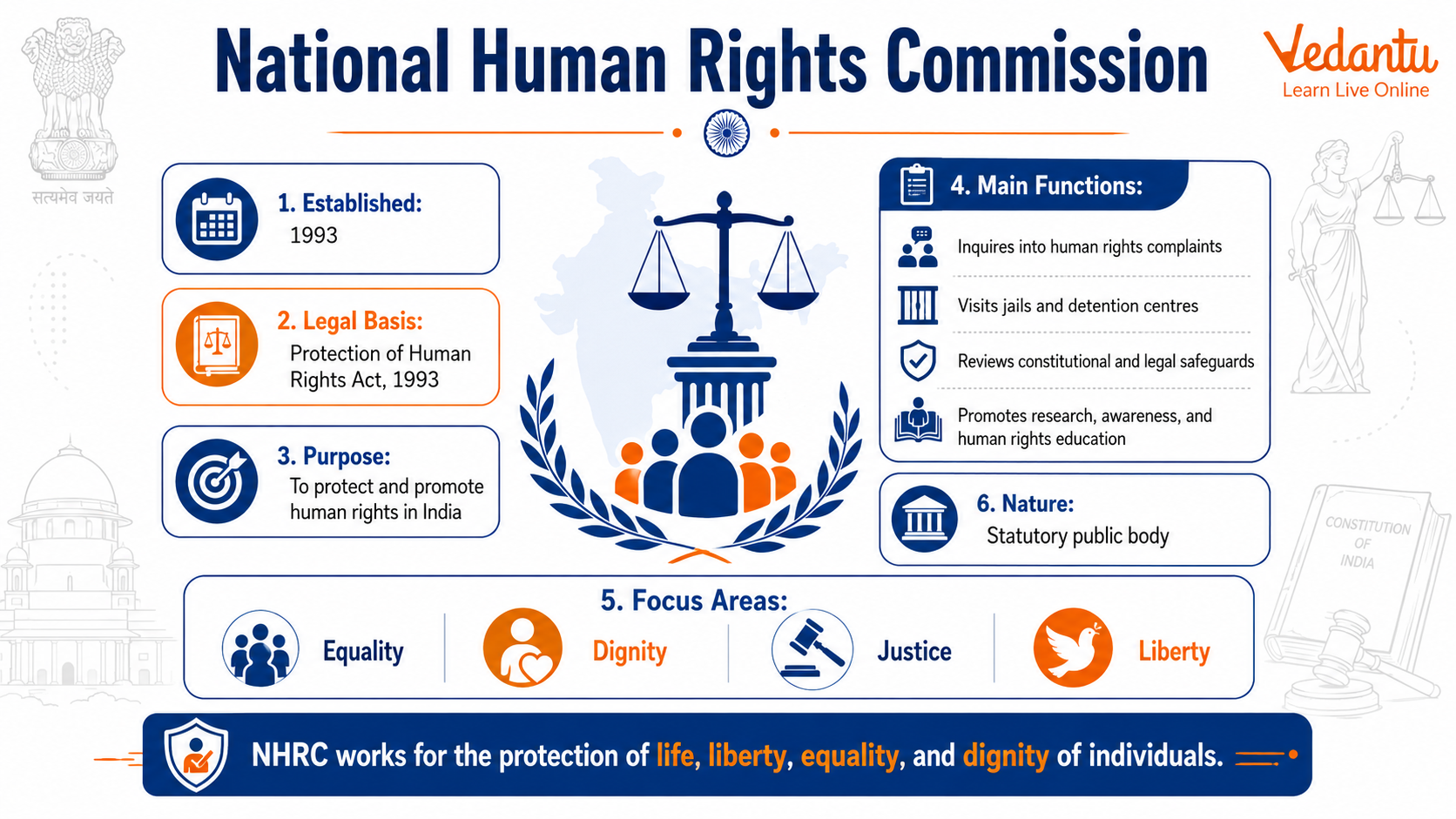
Introduction to National Human Rights Commission
The National Human Rights Commission was established on 12 October 1993 under the Protection of Human Rights Act, 1993. It was created in accordance with the Paris Principles adopted by the United Nations General Assembly in 1991, which provide the framework for national human rights institutions.
The main objective of the NHRC is to protect and promote human rights in India by investigating complaints, spreading awareness, and advising the government on policy matters related to human rights.
Definition of Human Rights
According to the Protection of Human Rights Act, 1993, human rights are defined as the rights relating to life, liberty, equality, and dignity of the individual guaranteed by the Constitution or embodied in international covenants and enforceable by courts in India.
Composition of NHRC
The NHRC consists of a Chairperson and other members appointed by the President of India.
- Chairperson - A former Chief Justice of India or a Judge of the Supreme Court
- One Member - Who is or has been a Judge of the Supreme Court
- One Member - Who is or has been the Chief Justice of a High Court
- Three Members - Persons having knowledge or practical experience in human rights
- Ex-officio Members - Chairpersons of National Commissions for SC, ST, Women, Minorities, and other statutory bodies
Key Details of National Human Rights Commission
| Feature | Details | Year / Authority |
|---|---|---|
| Establishment | 12 October 1993 | Protection of Human Rights Act, 1993 |
| Appointing Authority | President of India | On recommendation of selection committee |
| Headquarters | New Delhi | India |
The selection committee for appointment includes the Prime Minister as Chairperson, the Speaker of Lok Sabha, the Home Minister, the Leaders of Opposition in both Houses, and the Deputy Chairman of Rajya Sabha.
Functions of NHRC
The NHRC performs various functions to protect and promote human rights in India.
- Inquire into complaints of human rights violations or negligence by public servants
- Intervene in court proceedings involving allegations of human rights violations
- Visit jails and detention centers to study living conditions of inmates
- Review constitutional and legal safeguards for protection of human rights
- Promote research and spread awareness about human rights
- Encourage the efforts of non-governmental organizations working in the field of human rights
Powers of NHRC
While inquiring into complaints, the NHRC has powers similar to that of a civil court.
- Summon and enforce attendance of witnesses
- Examine witnesses under oath
- Receive evidence on affidavits
- Requisition public records from any court or office
- Recommend compensation to victims
However, the recommendations of the NHRC are advisory in nature and not legally binding on the government.
Limitations of NHRC
- Cannot investigate matters older than one year from the date of occurrence
- Cannot inquire into matters pending before courts
- Recommendations are not binding on authorities
- Limited jurisdiction over armed forces cases
State Human Rights Commissions
Apart from the NHRC at the national level, State Human Rights Commissions are established in various states under the same Act. They deal with human rights violations at the state level and function similarly to the NHRC.
Importance of NHRC
The NHRC strengthens democracy by ensuring that state authorities respect human rights. It promotes transparency, accountability, and justice in governance. It also creates awareness among citizens about their rights and remedies available in case of violations.
- Protects vulnerable groups such as women, children, minorities, and prisoners
- Encourages reforms in police and prison administration
- Enhances India's credibility in the international human rights arena
Conclusion
The National Human Rights Commission is a vital institution for the protection and promotion of human rights in India. Established under the Protection of Human Rights Act, 1993, it plays an advisory, investigative, and awareness-building role. Although its recommendations are not binding, the NHRC significantly contributes to ensuring justice, accountability, and dignity for all individuals. Understanding its structure, powers, and limitations is essential for students and competitive exam aspirants in the field of General Knowledge and Indian Polity.
FAQs on National Human Rights Commission: Role and Importance in India
1. What is the National Human Rights Commission (NHRC)?
The National Human Rights Commission (NHRC) is a statutory public body established to protect and promote human rights in India.
• It was set up under the Protection of Human Rights Act, 1993.
• It safeguards rights related to life, liberty, equality, and dignity guaranteed by the Constitution.
• The NHRC investigates complaints of human rights violations by public servants.
• It plays a key role in promoting awareness about fundamental rights, civil liberties, and social justice.
2. When and why was the NHRC established?
The NHRC was established on 12 October 1993 to address increasing concerns about human rights violations in India.
• Created under the Protection of Human Rights Act, 1993.
• Formed to comply with international standards like the Paris Principles (1991).
• Aimed to strengthen the protection of fundamental rights and civil freedoms.
• Responded to issues such as custodial deaths, police brutality, and discrimination.
3. What is the composition of the National Human Rights Commission?
The composition of NHRC includes a Chairperson and several members appointed by the President of India.
• Chairperson: Former Chief Justice of India or a Supreme Court Judge.
• One member who is/was a Supreme Court Judge.
• One member who is/was a Chief Justice of a High Court.
• Three members with knowledge in human rights.
• Ex-officio members from national commissions like NCW, NCSC, and NCST.
4. What are the functions of the NHRC?
The functions of NHRC focus on protecting and promoting human rights across India.
• Inquire into complaints of human rights violations.
• Visit jails and detention centers to examine living conditions.
• Review constitutional and legal safeguards.
• Promote human rights education and awareness.
• Recommend compensation and corrective measures to the government.
5. What are the powers of the National Human Rights Commission?
The NHRC has powers similar to a civil court while conducting inquiries.
• Summon and enforce attendance of witnesses.
• Require production of documents and evidence.
• Conduct investigations through police or independent agencies.
• Recommend interim relief or compensation.
• Approach the Supreme Court or High Courts for enforcement of human rights.
6. How can a complaint be filed with the NHRC?
Any person can file a complaint with NHRC regarding human rights violations by public servants.
• Complaints can be filed online, by post, or in person.
• No court fee is required.
• The complaint must be filed within one year of the incident.
• Anonymous or vague complaints are generally not entertained.
7. What is the role of NHRC in protecting human rights in India?
The role of NHRC is to act as a watchdog for the protection of constitutional and legal rights.
• Monitors cases of custodial violence and fake encounters.
• Advises the government on policy reforms and amendments.
• Promotes research in human rights law and governance.
• Coordinates with State Human Rights Commissions (SHRCs).
8. What are the limitations of the National Human Rights Commission?
The NHRC has certain limitations that restrict its effectiveness.
• Its recommendations are not legally binding.
• Cannot take action against private individuals directly.
• Cannot inquire into matters older than one year.
• Limited powers regarding the armed forces.
9. What is the difference between NHRC and SHRC?
The main difference between NHRC and SHRC lies in their jurisdiction and scope.
• NHRC operates at the national level across India.
• State Human Rights Commission (SHRC) functions at the state level.
• NHRC can transfer cases to SHRCs when appropriate.
• Both aim to protect fundamental rights and human dignity.
10. Why is the National Human Rights Commission important for competitive exams?
The NHRC is important for competitive exams like UPSC, SSC, and State PSC due to its constitutional and legal relevance.
• Frequently asked in Polity and General Knowledge sections.
• Covers topics like Protection of Human Rights Act, 1993.
• Linked to current affairs such as human rights violations and reforms.
• Essential for understanding governance, democracy, and rule of law.
