






How Many Railway Zones Are There in India and Their Headquarters?
The Indian Railways is one of the largest railway networks in the world and plays a crucial role in India’s economic growth and connectivity. To ensure smooth administration and efficient management, Indian Railways is divided into several zones. Each railway zone is responsible for managing railway operations, passenger services, freight movement, and infrastructure within its designated region. Understanding the Major Railway Zones of India is important for students, competitive exam aspirants, and general knowledge enthusiasts.
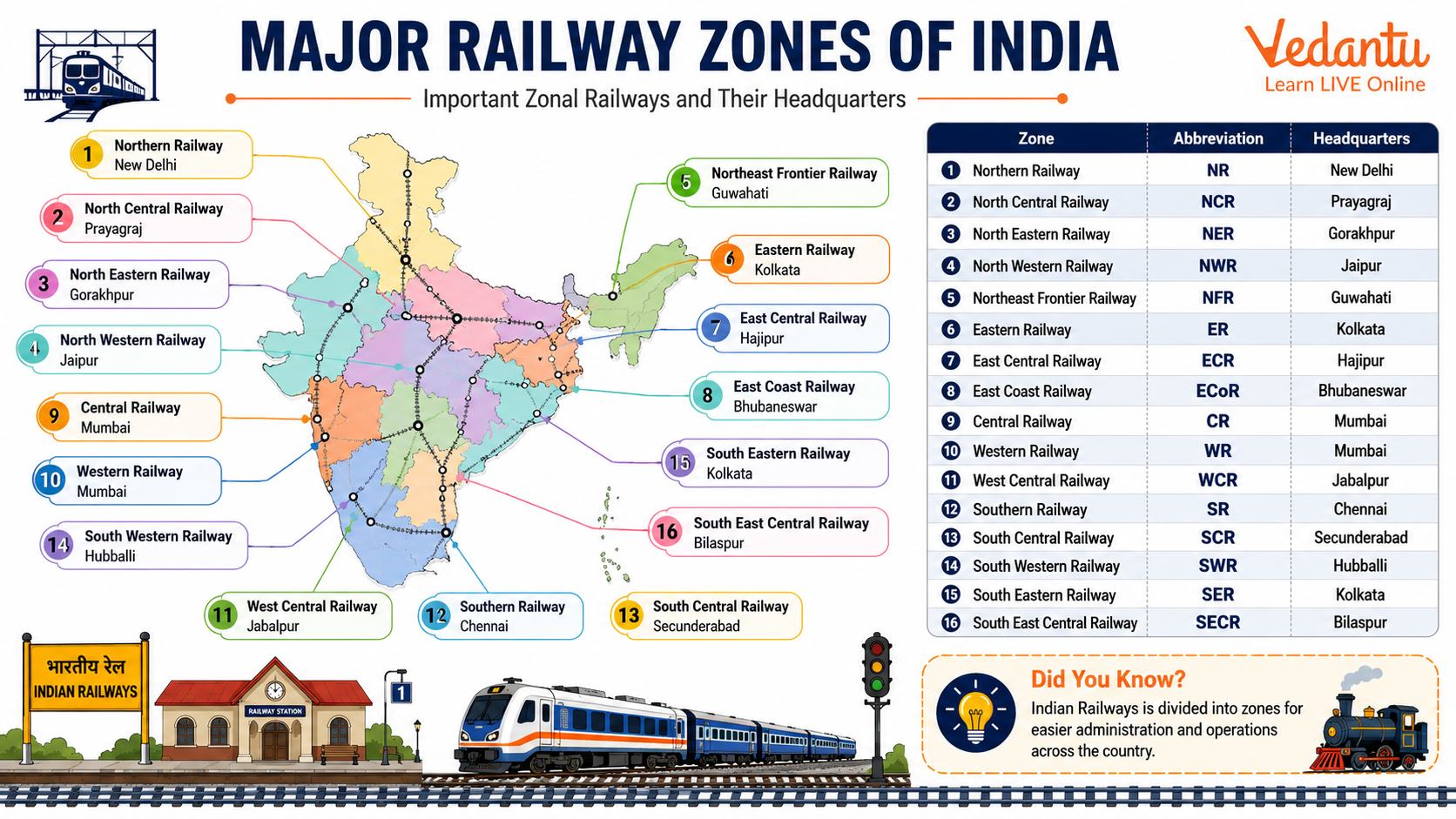
Introduction to Indian Railways Zones
Indian Railways functions under the Ministry of Railways, Government of India. For better management and operational efficiency, the entire railway network is divided into zones, which are further subdivided into divisions. Each zone is headed by a General Manager who reports to the Railway Board.
- Total Railway Zones in India - 18
- Each zone consists of multiple railway divisions
- Zones manage passenger trains, freight trains, maintenance, and infrastructure development
- Headquarters of each zone is located in a major city
List of Major Railway Zones of India
| Railway Zone | Headquarters | Year Established |
|---|---|---|
| Central Railway | Mumbai | 1951 |
| Eastern Railway | Kolkata | 1952 |
| East Central Railway | Hajipur | 2002 |
| East Coast Railway | Bhubaneswar | 2003 |
| Northern Railway | New Delhi | 1952 |
| North Central Railway | Prayagraj | 2003 |
| North Eastern Railway | Gorakhpur | 1952 |
| Northeast Frontier Railway | Maligaon - Guwahati | 1958 |
| North Western Railway | Jaipur | 2002 |
| Southern Railway | Chennai | 1951 |
| South Central Railway | Secunderabad | 1966 |
| South Eastern Railway | Kolkata | 1955 |
| South East Central Railway | Bilaspur | 2003 |
| South Western Railway | Hubballi | 2003 |
| Western Railway | Mumbai | 1951 |
| West Central Railway | Jabalpur | 2003 |
| Kolkata Metro Railway | Kolkata | 2010 |
| South Coast Railway | Visakhapatnam | 2019 |
These railway zones collectively manage thousands of kilometers of railway tracks across India. Some zones were formed during the initial reorganization in 1951 to 1952, while others were created later to improve administrative efficiency and manage increasing traffic.
Largest and Important Railway Zones
Northern Railway
Northern Railway is one of the largest railway zones in India. It covers several northern states and manages major routes connecting the national capital with different parts of the country.
Southern Railway
Southern Railway is the first railway zone formed after independence. It serves Tamil Nadu, Kerala, Puducherry, and parts of Karnataka and Andhra Pradesh.
Central and Western Railways
Both Central Railway and Western Railway have their headquarters in Mumbai. They handle heavy suburban traffic and long distance passenger as well as freight services.
Functions of Railway Zones
Each railway zone performs several administrative and operational functions to ensure smooth functioning of the rail network.
- Operation of passenger and freight trains
- Maintenance of railway tracks and signaling systems
- Management of railway stations and staff
- Safety and security of railway operations
- Implementation of modernization and electrification projects
Why Railway Zones are Important
The division of Indian Railways into zones helps in decentralized administration and efficient decision making. It allows better supervision of railway divisions and ensures quicker response to operational challenges. Railway zones also help in region specific planning and infrastructure development.
Railway Zones and Competitive Exams
Questions about Major Railway Zones of India are frequently asked in competitive exams such as UPSC, SSC, RRB, State PSC, and other government recruitment tests. Students should focus on headquarters, year of establishment, and newly formed zones for exam preparation.
- Memorize all 18 railway zones and their headquarters
- Focus on newly created zones like South Coast Railway
- Understand which zone serves which region
- Revise frequently using tables and short notes
Conclusion
The Major Railway Zones of India form the backbone of railway administration in the country. With 18 zones spread across different regions, Indian Railways ensures efficient transport of passengers and goods nationwide. Knowledge of railway zones, their headquarters, and establishment years is essential for general awareness and competitive exam preparation. A clear understanding of this topic helps in strengthening overall General Knowledge about India’s transport infrastructure.
FAQs on Major Railway Zones in India: Complete Guide for Students
1. What are the major railway zones in India?
The major railway zones in India are administrative divisions of Indian Railways created for efficient management and operations.
- Currently, there are 18 railway zones in India.
- Some key zones include Northern Railway, Southern Railway, Eastern Railway, Western Railway, Central Railway.
- The newest zone is South Coast Railway (2019).
- Each zone is headed by a General Manager (GM).
These zones improve railway administration, passenger services, freight operations, and regional connectivity across India.
2. How many railway zones are there in India in 2026?
As of 2026, there are 18 railway zones in India under Indian Railways.
- Established between 1951 and 2019.
- The latest zone: South Coast Railway (SCoR).
- Each zone is divided into smaller railway divisions.
This zonal system helps manage one of the world’s largest railway networks efficiently.
3. Which is the largest railway zone in India?
The Northern Railway (NR) is considered the largest railway zone in India in terms of route length and coverage.
- Headquarters: New Delhi.
- Covers states like Delhi, Punjab, Haryana, Uttar Pradesh.
- Established in 1952.
It plays a major role in passenger traffic, freight transport, and connectivity to northern border regions.
4. Which is the oldest railway zone in India?
The Southern Railway is the oldest railway zone in India, formed in 1951.
- Headquarters: Chennai.
- Covers Tamil Nadu, Kerala, Puducherry.
- Formed by merging several former princely state railways.
It is important in railway history and South Indian rail connectivity.
5. What is the role of railway zones in India?
The primary role of railway zones in India is to manage railway operations efficiently across regions.
- Supervise passenger and freight services.
- Maintain railway tracks, stations, and infrastructure.
- Ensure safety, scheduling, and administration.
- Oversee railway divisions within their jurisdiction.
This zonal structure ensures smooth functioning of the vast Indian Railways network.
6. What are railway divisions under railway zones?
Railway divisions are sub-units of railway zones responsible for local railway administration.
- Headed by a Divisional Railway Manager (DRM).
- Manage daily train operations and maintenance.
- Examples: Delhi Division (Northern Railway), Mumbai Division (Central Railway).
Divisions help decentralize railway management for better efficiency.
7. Which railway zone has its headquarters in Mumbai?
Two major railway zones have headquarters in Mumbai: Central Railway (CR) and Western Railway (WR).
- Central Railway established in 1951.
- Western Railway established in 1951.
- Both manage suburban and long-distance train services.
Mumbai is a crucial hub in India’s railway transport system.
8. Which is the newest railway zone in India?
The newest railway zone in India is the South Coast Railway (SCoR).
- Announced in 2019.
- Headquarters: Visakhapatnam, Andhra Pradesh.
- Formed by reorganizing parts of South Central Railway.
It was created to improve railway administration in Andhra Pradesh.
9. Why are railway zones important for competitive exams?
Questions about major railway zones of India are frequently asked in competitive exams.
- Important for UPSC, SSC, RRB, State PSC exams.
- Common topics: number of zones, headquarters, largest zone.
- Falls under General Knowledge (GK) and Indian Geography.
Understanding railway zones helps in scoring well in government and railway recruitment exams.
10. How are railway zones formed in India?
Railway zones in India are formed by the Ministry of Railways for administrative convenience and operational efficiency.
- Created through government notifications.
- Based on regional connectivity and workload.
- Aim to reduce congestion and improve services.
The reorganization of zones ensures better management of the expanding Indian Railways network.
