






Who Were the Vice Presidents of India and How Long Did They Serve?
The Vice President of India is the second highest constitutional authority in the country after the President. The position holds significant importance in the Indian political system as the Vice President also serves as the ex-officio Chairman of the Rajya Sabha. Understanding the list of Vice Presidents in India and their term of office is important for students, competitive exam aspirants, and general knowledge enthusiasts. This topic is frequently asked in exams like UPSC, SSC, Banking, State PSCs, and other government examinations.
Constitutional Position of the Vice President of India
The office of the Vice President is established under Article 63 of the Indian Constitution. According to the Constitution, there shall be a Vice President of India. The Vice President acts as the President in case of resignation, removal, death, or absence of the President.
Key Constitutional Provisions
- Article 63 - Provides for the office of the Vice President of India.
- Article 64 - The Vice President is the ex-officio Chairman of the Rajya Sabha.
- Article 65 - The Vice President acts as President in certain contingencies.
- Article 66 - Deals with the election of the Vice President.
- Article 67 - Mentions the term of office which is 5 years.
Term of Office
The Vice President of India holds office for a term of 5 years from the date of entering office. However, the Vice President continues in office until the successor assumes charge. The Vice President can resign by submitting resignation to the President and can be removed by a resolution passed by the Rajya Sabha and agreed to by the Lok Sabha.
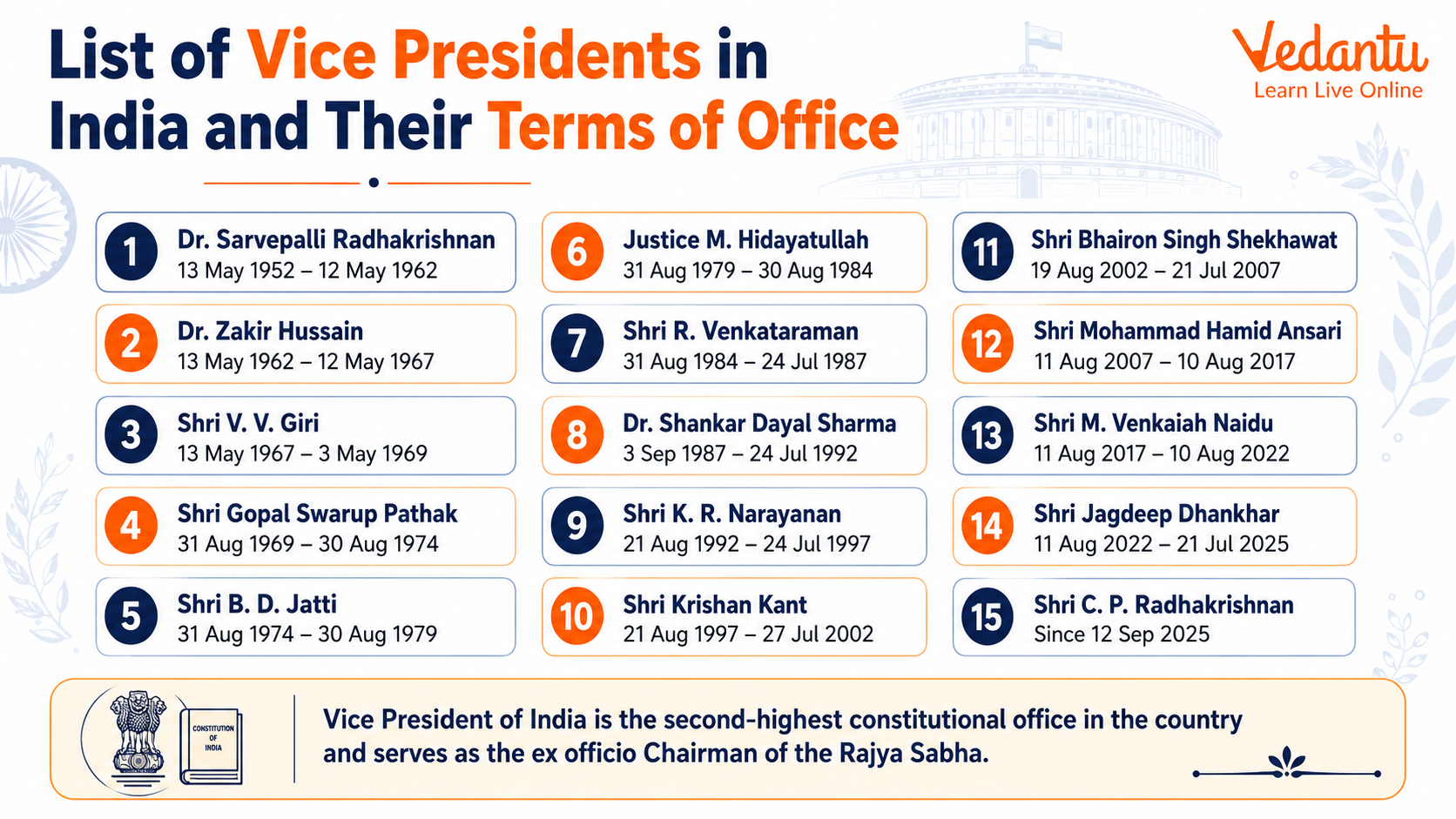
List of Vice Presidents in India and Their Term of Office
| S.No | Name of Vice President | Term of Office |
|---|---|---|
| 1 | Dr. Sarvepalli Radhakrishnan | 1952 - 1962 |
| 2 | Dr. Zakir Husain | 1962 - 1967 |
| 3 | Varahagiri Venkata Giri | 1967 - 1969 |
| 4 | Gopal Swarup Pathak | 1969 - 1974 |
| 5 | B. D. Jatti | 1974 - 1979 |
| 6 | Mohammad Hidayatullah | 1979 - 1984 |
| 7 | R. Venkataraman | 1984 - 1987 |
| 8 | Dr. Shankar Dayal Sharma | 1987 - 1992 |
| 9 | K. R. Narayanan | 1992 - 1997 |
| 10 | Krishan Kant | 1997 - 2002 |
| 11 | Bhairon Singh Shekhawat | 2002 - 2007 |
| 12 | Mohammad Hamid Ansari | 2007 - 2017 |
| 13 | M. Venkaiah Naidu | 2017 - 2022 |
| 14 | Jagdeep Dhankhar | 2022 - 2025 |
Dr. Sarvepalli Radhakrishnan was the first Vice President of India, while Jagdeep Dhankhar is the current Vice President as of the latest update. Mohammad Hamid Ansari served two consecutive terms from 2007 to 2017, making him one of the longest serving Vice Presidents of India.
Powers and Functions of the Vice President
The Vice President performs both constitutional and parliamentary functions. While the role is largely ceremonial, it becomes highly significant during constitutional emergencies.
As Chairman of Rajya Sabha
- Presides over the sessions of the Rajya Sabha.
- Maintains order and discipline in the House.
- Decides on points of order.
- Has a casting vote in case of a tie.
As Acting President
- Acts as President in case of death, resignation, removal, or impeachment of the President.
- Exercises all powers and functions of the President during that period.
Important Facts for Exams
- The Vice President is elected by members of both Houses of Parliament through proportional representation by means of a single transferable vote.
- Minimum age required to become Vice President is 35 years.
- The Vice President must be qualified to be elected as a member of the Rajya Sabha.
- Only Mohammad Hamid Ansari has served two full terms as Vice President of India.
- Dr. Zakir Husain and R. Venkataraman later became Presidents of India.
Conclusion
The list of Vice Presidents in India and their term of office reflects the constitutional continuity and democratic stability of the country. The Vice President plays a crucial dual role as the Chairman of the Rajya Sabha and as a standby for the President. For competitive exams and general awareness, remembering the chronological order, tenure periods, and key facts about each Vice President is highly beneficial. A clear understanding of this topic strengthens overall knowledge of Indian Polity and governance.
FAQs on List of Vice Presidents in India and Their Terms of Office (1952–Present)
1. Who was the first Vice President of India and what was his term of office?
The first Vice President of India was Dr. Sarvepalli Radhakrishnan, who served from 1952 to 1962.
- Elected as the inaugural Vice President of India after the Constitution came into effect
- Served two consecutive terms (1952–1957 and 1957–1962)
- Later became the second President of India
- A renowned philosopher, teacher, and statesman often asked in GK and competitive exams
2. How many Vice Presidents of India have served till now?
India has had 14 Vice Presidents from 1952 to 2026.
- The office was established under Article 63 of the Indian Constitution
- Each Vice President holds office for a five-year term
- The current Vice President (as of 2026) is Jagdeep Dhankhar
- Frequently searched in GK questions, UPSC, SSC, and other competitive exams
3. What is the term of office of the Vice President of India?
The Vice President of India serves a term of five years from the date of entering office.
- Mentioned under Article 67 of the Constitution
- Eligible for re-election without term limits
- Continues in office until a successor assumes charge
- Can resign or be removed by a Rajya Sabha resolution
4. Who is the current Vice President of India and when did he assume office?
The current Vice President of India is Jagdeep Dhankhar, who assumed office on 11 August 2022.
- He is the 14th Vice President of India
- Also serves as the ex-officio Chairman of the Rajya Sabha
- Elected by members of both Houses of Parliament
- Important for current affairs and political GK
5. Who was the Vice President of India with the longest tenure?
The longest-serving Vice President of India was Dr. Sarvepalli Radhakrishnan, with a tenure of 10 years (1952–1962).
- Served two full consecutive terms
- Played a key role in shaping parliamentary traditions
- Later elected as President of India
- Commonly asked in "longest-serving constitutional authority" GK questions
6. Which Vice Presidents of India later became President of India?
Several Vice Presidents were later elected as President of India.
- Dr. Sarvepalli Radhakrishnan
- Dr. Zakir Husain
- V. V. Giri
- R. Venkataraman
- Dr. Shankar Dayal Sharma
- K. R. Narayanan
- These transitions are significant in Indian polity and constitutional studies
7. What are the main duties of the Vice President of India?
The primary duty of the Vice President of India is to act as the Chairman of the Rajya Sabha.
- Presides over sessions of the Upper House of Parliament
- Maintains order and discipline in debates
- Casts a casting vote in case of a tie
- Acts as President of India in case of vacancy or absence
8. How is the Vice President of India elected?
The Vice President of India is elected by an electoral college consisting of members of both Houses of Parliament.
- Includes elected and nominated members
- Election conducted by proportional representation system
- Voting done by single transferable vote
- Secret ballot method is followed
9. Can the Vice President of India be removed from office?
Yes, the Vice President of India can be removed through a parliamentary procedure.
- Removal resolution must be initiated in the Rajya Sabha
- Requires a majority of all members of Rajya Sabha
- Must be agreed to by the Lok Sabha
- No specific grounds like impeachment are required
10. Where can I find the complete list of Vice Presidents of India and their term of office?
The complete list of Vice Presidents of India and their term of office can be found in standard Indian Polity and GK resources.
- Covers tenure from 1952 to present
- Includes names, years in office, and major contributions
- Frequently asked in UPSC, SSC, State PCS, and school exams
- Important for understanding India’s constitutional framework and parliamentary system
