






Major Categories of International Organizations and Their Key Examples
International Organizations are formal institutions created by multiple countries to work together on common global issues such as peace, security, trade, health, environment, and development. These organizations play a vital role in maintaining international cooperation and solving problems that go beyond national boundaries. Understanding the types of International Organizations is important for students, competitive exam aspirants, and general readers as it forms a key part of General Knowledge and current affairs.
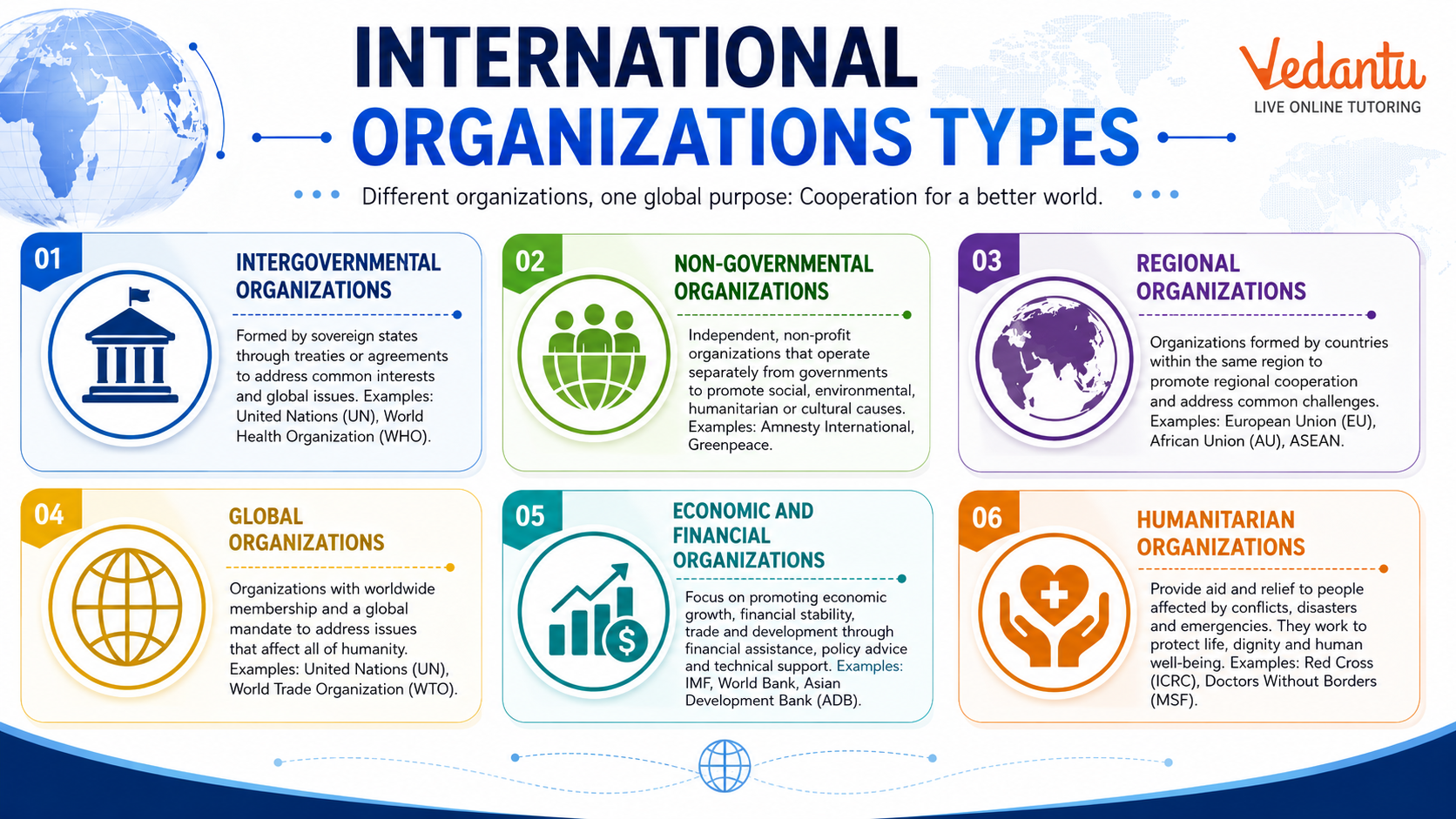
What are International Organizations?
International Organizations are bodies formed by agreements between two or more countries to achieve shared goals. They are governed by international laws and treaties and operate across national borders. These organizations can be global, regional, economic, political, or specialized in specific fields such as health, education, or finance.
Main Types of International Organizations
International Organizations are broadly classified based on their structure, membership, and functions. The major types are explained below.
1. Intergovernmental Organizations - IGOs
Intergovernmental Organizations are formed by sovereign states through treaties or agreements. Only countries are members of these organizations. They work on issues such as security, trade, development, and human rights.
- Created through formal agreements between governments
- Have defined objectives and permanent structures
- Decisions are made by representatives of member states
Examples of IGOs
Major Intergovernmental Organizations
| Organization | Established | Main Purpose |
|---|---|---|
| United Nations - UN | 1945 | Maintain international peace and security |
| World Trade Organization - WTO | 1995 | Regulate international trade |
| World Health Organization - WHO | 1948 | Promote global public health |
IGOs are legally recognized entities and play a significant role in shaping international policies and cooperation among nations.
2. Non Governmental Organizations - NGOs
Non Governmental Organizations operate independently from governments. Although they may work with governments and international bodies, they are privately organized and focus on humanitarian, environmental, social, or developmental causes.
- Not formed by governments
- Work at local, national, or international levels
- Focus on welfare, advocacy, and development
Examples of NGOs
Major Non Governmental Organizations
| Organization | Established | Main Focus |
|---|---|---|
| International Red Cross | 1863 | Humanitarian aid and disaster relief |
| Amnesty International | 1961 | Human rights protection |
| Greenpeace | 1971 | Environmental protection |
NGOs influence global policies by raising awareness, conducting research, and supporting vulnerable communities across the world.
3. Regional Organizations
Regional Organizations are formed by countries within a specific geographical region. Their aim is to promote economic, political, or security cooperation within that region.
- Membership limited to countries of a particular region
- Promote regional trade and integration
- Address regional security and development issues
Major Regional Organizations
| Organization | Region | Main Objective |
|---|---|---|
| European Union - EU | Europe | Economic and political integration |
| ASEAN | Southeast Asia | Regional economic cooperation |
| African Union - AU | Africa | Promote unity and development |
Regional organizations strengthen cooperation among neighboring countries and help maintain peace and economic stability within specific areas.
4. Financial and Economic Organizations
These organizations focus on global financial stability, economic development, and monetary cooperation. They provide loans, financial assistance, and policy advice to countries.
- Support economic growth and stability
- Provide financial aid and technical assistance
- Monitor global financial systems
Major Financial Organizations
| Organization | Established | Purpose |
|---|---|---|
| International Monetary Fund - IMF | 1944 | Ensure global monetary stability |
| World Bank | 1944 | Provide development assistance |
| Asian Development Bank - ADB | 1966 | Promote economic development in Asia |
Financial and economic organizations play a crucial role in reducing poverty, supporting infrastructure development, and maintaining economic stability across countries.
Importance of International Organizations
International Organizations are essential in today’s interconnected world. They help countries collaborate on global challenges such as climate change, pandemics, trade disputes, and conflicts.
- Promote global peace and security
- Encourage economic cooperation and trade
- Support humanitarian and development activities
- Provide platforms for diplomatic dialogue
Conclusion
International Organizations are key pillars of global governance and cooperation. They are broadly classified into Intergovernmental Organizations, Non Governmental Organizations, Regional Organizations, and Financial Organizations. Each type serves a distinct purpose but collectively contributes to peace, development, and stability worldwide. A clear understanding of the types of International Organizations is important for academic studies, competitive exams, and staying informed about global affairs.
FAQs on International Organizations Types and Their Roles in Global Affairs
1. What are International Organizations?
International Organizations are structured groups formed by multiple countries to promote cooperation, peace, and development at the global level.
• They are created through treaties or agreements between nations.
• They address global issues like peace, security, trade, health, and environment.
• Examples include the United Nations (UN), World Bank, and World Health Organization (WHO).
• Also known as intergovernmental organizations (IGOs) in GK and competitive exams.
People also ask: What is the meaning of international organization? What are global institutions?
2. What are the main types of International Organizations?
The main types of International Organizations are classified based on membership and purpose.
• Intergovernmental Organizations (IGOs) – Formed by governments (e.g., UN, NATO).
• Non-Governmental Organizations (NGOs) – Formed by private individuals or groups (e.g., Amnesty International).
• Regional Organizations – Limited to specific regions (e.g., EU, ASEAN, SAARC).
• Financial Institutions – Focus on economic stability (e.g., IMF, World Bank).
People also search: categories of global organizations, classification of international institutions.
3. What is the difference between IGOs and NGOs?
The key difference between IGOs and NGOs lies in their membership and authority.
• IGOs (Intergovernmental Organizations) are formed by member countries through treaties (e.g., United Nations).
• NGOs (Non-Governmental Organizations) are formed by private groups or individuals (e.g., Red Cross).
• IGOs have official governmental authority; NGOs work independently.
• IGOs focus on diplomacy and policy; NGOs focus on humanitarian and social causes.
Common query: IGO vs NGO difference for exams.
4. What are examples of major International Organizations?
Major International Organizations play a significant role in global governance and development.
• United Nations (UN) – Global peace and security.
• World Health Organization (WHO) – International public health.
• International Monetary Fund (IMF) – Global financial stability.
• World Trade Organization (WTO) – International trade rules.
• World Bank – Development and poverty reduction.
People also ask: List of important international organizations for GK.
5. What is the role of the United Nations (UN)?
The United Nations (UN) is the largest global organization responsible for maintaining international peace and cooperation.
• Established in 1945 after World War II.
• Promotes peace, security, human rights, and sustainable development.
• Main organs include the General Assembly, Security Council, and International Court of Justice.
• Headquarters in New York, USA.
Related searches: functions of UN, objectives of United Nations.
6. What are Regional International Organizations?
Regional International Organizations are groups of countries within a specific geographical area working together for common goals.
• Focus on regional cooperation and economic integration.
• Examples: European Union (EU), ASEAN, African Union (AU), SAARC.
• Aim to promote trade, security, and cultural exchange within the region.
• Important for regional stability and development.
People also ask: What is a regional organization in geography and civics?
7. What are Financial International Organizations?
Financial International Organizations are institutions that manage global economic stability and development.
• International Monetary Fund (IMF) – Provides financial assistance and monitors exchange rates.
• World Bank – Offers loans for development projects.
• Asian Development Bank (ADB) – Supports economic growth in Asia.
• Promote economic cooperation, poverty reduction, and financial stability.
Common exam query: Functions of IMF and World Bank.
8. Why are International Organizations important?
International Organizations are important because they promote global cooperation and solve international problems collectively.
• Maintain international peace and security.
• Support economic development and trade.
• Address global challenges like climate change, pandemics, and poverty.
• Provide a platform for diplomatic dialogue.
People also search: importance of global organizations in international relations.
9. How are International Organizations formed?
International Organizations are formed through formal agreements between countries.
• Created by signing a treaty or charter.
• Member states agree on objectives, structure, and rules.
• Example: The UN Charter (1945) established the United Nations.
• Membership may be global or regional depending on purpose.
Related query: Formation of international institutions for competitive exams.
10. What is the difference between global and regional International Organizations?
The difference between global and regional organizations lies in their membership scope and operational area.
• Global Organizations – Open to countries worldwide (e.g., UN, WHO, WTO).
• Regional Organizations – Limited to a specific region (e.g., EU, ASEAN, AU).
• Global bodies address worldwide issues; regional bodies focus on local cooperation.
• Both are key topics in General Knowledge (GK) and competitive exams.
People also ask: Global vs regional institutions difference.
