






Why did Gandhi launch the Individual Civil Disobedience campaign in 1940?
Individual Satyagraha was a limited civil disobedience movement launched by Mahatma Gandhi in 1940 during the Second World War. It was initiated to affirm the right of Indians to free speech and to oppose India’s forced participation in the war without the consent of its people. Unlike mass movements such as the Non Cooperation Movement or the Quit India Movement, Individual Satyagraha was carefully controlled and symbolic in nature. It played an important role in keeping the spirit of freedom alive while avoiding large scale repression by the British government.
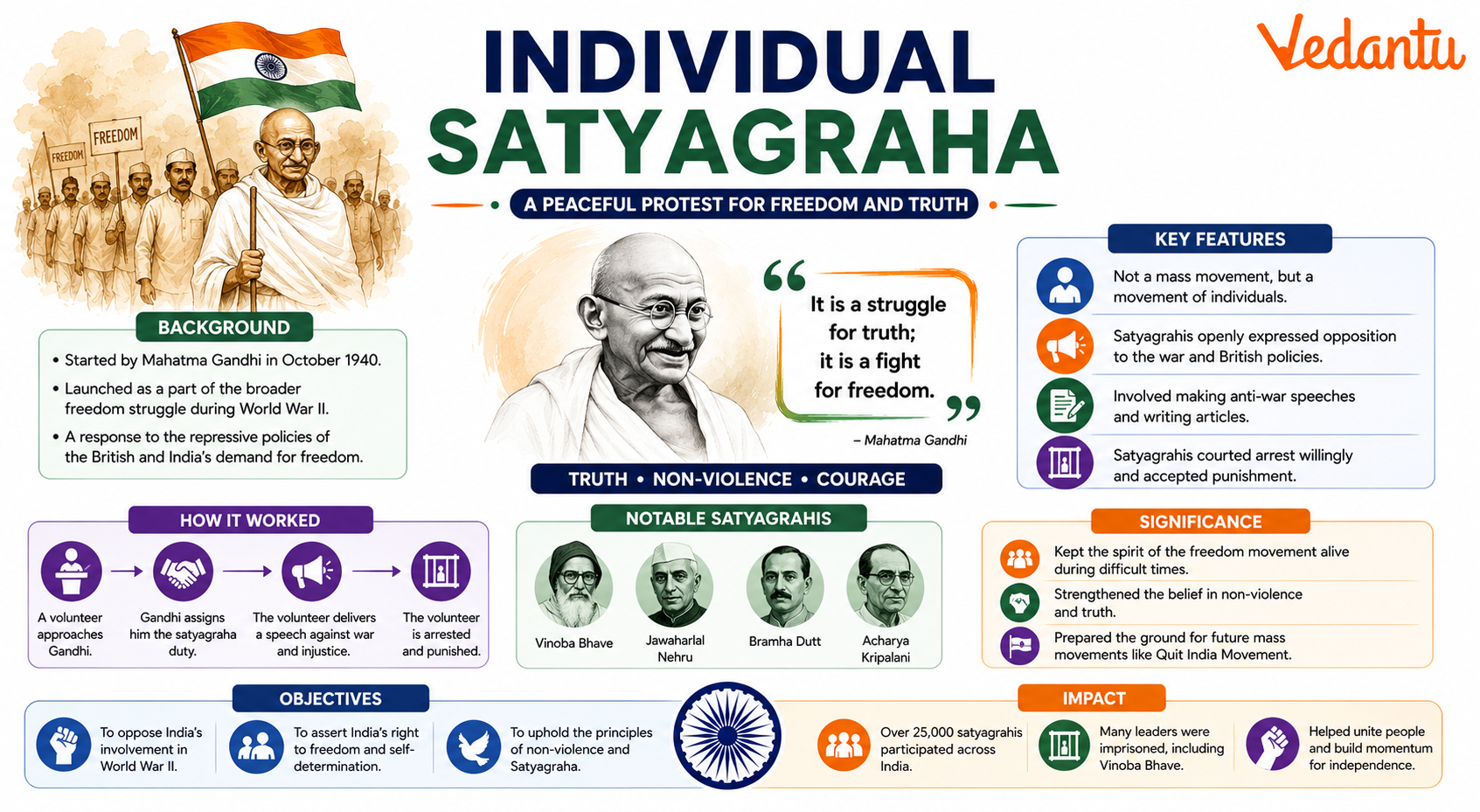
Background of Individual Satyagraha
In September 1939, Britain declared war on Germany and involved India in the Second World War without consulting Indian leaders. The Indian National Congress strongly opposed this unilateral decision. When the British government refused to promise complete independence after the war, Congress ministries resigned in protest in 1939.
Mahatma Gandhi was not in favor of launching a mass movement immediately because the global situation was sensitive. Instead, he decided to start Individual Satyagraha in October 1940 as a limited protest to assert the moral right of Indians to oppose war and colonial rule.
Objectives of Individual Satyagraha
- To affirm the right to freedom of speech.
- To oppose India’s forced participation in World War II.
- To avoid mass civil disobedience and violent repression.
- To keep the spirit of national movement alive.
- To demonstrate that Indians did not support imperialist war efforts.
Why It Was Called Individual Satyagraha
The movement was called Individual Satyagraha because only selected individuals were allowed to participate one by one. Each satyagrahi would publicly speak against the war and British rule. After delivering the speech, the person would court arrest peacefully. This method ensured discipline and prevented large scale unrest.
Major Leaders and Participants
Mahatma Gandhi carefully selected participants for the movement. The first three satyagrahis were prominent leaders of the Congress.
Key Participants of Individual Satyagraha
| Name | Role | Significance |
|---|---|---|
| Vinoba Bhave | First Satyagrahi | Started the movement on 17 October 1940 |
| Jawaharlal Nehru | Second Satyagrahi | Arrested for anti war speech |
| Brahma Dutt | Third Satyagrahi | Continued symbolic protest |
After these leaders, many other Congress members participated in batches. More than 25,000 individuals were arrested during the movement.
Features of Individual Satyagraha
- It was non violent and disciplined.
- Participation was selective and not open to masses.
- The main action was delivering anti war speeches.
- Satyagrahis voluntarily courted arrest.
- It avoided direct confrontation with British authority.
Impact and Significance
Although Individual Satyagraha did not create immediate political change, it had great moral and political significance. It demonstrated that India did not support British war policies. It also maintained national unity and prepared the ground for the Quit India Movement in 1942.
The movement showed Gandhi’s strategic thinking. He balanced opposition to colonial rule with global realities of war. It also strengthened the commitment of Congress leaders and workers toward non violent resistance.
Comparison with Other Movements
Individual Satyagraha vs Mass Movements
| Feature | Individual Satyagraha | Quit India Movement |
|---|---|---|
| Nature | Limited and symbolic | Mass uprising |
| Year | 1940 | 1942 |
| Participation | Selected individuals | Nationwide participation |
This comparison highlights that Individual Satyagraha was a preparatory phase that maintained pressure on the British government without triggering widespread violence.
Important Facts for Competitive Exams
- Launched on 17 October 1940.
- First Satyagrahi was Vinoba Bhave.
- Focused on freedom of speech and anti war protest.
- Over 25,000 people were arrested.
- Preceded the Quit India Movement of 1942.
Conclusion
Individual Satyagraha was a strategic and symbolic protest movement led by Mahatma Gandhi during World War II. It reflected India’s opposition to colonial rule and its demand for self determination. Though limited in scale, it played a crucial role in sustaining the freedom struggle and preparing the nation for more decisive action in the coming years. For students and competitive exam aspirants, understanding this movement is important to grasp the gradual development of India’s independence movement.
FAQs on Individual Satyagraha Movement in 1940: Background and Significance
1. What was Individual Satyagraha?
Individual Satyagraha was a limited non-violent movement launched by Mahatma Gandhi in 1940 to protest against British rule and India’s forced involvement in World War II.
• It emphasized freedom of speech and the right to oppose war peacefully.
• It was different from mass movements like the Non-Cooperation Movement and Civil Disobedience Movement.
• The aim was to avoid mass unrest while asserting India’s demand for Swaraj (self-rule).
• It is also known as the Individual Civil Disobedience Movement.
2. Why was the Individual Satyagraha launched?
Individual Satyagraha was launched to oppose India’s participation in World War II without Indian consent.
• The British government declared India a participant in World War II (1939) without consulting Indian leaders.
• The Indian National Congress demanded a clear statement on independence.
• Gandhi chose a limited protest to maintain non-violence (Ahimsa).
• It aimed to express moral opposition rather than start a mass rebellion.
3. Who was the first satyagrahi in the Individual Satyagraha Movement?
Acharya Vinoba Bhave was the first satyagrahi selected by Mahatma Gandhi in October 1940.
• He delivered an anti-war speech against British policies.
• He was arrested soon after his protest.
• The second satyagrahi was Jawaharlal Nehru.
• Many other Congress leaders later participated in this peaceful resistance.
4. What were the main objectives of Individual Satyagraha?
The main objective was to assert the right to free speech and oppose British war policies peacefully.
• Demand recognition of India’s right to self-determination.
• Protest against forced involvement in World War II.
• Avoid large-scale violence or repression.
• Prepare the ground for the later Quit India Movement (1942).
5. How was Individual Satyagraha different from the Civil Disobedience Movement?
Individual Satyagraha was a limited and symbolic protest, unlike the mass-based Civil Disobedience Movement.
• Only selected individuals participated one by one.
• It focused on anti-war speeches rather than breaking major laws like the Salt Law.
• It aimed to avoid mass arrests and violence.
• It served as a controlled form of non-violent resistance under Gandhi’s leadership.
6. What were the outcomes of the Individual Satyagraha Movement?
The movement strengthened India’s demand for independence and exposed British intolerance.
• Thousands of satyagrahis were arrested.
• It showed continued Indian opposition to colonial rule.
• It maintained the principle of Ahimsa (non-violence).
• It paved the way for the more intense Quit India Movement of 1942.
7. When did the Individual Satyagraha take place?
The Individual Satyagraha began in October 1940 and continued until 1941.
• It was launched during the early years of World War II.
• Gandhi carefully selected participants in phases.
• The movement slowed down as political conditions changed before the Quit India Movement.
8. What role did Mahatma Gandhi play in Individual Satyagraha?
Mahatma Gandhi was the architect and guiding force behind the Individual Satyagraha.
• He selected each satyagrahi personally.
• He ensured the movement followed strict non-violent principles.
• He aimed to balance protest with restraint.
• His leadership reinforced the philosophy of Satyagraha (truth-force).
9. How did the British government respond to Individual Satyagraha?
The British government responded by arresting satyagrahis and suppressing protests.
• Leaders like Vinoba Bhave and Jawaharlal Nehru were jailed.
• Thousands of Congress workers were imprisoned.
• The government used legal measures to curb anti-war speeches.
• This repression increased nationalist sentiments across India.
10. Why is Individual Satyagraha important in Indian history?
Individual Satyagraha is important because it marked a crucial phase between Civil Disobedience and Quit India Movement.
• It reaffirmed India’s commitment to non-violent freedom struggle.
• It highlighted the demand for complete independence (Purna Swaraj).
• It demonstrated moral opposition to colonial war policies.
• It remains a key topic in Indian National Movement and competitive exams like UPSC, SSC, and state PSC.
